
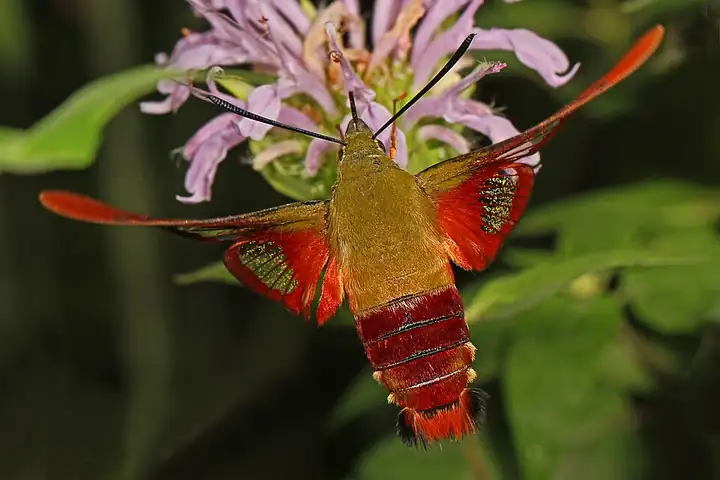
Sphinx moths (hawk moths, hummingbird moths)
Family Sphingidae; garden favorites include the hummingbird clearwing (Hemaris thysbe), snowberry clearwing (Hemaris diffinis) and white-lined sphinx (Hyles lineata). The tomato and tobacco hornworms are the caterpillars of two sphinx moths, Manduca quinquemaculata and Manduca sexta.
| Type | Insect |
|---|---|
| What it does | Pollinator |
| How common it is by region | Very common here: Northeast, Southeast, South Central, Midwest |
About
Sphinx moths are thick-bodied, fast-flying moths that hover at flowers like hummingbirds and drink with very long tongues. The adults pollinate deep, fragrant flowers, but their caterpillars are 'hornworms,' and the tomato hornworm is one of them.
This one is already on your side. Broad sprays kill it along with the pest, which is why the guide puts sprays last.
What it eats
Adults sip nectar, many at dusk or night from pale, fragrant, tube-shaped flowers, while clearwings feed by day. Caterpillars eat leaves of their host plants: clearwings use honeysuckle, viburnum, snowberry and dogbane, but tomato and tobacco hornworms eat tomato, pepper, eggplant and potato.
Spotting it
How to find it early
Look for a 'tiny hummingbird' with a fuzzy body and clear windows in its wings working bee balm, phlox or verbena on a sunny afternoon, or, at dusk, large gray-brown moths hovering at fragrant flowers.
Its young
Eggs are small, round and green, laid singly under leaves. Caterpillars are usually green with a horn at the rear end, and they pupate in the soil or leaf litter.
When
Late spring through summer; clearwings are most active when bee balm blooms, and the North gets one generation a year.
Easy to mistake for
- Tomato hornworm — The tomato hornworm is itself a sphinx moth caterpillar; on tomato, pepper, eggplant or potato it's a pest, while the slimmer clearwing hornworms live on honeysuckle, viburnum and snowberry and are rarely noticed.
- Bumble bees — The snowberry clearwing is a moth that hovers in front of the flower with a long tongue and has clear wing patches, while a bumble bee lands on the flower and has solid wings.
Bringing more of them in
Grow long-tubed and fragrant flowers, including some that open in the evening, and avoid broad-spectrum insecticides.
Plants that bring it in
Bee balm, Blazing star (liatris), Garden phlox (tall phlox), Joe-Pye weed, Milkweed, Pentas (Egyptian star flower), Petunia, Purple coneflower (echinacea), Trumpet honeysuckle (coral honeysuckle), Verbena (garden verbena)
Worth knowing
Harmless to people: they can't sting or bite. The catch is the caterpillars. Tomato and tobacco hornworms are the young of the five-spotted hawk moth and the Carolina sphinx, and they can strip tomato plants, so handle them as pests on your crops. The U.S. Forest Service suggests leaving a few on a spare plant if you want to see the moths, and any hornworm wearing white rice-like cocoons is already doomed by parasitic wasps, so leave it. In Hawaii, a big hornworm on tomato or eggplant could be the federally endangered Blackburn's sphinx moth, so take a photo and check with the state DLNR or U.S. Fish and Wildlife Service before removing it.
How common it is by region
| Northeast | Very common here |
|---|---|
| Southeast | Very common here |
| South Central | Very common here |
| Midwest | Very common here |
| Great Plains | Common here |
| Mountain West | Common here |
| Southwest | Common here |
| Pacific Northwest | Common here |
| California | Common here |
| Alaska | Occasional here |
| Hawaii | Common here |
Sources
- fs.usda.gov
- fs.usda.gov
- fs.usda.gov
- hort.extension.wisc.edu
- content.ces.ncsu.edu
- gardeningsolutions.ifas.ufl.edu
- extension.umn.edu
- xerces.org
- dlnr.hawaii.gov
Photo: Photo: Judy Gallagher / Wikimedia Commons, CC BY 2.0 (CC BY 2.0). Photo resized for the web.

Planting dates and advice are general guidance; check with your local Cooperative Extension office for your area.