
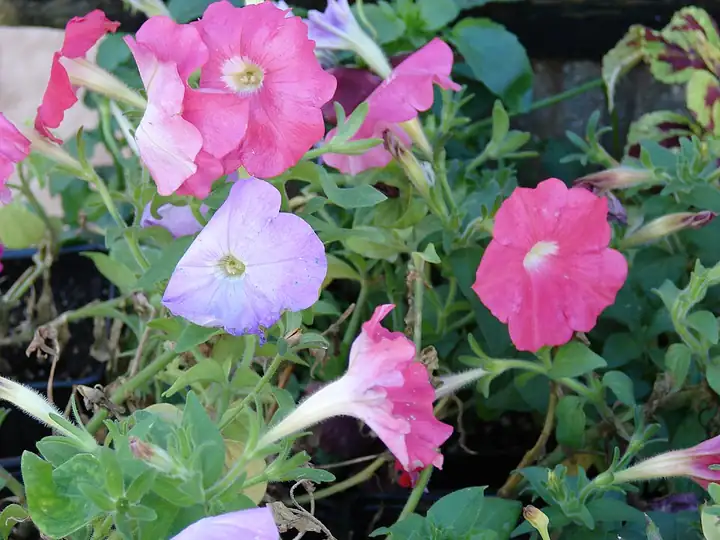
Petunia
Petunia x hybrida · Nightshade family (Solanaceae)
When to plant: Start seeds indoors 8 to 10 weeks before the last frost and set out plants up to 2 weeks after the last frost.
| Hardiness zones | 10 to 11 |
|---|---|
| Sun | full sun |
| Water | moderate |
| Life cycle | tender perennial (grown as an annual) |
| Frost | Half-hardy: takes a light frost |
| Soil pH | 6.0–7.0 |
| Spacing | 12 to 18 inches |
About Petunia
Petunias are classic summer bedding and container flowers with trumpet-shaped blooms in nearly every color, from tiny millifloras to big grandifloras and spreading types like 'Wave' that cover 3-4 feet. NC State notes the flowers give nectar to hummingbirds and butterflies. Calibrachoa (million bells) looks like a small petunia but is a different plant grown from cuttings; it is prone to iron deficiency and root disease (Kentucky Extension).
Grown as a summer annual almost everywhere; survives winter only in zones 10-11 (NC State).
When to plant
Timing is counted from your average last spring frost (and first fall frost). Sow & Tell works out the actual dates for your ZIP code.
- Start seeds indoors: 8 to 10 weeks before the last frost
- Set out plants: up to 2 weeks after the last frost
Start seed indoors 8-10 weeks before planting out (Clemson); the tiny seed needs light to sprout and germinates at 72-75 F (NC State). Most gardeners buy plants and set them out after frost danger has passed, 12-18 inches apart.
Soil
Light, well-drained soil of medium fertility; petunias tolerate poor soil if it drains well but bloom poorly in heavy soil.
Use light, well-drained soil of medium fertility with pH 6.0-7.0; follow a soil test.
Feeding
- About a month after planting, then monthly through summer: balanced fertilizer such as 10-10-10. Clemson advises a balanced fertilizer monthly. Kentucky Extension feeds spreading types in beds every 3-4 weeks, and in containers weekly with a water-soluble fertilizer.
Look for: a balanced or all-purpose fertilizer at the label rate. Skip high-phosphorus "bloom boosters" unless a soil test shows low phosphorus: most garden soils already have enough, and the extra can wash into streams.
Wetting leaves and flowers when watering invites petal blight and gray mold; water at the soil.
Harvest
Blooms from late spring until frost. Deadhead large-flowered and double types, and cut leggy plants back by about half in midsummer to bring on new flowers (Clemson); many newer spreading types keep blooming without deadheading (Kentucky Extension).
Varieties (21)
| Variety | Type | Notes |
|---|---|---|
| Daddy series | Grandiflora | Listed by Illinois Extension and NC State. Sources: [1][3] |
| Dreams series | Grandiflora | Listed by Illinois Extension and NC State. Sources: [1][3] |
| Limbo Violet | Grandiflora | Large violet flowers on a compact plant. 2004 AAS bedding plant winner. Sources: [6] |
| Picobella series | Milliflora | Very small flowers, 1-1.5 in across (milliflora type). Listed by Illinois Extension. Sources: [2][3] |
| Celebrity series | Multiflora | Listed by Illinois Extension and NC State. Sources: [1][3] |
| Comanche | Multiflora | Red flowers. 1953 AAS winner, called the first truly red petunia. Sources: [6] |
| Madness series | Multiflora | Listed by Illinois Extension and NC State; Double Madness is a double-flowered version. Sources: [1][3] |
| Merlin Blue Morn | Multiflora | White centers that blend to velvety blue at the edges. 2003 AAS winner. Sources: [6] |
| Laura Bush | Old-fashioned (Petunia x violacea) | Fragrant violet flowers on a vigorous plant about 24 in tall and 36 in wide; reseeds. A Texas Superstar that tolerates heat and alkaline soil; Texas A&M suggests cutting it back by about 20 percent each month. Sources: [7] |
| Bee's Knees | Spreading | Deep yellow flowers with darker veins, 2-2.5 in across, on mounding or trailing plants 8-10 in tall; tolerates heat and rain. AAS Gold Medal winner (announced among the 2022 winners), the first petunia with a Gold Medal since 1950. Sources: [6][8] |
| Opera Supreme Pink Morn | Spreading | Iridescent pink flowers on vigorous trailing plants. 2007 AAS bedding plant winner. Sources: [6] |
| Supertunia | Spreading | A spreading type grown from cuttings. Listed by Kentucky Extension and NC State. Sources: [1][4] |
| Surfinia | Spreading | Listed by Kentucky Extension as a spreading type. Sources: [4] |
| Easy Wave series | Spreading (Wave) | A spreading petunia series. Listed by Illinois Extension and NC State. Sources: [1][3] |
| Purple Wave | Spreading (Wave) | Low, ground-hugging purple petunia that spreads into a carpet of color. 1995 All-America Selections winner. Sources: [3][6] |
| Wave Blue | Spreading (Wave) | Trailing plant with velvety dark blue 2-inch flowers. 2003 AAS winner. Sources: [6] |
| Wave Lavender | Spreading (Wave) | Trailing, ground-cover habit with lavender flowers. 2002 AAS winner. Sources: [6] |
| Evening Scentsation | Spreading multiflora | Indigo-blue flowers with a sweet scent strongest in the evening; 5-8 in tall and 30-35 in wide. 2017 AAS winner, the first petunia to win for fragrance. Sources: [6][9] |
| Tidal Wave Cherry | Spreading/upright (Tidal Wave) | Cherry-colored flowers. Named a Texas Superstar by Texas A&M. Sources: [10] |
| Tidal Wave Red Velour | Spreading/upright (Tidal Wave) | Deep red flowers. Named a Texas Superstar by Texas A&M. Sources: [10] |
| Tidal Wave Silver | Spreading/upright (Tidal Wave) | Silvery white flowers with dark purple centers. 2002 AAS winner and a Texas Superstar; Kentucky Extension lists Tidal Wave as an upright type that can also spread. Sources: [4][6][10] |
Pests to watch for
Aphids, Flea beetles, Slugs, Brown garden snail, Thrips, Leafminers, Whiteflies, Tobacco budworm (geranium or petunia budworm)
Diseases and problems
Gray mold, Root rot, Mosaic viruses, Southern blight, Bacterial wilt, Hail and wind damage, Tobacco mosaic and tomato mosaic, Cucumber mosaic, Turnip mosaic
In the kitchen
Safety: NC State and the ASPCA list petunias as non-toxic.
Pets: Non-toxic to dogs, cats and horses (ASPCA)
Sources
- plants.ces.ncsu.edu
- hgic.clemson.edu
- web.extension.illinois.edu
- uky.edu
- aspca.org
- all-americaselections.org
- texassuperstar.com
- lancaster.unl.edu
- all-americaselections.org
- texassuperstar.com
Photo: Photo: Forest and Kim Starr, CC BY 3.0, via Wikimedia Commons (CC BY 3.0). Photo resized for the web.

Planting dates and advice are general guidance; check with your local Cooperative Extension office for your area.