
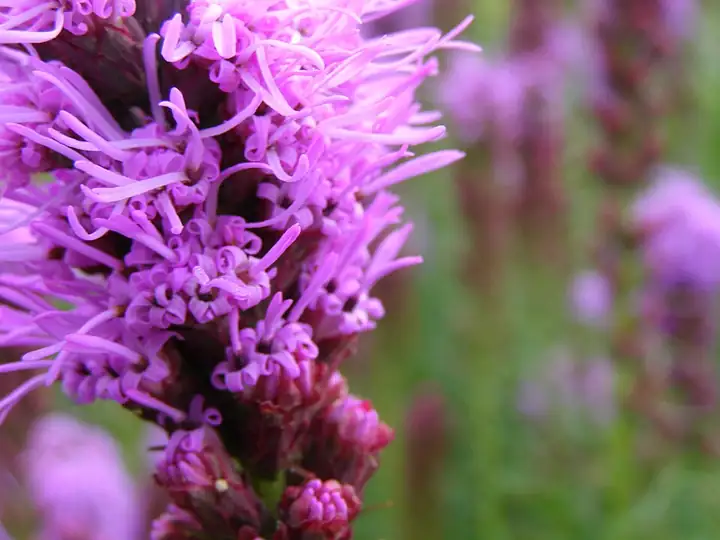
Blazing star (liatris)
Liatris spicata (dense blazing star, gayfeather) and relatives such as L. ligulistylis and L. aspera · Aster family (Asteraceae)
When to plant: Plant in spring after frost, or set out potted plants in summer and fall; space 12-15 inches apart (UF/IFAS).
| Hardiness zones | 3 to 9 |
|---|---|
| Sun | full sun |
| Water | moderate |
| Life cycle | perennial |
| Frost | Hardy: takes frost |
| Spacing | 12 to 15 inches |
About Blazing star (liatris)
Blazing star is a native prairie and meadow wildflower that grows from a corm and sends up tall wands of fuzzy purple, pink or white flowers that open from the top down. It is a butterfly favorite; meadow blazing star (L. ligulistylis) is famous as a monarch magnet. The spikes make long-lasting cut and dried flowers.
NC State lists L. spicata for zones 3-8 and the genus for 3-9.
When to plant
Plant in spring after frost, or set out potted plants in summer and fall; space 12-15 inches apart (UF/IFAS).
Seed can be sown directly in the garden (UF/IFAS), but young plants may not bloom their first year (UW-Madison Arboretum). Divide corms to make more plants; if you store corms more than 3 weeks, keep them in the refrigerator (NC State).
Soil
Average to moist, well-drained soil in clay, loam or sand; established plants tolerate drought, but corms rot if kept too wet (NC State; UF/IFAS).
Well-drained soil in full sun; loosen heavy clay with compost so corms don't sit wet (UF/IFAS; Clemson). Follow a soil test.
Feeding
- early spring, just before new shoots come up (optional): slow-release fertilizer such as 12-6-6, or a 1-inch layer of compost. Blazing star is a prairie plant that grows in average soil, and MSU notes most perennials need little fertilizer. Clemson's general rate for perennial beds is 1-2 lb of a slow-release 12-6-6 per 100 sq ft just before shoots emerge; MSU advises no more than 1 lb of nitrogen per 1,000 sq ft. Scatter it around the plants and water it in. Follow a soil test.
Look for: a balanced or all-purpose fertilizer at the label rate. Skip high-phosphorus "bloom boosters" unless a soil test shows low phosphorus: most garden soils already have enough, and the extra can wash into streams.
Overwatering and soggy soil rot the corms (UF/IFAS); extra fertilizer mainly gives floppy stems that need staking (MSU; NC State).
Harvest
Spikes bloom from midsummer into late summer or early fall, opening from the top down. Cut spikes for vases when the top flowers open. NC State suggests leaving spent stems 12-24 inches tall through winter as nest sites for stem-nesting bees; goldfinches eat the seeds.
Varieties (8)
Extension sources document only 5 named L. spicata cultivars; three related blazing star species that gardeners grow are added.
| Variety | Type | Season and days | Zones | Notes |
|---|---|---|---|---|
| Alba | Dense blazing star (L. spicata) | 3–9typical for blazing star | White flower spikes. Sources: [1] | |
| Callilepsis | Dense blazing star (L. spicata) | 3–9typical for blazing star | Long stems suited to cutting. Spelled as NC State lists it. Sources: [1] | |
| Floristan Violett | Dense blazing star (L. spicata) | 3–9typical for blazing star | Violet flower spikes; a florist favorite for cutting. Sources: [1] | |
| Floristan White | Dense blazing star (L. spicata) | 3–9typical for blazing star | White flower spikes. Sources: [1] | |
| Kobold | Dense blazing star (L. spicata) | 3–9typical for blazing star | Compact plant with deep purple spikes. Sources: [1] | |
| Meadow blazing star | Related species (L. ligulistylis) | Aug-Sep | 3–9typical for blazing star | 3-5 ft tall in good soil, with pink to purple flowers that open all at once and last a long time. UW-Madison Arboretum calls it a top monarch magnet; young plants may skip bloom the first year. Sources: [4] |
| Dwarf blazing star | Related species (L. microcephala) | 3–9typical for blazing star | 1.5-2 ft tall with rose-purple flowers. Sources: [2] | |
| Scaly blazing star | Related species (L. squarrosa) | 3–9typical for blazing star | 1-3 ft tall, early blooming, pinkish-purple. Sources: [2] |
Good neighbors
Wisconsin Extension lists blazing star among good partners for blanket flower in a sunny border; this is a design pairing, not a pest-control claim.
Diseases and problems
Leaf spot, Rust, Powdery mildew, White mold, Verticillium wilt
In the kitchen
Safety: The sources we checked list no toxic parts and no research-based guidance on pregnancy, drug interactions or allergies.
Pets: Not listed by the ASPCA
Sources
- plants.ces.ncsu.edu
- plants.ces.ncsu.edu
- gardeningsolutions.ifas.ufl.edu
- arboretum.wisc.edu
- hort.extension.wisc.edu
- extension.psu.edu
- aspca.org
- aspca.org
- hgic.clemson.edu
- homesoiltest.msu.edu
Photo: Photo: Frank Wouters, CC BY 2.0, via Wikimedia Commons (CC BY 2.0). Photo resized for the web.

Planting dates and advice are general guidance; check with your local Cooperative Extension office for your area.