
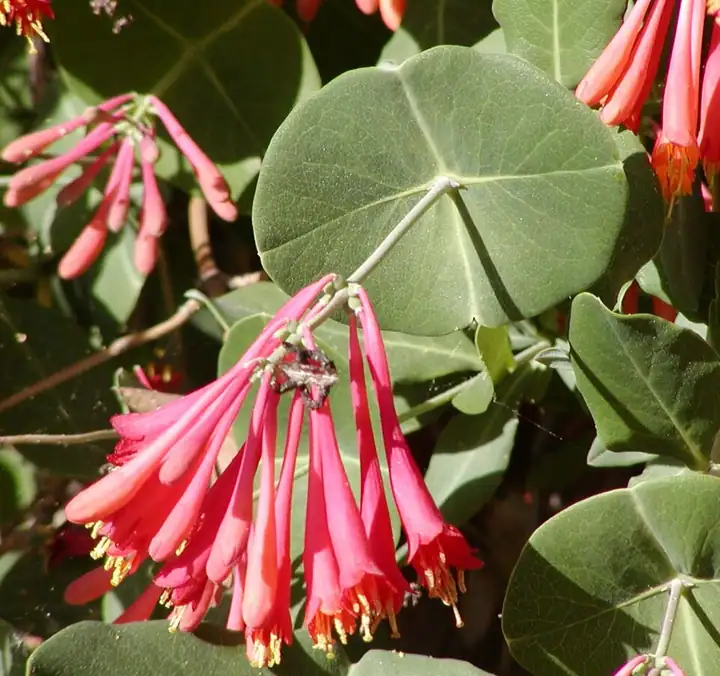
Trumpet honeysuckle (coral honeysuckle)
Lonicera sempervirens · Honeysuckle family (Caprifoliaceae)
| Hardiness zones | 4 to 9 |
|---|---|
| Sun | full sun to part shade |
| Water | moderate |
| Life cycle | perennial |
| Frost | Hardy: takes frost |
About Trumpet honeysuckle (coral honeysuckle)
Trumpet honeysuckle is a twining native vine of the eastern US with clusters of red-orange (or yellow) tubes that hummingbirds love. It blooms hardest in late spring, then off and on into fall, and songbirds eat its red berries. Don't mix it up with Japanese honeysuckle (Lonicera japonica), a white-to-yellow, sweet-scented vine with black berries that is invasive across much of the US and banned in New Hampshire.
Hardy in zones 4-9; it keeps its leaves in warm southern winters and drops them farther north. It is the native, non-invasive honeysuckle; the look-alike Japanese honeysuckle is highly invasive (NC State) and prohibited in New Hampshire (UNH).
Planting
Grow it on a trellis, arbor or fence; it twines and reaches 10-20 ft. It roots from summer cuttings or layering, and seed needs 2-3 months of cold, moist storage before it sprouts (Wildflower Center).
Soil
Well-drained, evenly moist soil; it adapts to clay, loam or sand and to acid or limy soil.
Loosen the soil and work in compost; follow a soil test before adding any fertilizer.
Feeding
Look for: a balanced or all-purpose fertilizer at the label rate. Skip high-phosphorus "bloom boosters" unless a soil test shows low phosphorus: most garden soils already have enough, and the extra can wash into streams.
High-nitrogen fertilizer gives lots of leaves and few flowers (NC State).
Harvest
Blooms heavily in mid to late spring, then here and there until fall. Prune lightly right after the spring flush to shape it; heavy nitrogen gives leaves instead of flowers (NC State).
Varieties (6)
Extension and botanical-garden sources we opened document 6 cultivars.
| Variety | Zones | Notes |
|---|---|---|
| Alabama Crimson | 4–9typical for trumpet honeysuckle | Deep crimson flowers and dark blue-green leaves; vine 10-20 ft. Sources: [1][4] |
| Cedar Lane | 4–9typical for trumpet honeysuckle | Coral-pink to scarlet 2-inch flowers with yellow throats; reblooms on new wood and resists aphids. Sources: [1][4] |
| John Clayton | 4–9typical for trumpet honeysuckle | Yellow flowers on a compact vine; blooms off and on through the season and sets many berries. Sources: [1][4] |
| Leo | 4–9typical for trumpet honeysuckle | Red flowers over a long season; blue-green leaves. Sources: [1] |
| Major Wheeler | 4–9typical for trumpet honeysuckle | Red-orange to scarlet flowers that bloom heavily and repeat over a long season. Sources: [1][4] |
| Sulphurea ('Flava') | 4–9typical for trumpet honeysuckle | Bright yellow flowers in abundance with bright green leaves. Sources: [1][4] |
Pests to watch for
Diseases and problems
Powdery mildew, Leaf spot
In the kitchen
Safety: The red berries are not for people to eat (NC State). The berries of the look-alike Japanese honeysuckle contain saponins and can make people sick in large amounts (NC State).
Pets: Not listed as toxic by the ASPCA (no honeysuckle entry)
Sources
- plants.ces.ncsu.edu
- wildflower.org
- mtcubacenter.org
- extension.psu.edu
- extension.unh.edu
- plants.ces.ncsu.edu
- hgic.clemson.edu
Photo: Photo: Stan Shebs, CC BY-SA 3.0, via Wikimedia Commons (CC BY-SA 3.0). Photo resized for the web.

Planting dates and advice are general guidance; check with your local Cooperative Extension office for your area.