
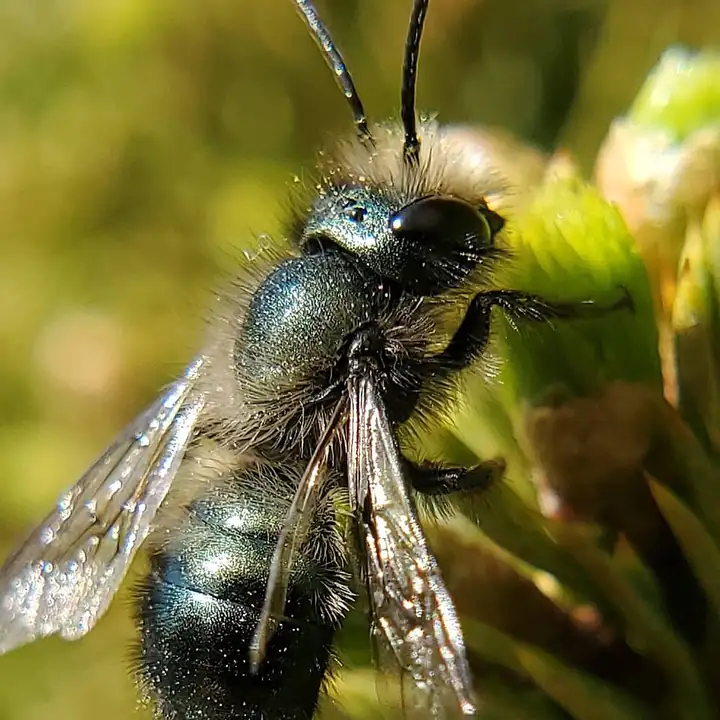
Mason bees (orchard mason bees)
Osmia species, especially the blue orchard bee (Osmia lignaria)
| Type | Insect |
|---|---|
| What it does | Pollinator |
| When | Early spring, roughly when fruit trees bloom; adults live only a few weeks |
| How common it is by region | Very common here: Pacific Northwest, California |
About
Mason bees are small, shiny blue-green bees that fly in early spring and nest in holes, sealing each chamber with mud. They are excellent fruit-tree pollinators and very gentle.
This one is already on your side. Broad sprays kill it along with the pest, which is why the guide puts sprays last.
What it eats
Females collect pollen and nectar to stock their nests and are especially good at pollinating apple, cherry, pear, plum, apricot and peach blossoms. They forage only about 200 to 300 feet from home (Oregon State).
Spotting it
How to find it early
Look for a honey-bee-sized, dark metallic blue-green bee around fruit trees in early spring, or for nest tubes and holes capped with mud.
Its young
Eggs and larvae sit on pollen loaves inside sealed tubes, then spin brown cocoons that wait there until next spring.
When
Early spring, roughly when fruit trees bloom; adults live only a few weeks
Bringing more of them in
Hang nest tubes or drilled blocks 3 to 6 feet up in a sunny, sheltered spot near spring flowers, and keep a patch of moist clay soil for mud. Clean out or replace tubes each fall to cut down on mites and disease.
Plants that bring it in
Apple (backyard tree), Apricot, Cherry (sweet and tart), Peach, Pear, Plum
Buying it
Oregon State says cocoons can be bought in early spring and the bees will keep coming back if they have nest holes, mud and nearby flowers.
Worth knowing
Mason bees are gentle and sting only if handled roughly or trapped in clothing.
How common it is by region
| Northeast | Common here |
|---|---|
| Southeast | Common here |
| South Central | Common here |
| Midwest | Common here |
| Great Plains | Common here |
| Mountain West | Common here |
| Southwest | Common here |
| Pacific Northwest | Very common here |
| California | Very common here |
| Alaska | Occasional here |
| Hawaii | Occasional here |
Sources
Photo: Photo: Doug Wolfe / Wikimedia Commons, CC BY 4.0 (CC BY 4.0). Photo resized for the web.

Planting dates and advice are general guidance; check with your local Cooperative Extension office for your area.