
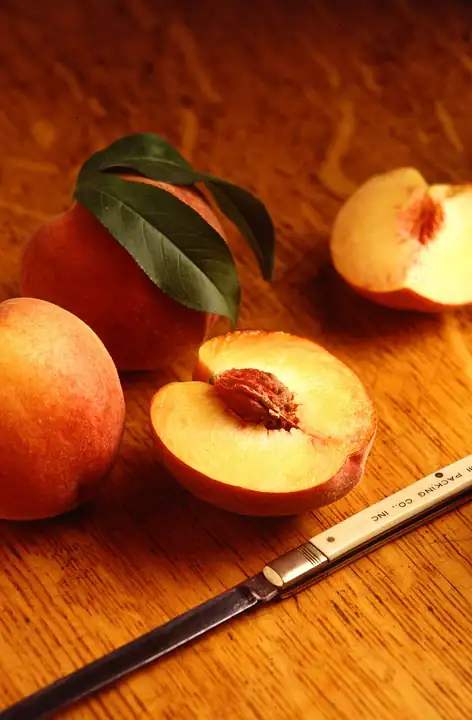
Peach
Prunus persica · Rose family (Rosaceae)
When to plant: Set out plants up to 6 weeks before the last frost.
| Hardiness zones | 5 to 9 |
|---|---|
| Sun | full sun |
| Water | moderate |
| Life cycle | perennial |
| Frost | Hardy: takes frost |
| Soil pH | 6.0–6.5 |
| Spacing | 216 to 240 inches |
About Peach
Peach trees grow fast, bear young and are self-fruitful, so one tree is enough. Their early blossoms are the weak spot: a late spring freeze is the biggest threat to the crop.
NC State lists zones 5-9. Varieties range from low chill (under 600 hours below 45 F) to very high chill (over 900 hours) (UGA); pick one that matches your winter, and choose a site with good air drainage to dodge late frosts.
When to plant
Timing is counted from your average last spring frost (and first fall frost). Sow & Tell works out the actual dates for your ZIP code.
- Set out plants: up to 6 weeks before the last frost
Plant dormant trees in late winter (February to early March in Oklahoma; December to February in Georgia) and do not let the roots dry out or freeze. Peaches begin bearing in the third year and reach full production by year five (Oklahoma State).
Soil
Moist but well-drained soil; peaches do poorly where water stands.
Test the soil before planting and aim for a pH of 6 to 6.5; work in any lime, phosphorus or potassium the test calls for before planting, but no nitrogen.
Feeding
- First year: about a month after planting (in the South, wait until March for trees planted in winter): balanced fertilizer such as 10-10-10 or 12-12-12. Missouri suggests 1/2 cup of 12-12-12 in a circle about 6 inches from the trunk; Georgia uses 1 lb of 10-10-10 per tree in March, spread evenly a few inches away from the trunk.
Look for: mostly nitrogen, in spring as growth starts. Spring feeding grows the new shoots and leaves that carry flowers and fruit; feeding after midsummer pushes soft growth that may not harden before winter. - First year in the South: May and again in July: nitrogen fertilizer such as calcium nitrate. Georgia suggests about 1 lb per tree each time, spread evenly around the tree away from the trunk.
Look for: mostly nitrogen, in spring as growth starts. Spring feeding grows the new shoots and leaves that carry flowers and fruit; feeding after midsummer pushes soft growth that may not harden before winter. - Each early spring from the second year on, before growth begins: balanced fertilizer such as 10-10-10 or 12-12-12. Follow a soil test; Missouri suggests about 1 lb of 12-12-12 per year of tree age (up to about 5 lb for bearing trees), spread under the drip line.
Look for: mostly nitrogen, in spring as growth starts. Spring feeding grows the new shoots and leaves that carry flowers and fruit; feeding after midsummer pushes soft growth that may not harden before winter.
Do not fertilize in late summer or early fall, which leaves trees open to frost cracking, and do not plant too deep.
Harvest
Pick when the fruit is firm with a yellow (or cream, for white-fleshed types) background color and a strong aroma; sugar does not increase after picking. Thin fruitlets to one every 6-8 inches when they are about an inch across.
Each peach tree gives one crop a year; depending on variety, fruit ripens anywhere from early May to early September in Georgia, so planting early and late varieties spreads out the harvest. Thin fruitlets to one every 6-8 inches for good size.
Varieties (51)
| Variety | Type | Season and days | Zones | Notes |
|---|---|---|---|---|
| Canadian Harmony | Cold-hardy yellow freestone | Mid to late August in Utah; mid-September in Maine | 5–8 | Sweet. Yellow, non-browning freestone that keeps longer than most peaches. Good cold hardiness in Maine; fair leaf curl and bacterial spot resistance. Sources: [10][11] |
| Contender | Cold-hardy yellow freestone | Mid-July in Georgia; about 18 days after Redhaven in Missouri | 4–8 | Good quality; the flesh resists browning. Medium yellow freestone with good bud hardiness and excellent bacterial spot resistance. Recommended for North Carolina home orchards. Self-fruitful; one tree is enough. 900+ chill hours Sources: [3][9][12][13][14] |
| Reliance | Cold-hardy yellow freestone | Mid-August in Maine; about 11 days after Redhaven in Missouri | 5–9typical for peach | Fruit quality is only fair. Small yellow freestone. Among the hardiest peaches; moderate bacterial spot resistance and poor leaf curl resistance. The only peach Illinois suggests for northern Illinois, and one of the most hardy for New Hampshire. Self-fruitful; one tree is enough. Sources: [1][9][12][15][16] |
| Madison | Cold-hardy yellow peach | Late September in Maine | 5–9typical for peach | Fair quality. Large yellow-fleshed fruit with good bud hardiness. Suggested for central and southern Illinois and better New Hampshire sites. Self-fruitful; one tree is enough. Sources: [1][12][15][16] |
| Garnet Beauty | Early yellow peach | Early June in Georgia; about 10 days before Redhaven in Missouri | 5–9typical for peach | A bud sport of Redhaven; semi-freestone to freestone when fully ripe. Good bacterial spot resistance. Missouri says it is best for cooler areas. 750–900 chill hours Sources: [1][3][9] |
| Juneprince | Early yellow peach | Early June in Georgia; mid to late July in western Washington | 5–9typical for peach | Freestone to semi-freestone with tough skin and very few split pits. Resistant to bacterial spot. 600–750 chill hours Sources: [1][3][17] |
| Saturn | Flat (doughnut) peach | About 2 days after Redhaven in Missouri | 5–9typical for peach | Sweet, with a hint of almond. Medium, flat, doughnut-shaped yellow freestone. Self-fruitful; one tree is enough. Sources: [1][9] |
| Victoria | Late yellow freestone | About 45 days after Redhaven in Missouri | 5–9typical for peach | Large freestone that holds its quality in cold storage. Good bacterial spot resistance. Sources: [1][9] |
| Q-1-8 | Leaf curl-resistant peach | 5–9typical for peach | Listed as resistant to peach leaf curl in the Pacific Northwest disease handbook. Sources: [1][18] | |
| Salish Summer | Leaf curl-resistant peach | Mid-September in Maine | 5–9typical for peach | Good leaf curl resistance and good blossom hardiness in Maine ratings; fair bacterial spot resistance. Sources: [1][11] |
| Avalon Pride | Leaf curl-resistant yellow peach | Mid to late July in western Washington | 5–9typical for peach | Good quality. Yellow semi-freestone that is quite resistant to leaf curl, though yields vary. Sources: [1][17][18] |
| Frost | Leaf curl-resistant yellow peach | Mid-August in western Washington | 5–9typical for peach | Fair to good. Yellow semi-freestone; productive but not very colorful, with some split pits. Older trees resist peach leaf curl. WSU says young trees have no curl resistance and need protection for their first 2 to 3 years. Sources: [1][17][18][19] |
| Babcock | Low-chill white peach | Sweet, juicy, aromatic and low in acid. White-fleshed freestone; self-fruitful. Arizona recommends it for the low desert. 250–300 chill hours Sources: [20] | ||
| Flordaglo | Low-chill white peach | Early (about 78 days from bloom) | White, melting-flesh, semi-clingstone fruit that bruises easily; resists bacterial spot. Suited to backyards and u-pick in central and south-central Florida. UF/IFAS rates it at about 150 chill units (Florida's measure, similar to chill hours). Self-fruitful; one tree is enough. Sources: [21] | |
| TropicSnow | Low-chill white peach | Midseason in Florida (about 90 to 97 days from bloom) | Very low acid and very sweet. White, melting-flesh, semi-freestone fruit. A joint UF and Texas A&M release (1989) for central and south-central Florida. UF/IFAS rates it at about 225 chill units (Florida's measure, similar to chill hours). Self-fruitful; one tree is enough. Sources: [21] | |
| August Pride | Low-chill yellow peach | Sweet, aromatic and rich. Yellow freestone; self-fruitful. Arizona ranks it among the best low-chill peaches. up to 300 chill hours Sources: [20] | ||
| Desert Gold | Low-chill yellow peach | Mid-May in Arizona's low desert | Good flavor and sweetness for a very early peach. Yellow clingstone; self-fruitful. 250 chill hours Sources: [20] | |
| Eva's Pride | Low-chill yellow peach | Early to late May in Arizona's low desert | Fine flavor. Yellow freestone; self-fruitful. 100–200 chill hours Sources: [20] | |
| Flordacrest | Low-chill yellow peach | Early May in Georgia | Yellow semi-clingstone; resistant to bacterial spot. For south Georgia; in middle and north Georgia it blooms too early and often loses its crop to freezes. up to 600 chill hours Sources: [3] | |
| Flordaking | Low-chill yellow peach | Early to mid-May | Fairly large, melting-flesh clingstone fruit; moderate bacterial spot resistance. Pits often split when the crop is light. Suggested for backyards in north Florida. UF/IFAS rates it at about 450 chill units (Florida's measure, similar to chill hours). Self-fruitful; one tree is enough. up to 600 chill hours Sources: [3][21] | |
| Flordaprince | Low-chill yellow peach | Very early (about 78 days from bloom) | Yellow, melting-flesh, semi-clingstone fruit, fairly small, with a heavy red blush. Best in central and south-central Florida. UF/IFAS rates it at about 150 chill units (Florida's measure, similar to chill hours). Self-fruitful; one tree is enough. Sources: [21] | |
| Gulfking | Low-chill yellow peach | Mid-May in Georgia | Firm (non-melting), clingstone to semi-clingstone fruit with a deep red blush; excellent bacterial spot resistance. Released in 2004 by UF, UGA and USDA; best in north and north-central Florida and south Georgia. UF/IFAS rates it at about 350 chill units (Florida's measure, similar to chill hours). Self-fruitful; one tree is enough. up to 600 chill hours Sources: [3][21] | |
| May Pride | Low-chill yellow peach | May in Arizona's low desert | Sweet and tangy. Semi-freestone; self-fruitful. 175–200 chill hours Sources: [20] | |
| Mid-Pride | Low-chill yellow peach | Midseason | Yellow freestone; self-fruitful. 250 chill hours Sources: [20] | |
| TropicBeauty | Low-chill yellow peach | April to May in Florida (about 89 days from bloom) | Yellow, melting-flesh, semi-freestone fruit of medium size. Recommended for Florida dooryards as well as farms, in central and south-central Florida. UF/IFAS rates it at about 150 chill units (Florida's measure, similar to chill hours). Self-fruitful; one tree is enough. Sources: [21] | |
| UFBest | Low-chill yellow peach | Very early (mid-April in Florida) | Large, nearly all-red, firm clingstone fruit; excellent bacterial spot resistance. Released in 2012 for central and south-central Florida. UF/IFAS rates it at about 100 chill units (Florida's measure, similar to chill hours). Self-fruitful; one tree is enough. Sources: [21] | |
| UFSun | Low-chill yellow peach | Early (about 80 days from bloom) | Medium, firm (non-melting), clingstone fruit; bears heavy crops every year. Best in central and south-central Florida. UF/IFAS rates it at about 100 chill units (Florida's measure, similar to chill hours). Self-fruitful; one tree is enough. Sources: [21] | |
| China Pearl | White freestone | Late July in Georgia | 4–8 | White-fleshed freestone for higher-chill areas. Georgia lists its bacterial spot rating as mixed (resistant/susceptible). 900+ chill hours Sources: [3][22] |
| Georgia Belle (Belle of Georgia) | White freestone | Mid-July in Georgia | 5–9typical for peach | White-fleshed freestone with bacterial spot resistance. Suggested as a white peach for central Illinois. Self-fruitful; one tree is enough. 750–900 chill hours Sources: [1][3][15] |
| White Lady | White freestone | Mid-July in Georgia | 5–9typical for peach | Low-acid, sweet white flesh that stays firm. Medium white freestone; fair to moderate bacterial spot resistance. Self-fruitful; one tree is enough. 750–900 chill hours Sources: [1][3][9] |
| Sugar Giant | White-fleshed peach | About 20 days after Redhaven in Missouri | 5–9typical for peach | Large fruit with firm white flesh and good quality. Moderate bacterial spot resistance. Sources: [1][9] |
| Allstar | Yellow freestone | About 19 days after Redhaven in Missouri | 5–9typical for peach | Bright red skin; keeps well in the refrigerator. Very good bacterial spot resistance. Sources: [1][9] |
| Blazingstar | Yellow freestone | Early August in western Washington; about 2 days after Redhaven in Missouri | 5–9typical for peach | Medium freestone, softer than Redhaven, with few split pits. Excellent bacterial spot resistance. Also written Blazing Star. Sources: [1][9][17] |
| Cresthaven | Yellow freestone | Mid-July in Georgia | 5–8 | Yellow freestone with bacterial spot resistance. Recommended in North Carolina and southern Illinois. Self-fruitful; one tree is enough. 900+ chill hours Sources: [3][13][15][23] |
| Early Elberta | Yellow freestone | Midseason | 5–8 | Rich and sweet. Golden-yellow freestone that resists bruising and can be picked slightly green to finish ripening. Also known as Gleason; on the UC Master Gardener list for Santa Clara County, California. Sources: [10][24] |
| Elberta | Yellow freestone | Mid-July in Georgia | 5–9typical for peach | Yellow freestone with bacterial spot resistance. Self-fruitful; one tree is enough. 750–900 chill hours Sources: [1][3] |
| Glohaven | Yellow freestone | Mid-August in Utah | 5–8 | Pleasant flavor; firm yellow flesh. Freestone that is more prone to spring frost damage than some peaches. Sources: [10] |
| Halehaven | Yellow freestone | Early September in Utah | 5–8 | Very sweet and juicy. Freestone with winter-hardy buds; Utah State calls it an excellent home garden choice. Sources: [10] |
| Harvester | Yellow freestone | Late June in Georgia | 5–9typical for peach | Yellow freestone with bacterial spot resistance. Recommended for home planting in south-central Texas. Self-fruitful; one tree is enough. 750–900 chill hours Sources: [1][3][25] |
| J.H. Hale | Yellow freestone | Mid to late season | 5–9 | Sweet, firm yellow flesh. Freestone. Needs another peach variety for cross-pollination. On the UC Master Gardener list for Santa Clara County, California. Sources: [10][24] |
| Jefferson | Yellow freestone | Mid-July in Georgia | 5–9typical for peach | Highly resistant to bacterial spot. 750–900 chill hours Sources: [1][3] |
| John Boy | Yellow freestone | About 5 days after Redhaven in Missouri | 5–9typical for peach | A bud sport of Loring; large, very firm freestone. Good bacterial spot resistance. Sources: [1][9] |
| La Feliciana | Yellow freestone | Early July in Georgia | 5–9typical for peach | Yellow freestone with bacterial spot resistance. Recommended for home planting in south-central Texas. Self-fruitful; one tree is enough. 600–750 chill hours Sources: [1][3][25] |
| Loring | Yellow freestone | Early July in Georgia | 5–9typical for peach | Large yellow freestone, good for canning and freezing; good bacterial spot resistance. Self-fruitful; one tree is enough. 750–900 chill hours Sources: [1][3][9] |
| Redglobe | Yellow freestone | Early July in Georgia; early to mid-August in Utah | 5–8 | Sweet. Firm yellow freestone and a very attractive peach. Resistant to bacterial spot in Georgia. Also written Red Globe. 750–900 chill hours Sources: [3][10] |
| Redhaven | Yellow freestone | Early July in Georgia; mid-July in central Missouri; late August in Maine | 5–9 | Good quality. Medium yellow-fleshed fruit (freestone to semi-clingstone). Needs heavy thinning; moderate to good bacterial spot resistance. The standard that other peaches are timed against. New Hampshire calls it the hardiest high-quality peach. Self-fruitful; one tree is enough. 900+ chill hours Sources: [3][9][12][13][15][16][26] |
| Redskin | Yellow freestone | Mid-July in Georgia | 5–9typical for peach | Yellow freestone with bacterial spot resistance. Recommended for home planting in south-central Texas. Self-fruitful; one tree is enough. 750–900 chill hours Sources: [1][3][25] |
| Ruston Red | Yellow freestone | Mid-July in Georgia | 5–9typical for peach | Highly resistant to bacterial spot. 750–900 chill hours Sources: [1][3] |
| Starfire | Yellow freestone | Early to mid-August in western Washington; early September in Maine | 5–9typical for peach | Good flavor. Medium, bright red freestone that needs several pickings; some split pits. Excellent bacterial spot resistance in Missouri. Missouri lists it ripening about a day after Redhaven. Sources: [1][9][11][17] |
| Winblo | Yellow freestone | Late June in Georgia | 5–9 | Yellow freestone with bacterial spot resistance. Recommended for North Carolina home orchards. Self-fruitful; one tree is enough. 750–900 chill hours Sources: [3][13][27] |
| Harken | Yellow semi-freestone | Early August in western Washington; mid-September in Maine | 5–9typical for peach | Good quality. Productive and reliable, with some split pits. Good cold hardiness and good leaf curl and bacterial spot resistance in Maine. Sources: [1][11][17] |
Pests to watch for
Aphids, Stink bugs, Tarnished plant bug, Root-knot nematodes, Eriophyid mites (rust, bud, blister and gall mites), Katydids, Annual cicadas (dog-day cicadas), Boxelder bugs, Opossum, Raccoon, Ground squirrels, Granulate ambrosia beetle, Obliquebanded leafroller, European red mite, Plum curculio, Oriental fruit moth, Peachtree borer, Scale insects, Strawberry sap beetle, Spotted lanternfly, Rose chafer, Eastern tent caterpillar, Green June beetle (fig-eater), Leaffooted bugs
Diseases and problems
Brown rot, Bacterial spot, Peach leaf curl, Peach scab, Nitrogen deficiency, Crown gall, Bacterial canker, Sunscald, Herbicide injury, Armillaria root rot, Gray mold (Botrytis), Tomato and tobacco ringspot
In the kitchen
Eaten fresh, baked, canned, frozen or made into preserves.
Keeping it: Ripen firm peaches in a loosely closed paper bag at room temperature, then refrigerate ripe ones and use them within 3 to 5 days.
Safety: The seeds inside the pit contain cyanide-forming compounds. Swallowing a pit or two whole will not cause poisoning, but crushed pits or chewed seeds are more dangerous, so do not blend unpitted fruit into smoothies (NC State).
Pets: Toxic to dogs, cats and horses (ASPCA plant lists; peach is grouped with plum, apricot and cherry, whose leaves, stems and seeds contain cyanogenic glycosides)
Sources
- plants.ces.ncsu.edu
- content.ces.ncsu.edu
- fieldreport.caes.uga.edu
- extension.okstate.edu
- extension.umd.edu
- aspca.org
- aspca.org
- extension.psu.edu
- extension.missouri.edu
- intermountainfruit.org
- extension.umaine.edu
- extension.umaine.edu
- content.ces.ncsu.edu
- plants.ces.ncsu.edu
- extension.illinois.edu
- extension.unh.edu
- wpcdn.web.wsu.edu
- pnwhandbooks.org
- hortsense.cahnrs.wsu.edu
- extension.arizona.edu
- ask.ifas.ufl.edu
- plants.ces.ncsu.edu
- plants.ces.ncsu.edu
- ucanr.edu
- austin.agrilife.org
- plants.ces.ncsu.edu
- plants.ces.ncsu.edu
Photo: Photo: Patrick Tregenza, USDA ARS, Public domain (USDA ARS), via Wikimedia Commons. Photo resized for the web.

Planting dates and advice are general guidance; check with your local Cooperative Extension office for your area.