
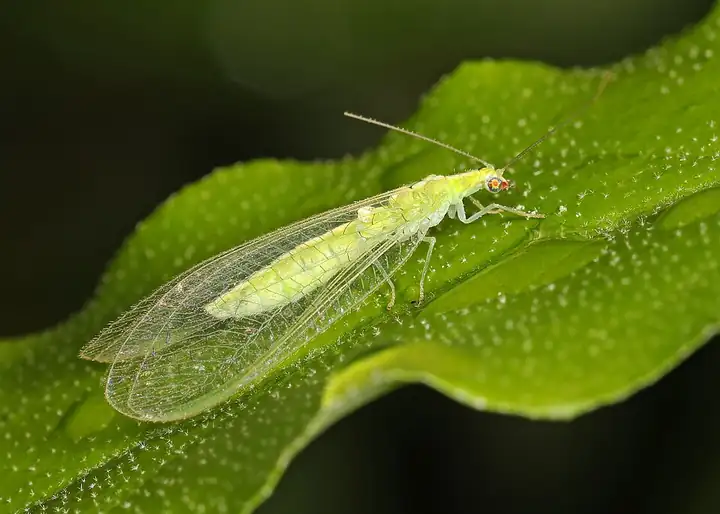
Green lacewings
Family Chrysopidae; common species include Chrysoperla carnea and Chrysopa species
| Type | Insect |
|---|---|
| What it does | Predator |
| How common it is by region | Very common here: Northeast, Southeast, South Central, Midwest, Great Plains, Mountain West, Southwest, Pacific Northwest, California |
About
Green lacewings are delicate, pale green insects with gold eyes and lacy wings, often seen at porch lights on summer nights. Their larvae, called aphid lions, are fierce hunters of aphids and other soft-bodied pests.
This one is already on your side. Broad sprays kill it along with the pest, which is why the guide puts sprays last.
What it eats
The larvae eat aphids, mealybugs, thrips, mites, whiteflies, scale insects, lace bugs, leafhoppers, small caterpillars and insect eggs; UMN says one larva can eat up to 200 aphids a week. Most adults feed on nectar, pollen and honeydew.
Pests it goes after
Aphids, Lace bugs (azalea and chrysanthemum lace bugs), Mealybugs, Scale insects, Thrips, Twospotted spider mite, Whiteflies
Spotting it
How to find it early
Adults are about three-quarters of an inch long, soft and green, with see-through, net-veined wings held like a roof and shiny gold eyes. Look for the stalked eggs and the larvae on aphid-infested plants.
Its young
Each egg sits on top of a hair-thin white stalk about half an inch tall, singly or in small groups under leaves. The larvae are tan or cream, flattened, up to half an inch long, with long curved jaws, like tiny alligators; some carry a pile of debris on their backs.
When
Spring through fall; they spend winter as cocooned larvae or pupae in protected spots, or as adults that may turn brownish.
Easy to mistake for
- Brown lacewings — Green lacewings are about twice as long as brown lacewings, and green lacewing larvae hold their heads forward without a 'neck'; color alone is not reliable, since some green lacewings turn brown in fall.
- Dragonflies and damselflies — Damselflies have a long, needle-thin body and fold their wings over the back as they flit near water; lacewings are soft, with lacy wings held like a roof, and flutter weakly to lights at night.
Bringing more of them in
Grow a mix of flowers that bloom all season, let a few aphids remain as food, skip broad-spectrum insecticides, and leave some leaves and plant debris over winter where they can shelter.
Plants that bring it in
Cilantro (coriander), Cosmos, Dill, Fennel
Buying it
Can be worth a try: eggs or larvae are sold, and because the larvae can't fly they stay near where you release them, unlike lady beetles (UMN, University of Kentucky).
Worth knowing
Larvae eat other helpful insects and each other when food is short. They rarely bite people, and the University of Kentucky says the nip only causes minor skin irritation.
How common it is by region
| Northeast | Very common here |
|---|---|
| Southeast | Very common here |
| South Central | Very common here |
| Midwest | Very common here |
| Great Plains | Very common here |
| Mountain West | Very common here |
| Southwest | Very common here |
| Pacific Northwest | Very common here |
| California | Very common here |
| Alaska | Common here |
| Hawaii | Common here |
Sources
- ipm.ucanr.edu
- extension.umn.edu
- entomology.mgcafe.uky.edu
- extension.usu.edu
- entomology.ces.ncsu.edu
- ipm-cahnr.media.uconn.edu
Photo: Photo: Judy Gallagher / Wikimedia Commons, CC BY 2.0 (CC BY 2.0). Photo resized for the web.

Planting dates and advice are general guidance; check with your local Cooperative Extension office for your area.