
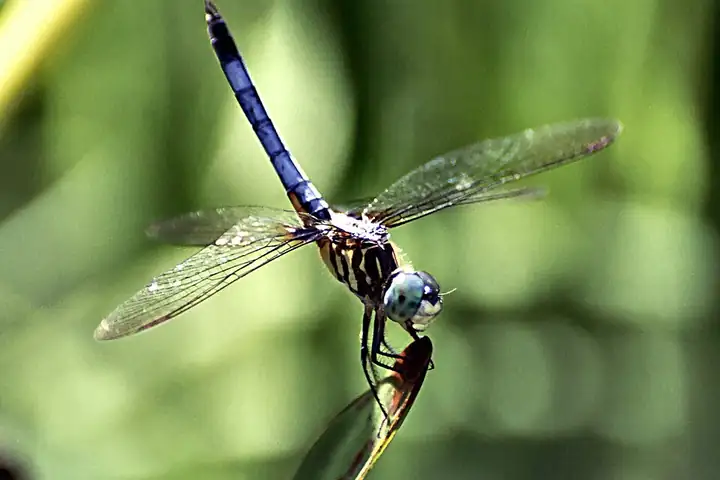
Dragonflies and damselflies
Order Odonata, with over 400 North American species; garden visitors include the common green darner (Anax junius), wandering glider (Pantala flavescens), common whitetail (Plathemis lydia) and blue dasher (Pachydiplax longipennis), plus many damselflies
| Type | Insect |
|---|---|
| What it does | Predator |
| When | Spring through fall. |
| How common it is by region | Very common here: Northeast, Southeast, South Central, Midwest, Great Plains, Mountain West, Pacific Northwest, California |
About
Dragonflies and damselflies are fast, sharp-eyed fliers that catch other insects in the air. Their young grow up underwater, so a garden near a pond, creek or water garden gets the most of them.
This one is already on your side. Broad sprays kill it along with the pest, which is why the guide puts sprays last.
What it eats
Adults catch flying insects such as mosquitoes, midges, flies and winged ants, and Penn State says they can eat hundreds a day. The underwater young eat aquatic insects, tadpoles and even small fish.
Spotting it
How to find it early
Dragonflies are stout and rest with wings held flat out to the sides; damselflies are slender, flutter low over water and fold their wings over their backs. Look near water and in nearby meadows.
Its young
The young (nymphs or naiads) live in ponds and streams; damselfly nymphs are slim with three leaf-like tails, and dragonfly nymphs are stouter. Both shoot out a hinged lower lip to grab prey, and they climb up plant stems to shed their skins as adults.
When
Spring through fall.
Easy to mistake for
- Green lacewings — Lacewings are soft, weak fliers with lacy wings held like a roof over the body that often come to lights at night; damselflies have a long, needle-thin body and flit low over water.
Bringing more of them in
A sunny backyard pond with native submerged, floating and edge plants is the best draw; add flat basking stones and sticks for perches, skip pesticides and heavy fertilizer near water, and leave some sediment on the bottom for the nymphs.
How common it is by region
| Northeast | Very common here |
|---|---|
| Southeast | Very common here |
| South Central | Very common here |
| Midwest | Very common here |
| Great Plains | Very common here |
| Mountain West | Very common here |
| Southwest | Common here |
| Pacific Northwest | Very common here |
| California | Very common here |
| Alaska | Common here |
| Hawaii | Common here |
Sources
Photo: Photo: Lea Maimone / Wikimedia Commons, CC BY-SA 2.5 (CC BY-SA 2.5). Photo resized for the web.

Planting dates and advice are general guidance; check with your local Cooperative Extension office for your area.