
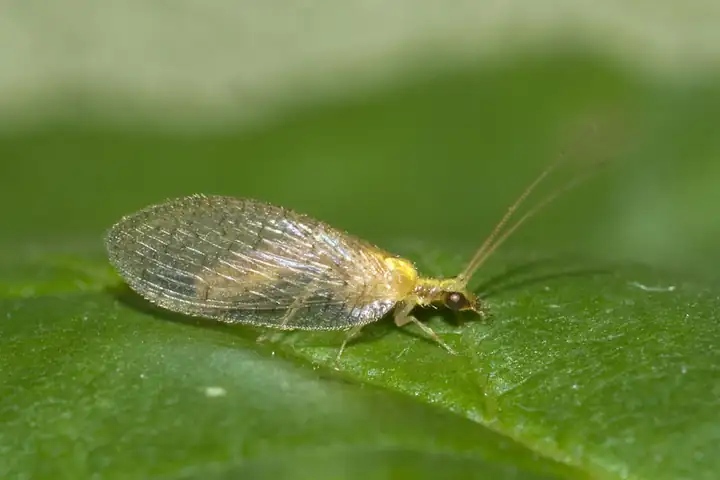
Brown lacewings
Family Hemerobiidae; Hemerobius species such as H. pacificus and H. stigma, plus Micromus and Sympherobius species
| Type | Insect |
|---|---|
| What it does | Predator |
| When | Early spring through fall, and through winter where it stays mild. |
| How common it is by region | Very common here: Pacific Northwest, California |
About
Brown lacewings are small, brownish cousins of green lacewings that hunt aphids and mites in cooler weather. Both the adults and the larvae are predators, and they are often busy early in spring before other natural enemies.
This one is already on your side. Broad sprays kill it along with the pest, which is why the guide puts sprays last.
What it eats
Aphids, mealybugs and mites most of all, plus whiteflies, thrips, scales, psyllids, leafhoppers, lace bugs, small caterpillars and insect eggs.
Pests it goes after
Aphids, Lace bugs (azalea and chrysanthemum lace bugs), Mealybugs, Scale insects, Thrips, Twospotted spider mite, Whiteflies
Spotting it
How to find it early
Adults are about a fifth to two-fifths of an inch long, brown, with hairy see-through wings held like a roof. They are mostly active from dusk to dawn and on cloudy days, so you may see them at lights.
Its young
Larvae are flattened, up to a third of an inch long, cream or gray with two brown or reddish stripes, and have a visible 'neck' and curved jaws; they swing their heads side to side as they hunt. Eggs are tiny gray, pink or white ovals laid one at a time right on buds and leaves.
When
Early spring through fall, and through winter where it stays mild.
Easy to mistake for
- Green lacewings — Brown lacewings are about half the length of green lacewings, and their larvae have a distinct neck and wag their heads, while green lacewing larvae hold the head straight forward.
Bringing more of them in
They favor gardens near trees and shrubs. Avoid broad-spectrum insecticides, and leave bark and plant debris where they can spend the winter.
How common it is by region
| Northeast | Common here |
|---|---|
| Southeast | Common here |
| South Central | Common here |
| Midwest | Common here |
| Great Plains | Common here |
| Mountain West | Common here |
| Southwest | Common here |
| Pacific Northwest | Very common here |
| California | Very common here |
| Alaska | Common here |
| Hawaii | Common here |
Sources
Photo: Photo: Ole Fogh Nielsen / Wikimedia Commons, CC BY 4.0 (CC BY 4.0). Photo resized for the web.

Planting dates and advice are general guidance; check with your local Cooperative Extension office for your area.