
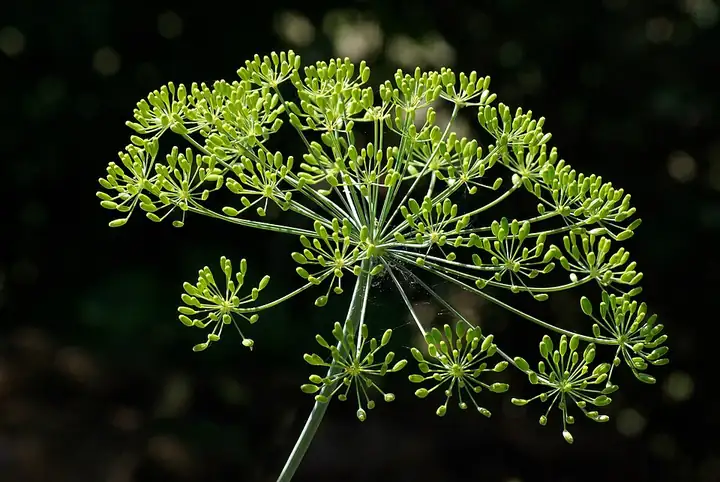
Dill
Anethum graveolens · Carrot family (Apiaceae)
When to plant: Sow seeds outdoors 1 to 2 weeks before the last frost.
| Hardiness zones | 2 to 11 |
|---|---|
| Sun | full sun |
| Water | moderate |
| Life cycle | annual |
| Frost | Half-hardy: takes a light frost |
| Soil pH | 5.5–6.5 |
| Spacing | 9 inches |
| Days to harvest | 42 to 56 days |
About Dill
Dill is a tall, feathery annual grown for its leaves (dill weed) and its seeds, which are classic for pickling. Its flat flower heads draw bees, hover flies and small wasps, and it is a host plant for black swallowtail caterpillars.
An annual that can be grown in every zone (NC State lists 2-11); plants often reseed themselves.
When to plant
Timing is counted from your average last spring frost (and first fall frost). Sow & Tell works out the actual dates for your ZIP code.
- Sow seeds outdoors: 1 to 2 weeks before the last frost
Days to harvest count from sowing. Sow seed about 1/4 inch deep, since it needs light to sprout, a week or two before the last frost; seedlings appear in 7-21 days. Dill has a long taproot and transplants poorly, so sow it where it will grow, and resow every 4-6 weeks.
Soil
Well-drained loam or sandy soil of moderate fertility; overwatering invites powdery mildew.
Follow a soil test and work any fertilizer it calls for into the top 6 inches; add no more than 1 inch of well-rotted compost per 100 sq ft. A pH of 5.5 to 6.5 is ideal.
Feeding
Look for: a light, all-purpose or nitrogen fertilizer. Herbs are grown for fresh leaves to pick, so a little nitrogen keeps new growth coming; most need only light feeding.
Dill does not need rich soil; no extra feeding is needed if the soil was amended at planting.
Harvest
Clip leaves any time after seedlings are up, most heavily 6 to 8 weeks after sowing. For seed, cut the heads once they turn golden brown and dry them upside down in a paper bag.
Clip leaves any time after seedlings are up, cutting at the stem or a few inches above the ground. Plants soon flower and go to seed, so sow every 4 to 6 weeks for a steady supply of leaves; cut seed heads when they turn brown.
Varieties (14)
Extension sources document 14 dill cultivars.
| Variety | Type | Season and days | Notes |
|---|---|---|---|
| Hera | Bunching leaf type | Bunching dill that bolts later than many varieties. Sources: [1] | |
| Ella | Compact leaf type | Short, dense plant suited to containers. Sources: [6] | |
| Monia | Compact leaf type | Compact plant suited to containers. Sources: [6] | |
| Vierling | Cut-flower type | Blue-green foliage and strong stems; its flower heads are sold as cut flowers. Sources: [7] | |
| Fernleaf | Dwarf leaf type | 65 days | Blue-green leaves with fine flavor. Dwarf plant about 12-18 inches tall with extra-fine foliage; one of the slowest dills to bolt, good for pots and small spaces. 1992 All-America Selections winner. Sources: [1][2][7][8][9][10] |
| Dukat | Leaf (dill weed) type | 65 days | Very aromatic, strong-flavored leaves. Heavier, finely textured foliage and later flowering than 'Bouquet'; slow to bolt, so leaf harvest lasts longer. Sources: [2][6][7][8][9] |
| SuperDukat | Leaf (dill weed) type | Strong flavor and high oil content. An improved form of 'Dukat'. Sources: [7][11] | |
| Delikat | Leaf type | Dense foliage for heavy leaf harvests. Sources: [1] | |
| Green Sleeves | Leaf type | Good for fresh dill and resistant to bolting. Sources: [6] | |
| Tetra | Leaf type | Bushy, slow-bolting plant grown for dill weed. Sources: [2][8] | |
| Bouquet | Standard (seed and leaf) | Early · 65 days | Leaves have a strong flavor. Usually 2-3 feet tall with blue-green leaves and large seed heads; also popular as a cut flower. Oregon State gives about 65 days for its recommended dill varieties. Illinois describes it as a more compact form of 'Mammoth'. Sources: [1][2][6][7][8][9] |
| Hercules | Tall leaf type (tetraploid) | Bred for foliage and slow to bolt; can reach 5 feet in good conditions. Sources: [7] | |
| Long Island Mammoth | Tall seed type | Tall plant with sparse green leaves and big flower heads on several stalks. Wisconsin Extension calls it the top dill for pickling; Penn State says it is the most widely grown cultivar for both dill weed and seed. Sources: [1][7][8] | |
| Mammoth | Tall seed type | 65 days | Tall plant, 2-3 feet, with sparse foliage; bolts fast and makes large seed heads. Penn State calls it best for pickling; UF/IFAS says it does best in Florida. Sources: [6][8][9][11] |
Pests to watch for
Diseases and problems
In the kitchen
Leaves, seeds and flowers are all edible and are used in pickles, fish dishes, sauces and teas.
Keeping it: Use fresh dill soon after cutting. Dry seed heads in a paper bag and store the seeds in a sealed jar.
Pets: Not listed as toxic by the ASPCA
Sources
- plants.ces.ncsu.edu
- extension.usu.edu
- aspca.org
- aspca.org
- aspca.org
- extension.illinois.edu
- hort.extension.wisc.edu
- extension.psu.edu
- horticulture.oregonstate.edu
- all-americaselections.org
- blogs.ifas.ufl.edu
Photo: Photo: JLPC / Wikimedia Commons, CC BY-SA 3.0 (CC BY-SA 3.0). Photo resized for the web.

Planting dates and advice are general guidance; check with your local Cooperative Extension office for your area.