
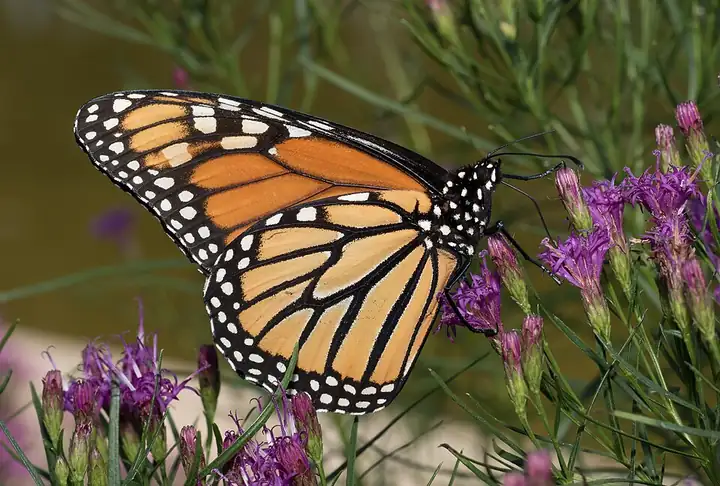
Monarch butterfly
Danaus plexippus
| Type | Insect |
|---|---|
| What it does | Pollinator |
| How common it is by region | Very common here: South Central, Midwest |
About
The monarch is the big orange butterfly with black veins whose caterpillars eat only milkweed. Its numbers have dropped sharply, and in December 2024 the U.S. Fish and Wildlife Service proposed listing it as threatened, so a garden with milkweed and fall flowers really helps.
This one is already on your side. Broad sprays kill it along with the pest, which is why the guide puts sprays last.
What it eats
Caterpillars eat milkweed leaves and nothing else; the milkweed makes them taste bad to birds. Adults sip nectar from many flowers and need blooms from spring through the fall migration.
Spotting it
How to find it early
Adults are orange with heavy black veins and white-spotted black edges. Look for caterpillars and chewed leaves on milkweed in summer.
Its young
Eggs are tiny (about 1 mm), cream-colored, ribbed and pointed, laid one at a time on milkweed. Caterpillars have bold yellow, black and white bands with a pair of black tentacles at each end and grow to about 2 inches; the chrysalis is pale green with gold markings.
When
Spring through fall; the last generation migrates south in late summer and early fall. Some live year-round in Florida, along the Gulf Coast and on the southern coasts.
Easy to mistake for
- Garden butterflies — The viceroy looks almost the same but has a dark band arching across the middle of each hind wing, and the queen lacks the monarch's dark wing veins.
Bringing more of them in
Plant milkweed that is native to your area, plus a run of nectar flowers from spring to fall. Skip insecticides, ask whether nursery plants were treated with systemic neonicotinoids, and if you grow tropical milkweed in a mild climate, cut it back in fall so it doesn't spread a monarch parasite.
Plants that bring it in
Aster, Bee balm, Black-eyed Susan, Blazing star (liatris), Goldenrod, Joe-Pye weed, Milkweed, Purple coneflower (echinacea)
Buying it
Not recommended: the Fish and Wildlife Service says captive rearing is not a recovery tool and can spread disease, and releasing or shipping monarchs across state lines needs a USDA APHIS permit.
How common it is by region
| Northeast | Common here |
|---|---|
| Southeast | Common here |
| South Central | Very common here |
| Midwest | Very common here |
| Great Plains | Common here |
| Mountain West | Occasional here |
| Southwest | Occasional here |
| Pacific Northwest | Occasional here |
| California | Common here |
| Alaska | Not found here |
| Hawaii | Occasional here |
Sources
Photo: Photo: Rhododendrites / Wikimedia Commons, CC BY-SA 4.0 (CC BY-SA 4.0). Photo resized for the web.

Planting dates and advice are general guidance; check with your local Cooperative Extension office for your area.