
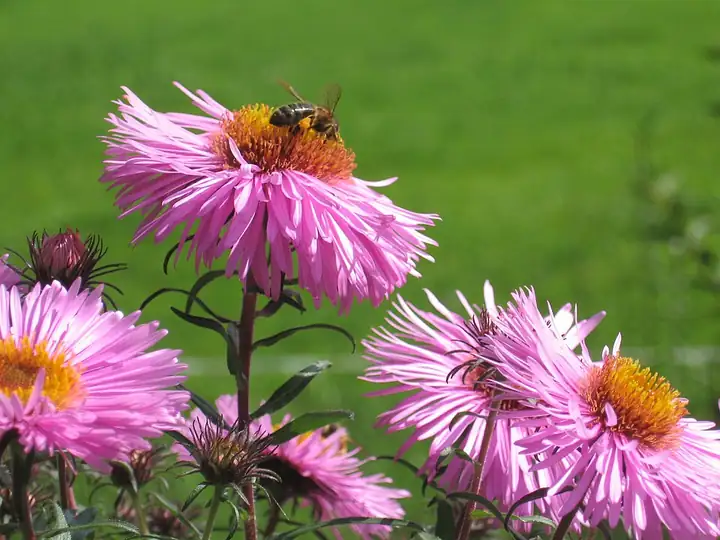
Aster
Symphyotrichum novae-angliae (New England aster), S. novi-belgii (New York aster) and relatives; also Aster x frikartii (Frikart's aster) · Aster family (Asteraceae)
When to plant: Most people set out potted plants in early spring or fall; finish fall planting at least 6 weeks before the ground freezes hard (Clemson).
| Hardiness zones | 3 to 8 |
|---|---|
| Sun | full sun to part shade |
| Water | moderate |
| Life cycle | perennial |
| Frost | Hardy: takes frost |
| Spacing | 12 to 36 inches |
About Aster
Fall asters are the purple, blue, pink and white daisies that light up the garden from late summer until hard frost. New England and New York asters are native to eastern North America and were moved from Aster to Symphyotrichum after DNA studies (Illinois Extension); Frikart's aster is a European-Asian hybrid that starts blooming in early summer. Late bees, hover flies and migrating monarchs lean on them, and New England aster feeds pearl crescent caterpillars.
Mt. Cuba lists New England aster for zones 3-8 and NC State lists New England and New York asters for 4-8; Frikart's aster is hardy only to about zone 5 and needs sharp winter drainage. A few asters spread fast by rhizomes (Chicago Botanic Garden), but we found no invasive listing for these species in the US.
When to plant
Most people set out potted plants in early spring or fall; finish fall planting at least 6 weeks before the ground freezes hard (Clemson).
For seed, press it onto the soil in late fall without burying it, since winter cold helps it sprout in spring (UVM); NRCS says spring-sown seed germinates better after chilling.
Soil
Moist, fertile, well-drained soil, including clay loam (NC State); Frikart's aster needs excellent drainage, especially in winter (Piedmont Master Gardeners).
Work compost into moist, well-drained soil (clay loam is fine); Clemson aims perennial beds at pH 6.0-6.5. Follow a soil test.
Feeding
- early spring, just before new shoots come up (optional; many asters need none): slow-release fertilizer such as 12-6-6, or a 1-inch layer of compost. Feed sparingly: Kentucky Extension says New York asters need little, and Chicago's trial asters got no fertilizer. Clemson's general rate for perennial beds is 1-2 lb of a slow-release 12-6-6 per 100 sq ft just before shoots emerge; MSU advises no more than 1 lb of nitrogen per 1,000 sq ft. Scatter it around the plants and water it in. Follow a soil test.
Look for: a balanced or all-purpose fertilizer at the label rate. Skip high-phosphorus "bloom boosters" unless a soil test shows low phosphorus: most garden soils already have enough, and the extra can wash into streams.
Too much fertilizer makes tall, floppy stems (MSU). Crowded clumps get more powdery mildew, so divide every 2-3 years and thin stems for air flow (Chicago Botanic Garden; Kentucky; Illinois).
Harvest
New England and New York asters bloom from August or September into October or later; Frikart's aster starts in June or July. Pinch stems a few times before mid-July (Mt. Cuba) or shear to half height in early June (Chicago Botanic Garden) for shorter, sturdier plants. Cutting stems after bloom limits self-seeding.
Varieties (27)
| Variety | Type | Season and days | Zones | Notes |
|---|---|---|---|---|
| October Skies | Aromatic aster (S. oblongifolium) | Aug-Oct | 3–8typical for aster | About 35 in tall and 50 in wide with lavender-blue flowers. Rated good (4 stars) in Chicago. Sources: [3] |
| Raydon's Favorite | Aromatic aster (S. oblongifolium) | Aug-Nov | 3–8typical for aster | Billowy, shrub-like plant about 3 ft tall with blue-purple flowers and minty-scented leaves. Top (5-star) rating in Chicago; a mildew-resistant alternative to New England aster. Kentucky calls it one of the best for late September-October bloom. Sources: [3][7] |
| Lady in Black | Calico aster (S. lateriflorum) | Sep-Oct | 3–8typical for aster | Purple foliage all summer and tiny white flowers whose centers turn pinkish-purple; about 34 in tall. Top (5-star) rating in Chicago with excellent disease resistance. Sources: [3] |
| Jungfrau | Frikart's aster (Aster x frikartii) | Jul-Oct | 3–8typical for aster | Compact, about 18 in, with violet flowers. Excellent mildew and rust resistance, but did not survive the wet Chicago winter. Sources: [3] |
| Mönch | Frikart's aster (Aster x frikartii) | Jun/Jul-Oct | 5+ | Loose, bushy mound about 2-3 ft tall with lavender-blue flowers and yellow centers, 2-3 in across. Blooms from early summer into fall; excellent mildew resistance but needs sharp winter drainage; it died over winter in Chicago and Kentucky trials. Sources: [3][7][8] |
| Wunder von Stäfa | Frikart's aster (Aster x frikartii) | Jul-Oct | 5+ | Taller than 'Mönch' with paler lavender-blue flowers. Also called 'Wonder of Staffa'; blooms a little earlier than 'Mönch' and needs excellent drainage. Sources: [3][8][9] |
| Snow Flurry | Heath aster (S. ericoides) | Sep-Oct | 3–8typical for aster | Low groundcover, about 8 in tall and 4 ft wide, with white flowers; good over walls. Top (5-star) rating in Chicago; no winter losses. Sources: [3] |
| Andenken an Alma Pötschke | New England aster (S. novae-angliae) | Aug-Oct | 3–8typical for aster | Bright cerise to salmon-pink flowers on plants about 2-4 ft tall (Chicago measured 38 in tall, 60 in wide). Chicago rated its mildew resistance fair and rust resistance excellent. Often sold as 'Alma Pötschke'. Sources: [1][3][4] |
| Barr's Blue | New England aster (S. novae-angliae) | Sep-Oct | 3–8typical for aster | Tall, wide plant (about 55 in by 68 in) with purple-blue flowers. Poor mildew resistance in Chicago's trial. Sources: [3] |
| Harrington's Pink | New England aster (S. novae-angliae) | Sep-Oct | 3–8typical for aster | Tall plant, about 5 ft, with rosy pink flowers. Fair mildew resistance, excellent rust resistance (Chicago). Sources: [3] |
| Honeysong Pink | New England aster (S. novae-angliae) | Sep-Oct | 3–8typical for aster | Rose-pink to deep pink flowers on 2.5-5 ft stems. Fair mildew resistance, excellent rust resistance (Chicago). Sources: [1][3] |
| Purple Cloud | New England aster (S. novae-angliae) | 3–8typical for aster | Very tall, about 6 ft, with large purple flowers. Sources: [1] | |
| Purple Dome | New England aster (S. novae-angliae) | Sep-Nov | 3–8typical for aster | Short, mounded plant about 16-24 in tall, covered in violet-purple flowers. Fair mildew resistance in Chicago's trial; a good choice where tall New England asters would flop. Sources: [1][3] |
| Red Cloud | New England aster (S. novae-angliae) | 3–8typical for aster | About 5 ft tall with deep rose-pink flowers. Sources: [1] | |
| September Ruby | New England aster (S. novae-angliae) | 3–8typical for aster | Ruby-red flowers with yellow centers. Also sold as 'Septemberrubin'; Chicago noted its stems flopped by early September. Sources: [1][3] | |
| Alice Haslem | New York aster (S. novi-belgii) | Aug-Oct | 3–8typical for aster | Dwarf, about 12 in, with light red flowers. Very poor mildew resistance in Chicago's trial. Sources: [3] |
| Blue Lake | New York aster (S. novi-belgii) | Sep-Oct | 3–8typical for aster | Tall (about 55 in) with violet-blue flowers. Excellent mildew resistance but very poor rust resistance in Chicago. Sources: [3] |
| Bonny Blue | New York aster (S. novi-belgii) | Sep-Oct | 3–8typical for aster | Low, about 8 in tall, with lavender flowers. Excellent mildew resistance, fair rust resistance (Chicago). Sources: [3] |
| Climax | New York aster (S. novi-belgii) | Sep-Nov | 3–8typical for aster | Tall (about 46 in) with lavender-blue flowers. One of the few New York asters with excellent resistance to both mildew and rust in Chicago; rated good (4 stars). Sources: [3] |
| Coombe Violet | New York aster (S. novi-belgii) | 3–8typical for aster | Violet, semi-double flowers. Sources: [2] | |
| Fellowship | New York aster (S. novi-belgii) | 3–8typical for aster | Pale pink double flowers. Sources: [2] | |
| Marjorie | New York aster (S. novi-belgii) | Sep-Oct | 3–8typical for aster | Low, about 18 in, with pink flowers. Very poor mildew and rust resistance in Chicago. Sources: [3] |
| Rosenwichtel | New York aster (S. novi-belgii) | Sep-Oct | 3–8typical for aster | Dwarf, about 12 in tall and 30 in wide, with purple-pink flowers. Excellent mildew and rust resistance; rated good (4 stars) in Chicago. Sources: [3] |
| Royal Ruby | New York aster (S. novi-belgii) | 3–8typical for aster | Rich mulberry-red flowers. Sources: [2] | |
| Schneekissen | New York aster (S. novi-belgii) | Sep-Oct | 3–8typical for aster | Tiny white-flowered mound about 10 in tall. Excellent mildew resistance, good rust resistance (Chicago). The name means 'snow cushion'. Sources: [3] |
| Wood's Light Blue | New York aster (S. novi-belgii) | Aug-Oct | 3–8typical for aster | Very low, about 8 in tall, with light blue flowers. Excellent mildew and rust resistance in Chicago's trial. Sources: [3] |
| Bluebird | Smooth aster (S. laeve) | 3–8typical for aster | Blue-green leaves and light purple-blue flowers. Kentucky rated its performance excellent. Sources: [3][7] |
Good neighbors
NC State suggests pairing New England aster with fall-blooming goldenrod for a showy fall display; this is a design pairing, not a pest-control companion.
Pests to watch for
Aphids, Twospotted spider mite, Leafminers, Deer, Rabbits, Leafhoppers, Annual cicadas (dog-day cicadas), Lace bugs (azalea and chrysanthemum lace bugs)
Diseases and problems
Powdery mildew, Rust, Aster wilt, Stem rot, Southern blight, Aster yellows
In the kitchen
Safety: The sources we checked list no toxic parts for these asters and no research-based guidance on pregnancy, drug interactions or allergies.
Pets: Not listed by name by the ASPCA (true asters, Symphyotrichum). The ASPCA's 'aster' entries are China aster (Callistephus chinensis), which it calls non-toxic to dogs, cats and horses, and giant aster (Townsendia sericea), listed as non-toxic to dogs, cats and horses.
Sources
- plants.ces.ncsu.edu
- plants.ces.ncsu.edu
- chicagobotanic.org
- mtcubacenter.org
- uvm.edu
- extension.illinois.edu
- uky.edu
- piedmontmastergardeners.org
- planttalk.colostate.edu
- plants.sc.egov.usda.gov
- hgic.clemson.edu
- aspca.org
- aspca.org
- aspca.org
- extension.psu.edu
- xerces.org
- homesoiltest.msu.edu
Photo: Photo: Caumasee, CC BY-SA 4.0, via Wikimedia Commons (CC BY-SA 4.0). Photo resized for the web.

Planting dates and advice are general guidance; check with your local Cooperative Extension office for your area.