
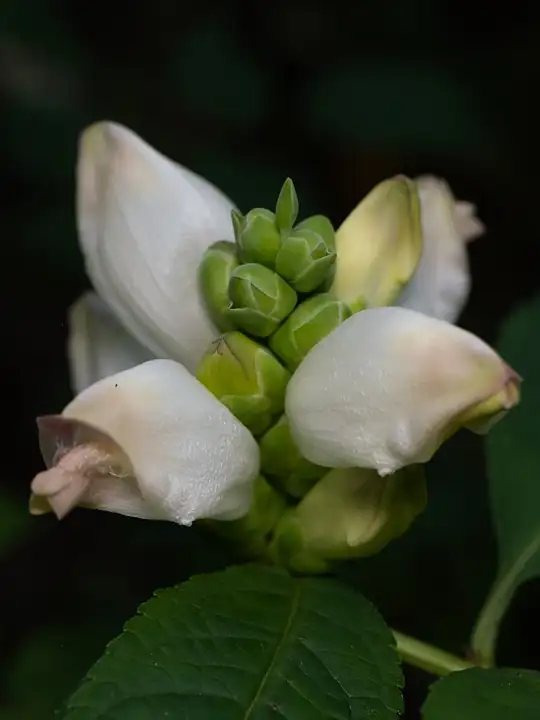
Turtlehead
Chelone glabra (white turtlehead), C. lyonii (pink turtlehead) and C. obliqua (red or pink turtlehead), plus hybrids · Plantain family (Plantaginaceae)
When to plant: Plant nursery-grown plants or divisions in spring, or divide dormant clumps in early spring or late fall and set them about 18 inches apart (Wildflower Center).
| Hardiness zones | 3 to 9 |
|---|---|
| Sun | full sun to part shade |
| Water | high |
| Life cycle | perennial |
| Frost | Hardy: takes frost |
| Spacing | 18 inches |
About Turtlehead
Turtleheads are native wildflowers of stream banks, wet woods and marshes, with glossy toothed leaves and tight clusters of hooded flowers shaped like a turtle's head with its mouth open, from late summer into fall (NC State, Wisconsin Extension). White turtlehead grows wild from Newfoundland to Minnesota and south to Georgia and northeast Arkansas; pink turtlehead is from the southern Appalachians, and red turtlehead from the Southeast and central U.S. (Wildflower Center, NC State). Bumblebees, butterflies and hummingbirds visit the flowers, and it is the favorite caterpillar host of the Baltimore checkerspot butterfly (Wildflower Center, Wisconsin Extension).
White and pink turtlehead are hardy in zones 3-8; red turtlehead in zones 5-9 (NC State, Wisconsin Extension). Native to the eastern half of the U.S.; red turtlehead is rare in North Carolina.
When to plant
Plant nursery-grown plants or divisions in spring, or divide dormant clumps in early spring or late fall and set them about 18 inches apart (Wildflower Center).
From seed, sow outdoors in fall or chill moist seed for 6 weeks to 3 months and sow it on the surface, since light helps it sprout; germination can take months and plants take about two years to flower (Wildflower Center, Wisconsin Extension).
Soil
Rich, humus-heavy soil that stays moist to wet; a pond or stream edge, rain garden or low spot suits it, and mulch helps hold moisture (NC State, Wisconsin Extension).
Mix plenty of compost or other organic matter into the bed; turtlehead wants fertile, humus-rich soil that stays moist (NC State, Wisconsin Extension).
Feeding
- Early spring, before new growth, only if a soil test shows a need: compost, or a complete slow-release fertilizer such as 12-6-6. Top-dress with compost each spring, or without a soil test use about 1-2 lb of 12-6-6 per 100 sq ft (Clemson), kept off the leaves and watered in.
Look for: a balanced or all-purpose fertilizer at the label rate. Skip high-phosphorus "bloom boosters" unless a soil test shows low phosphorus: most garden soils already have enough, and the extra can wash into streams.
Don't let the soil dry out: dry soil invites powdery mildew. Too much shade makes it tall and floppy (NC State).
Harvest
Flowers open from the bottom of each spike upward from midsummer or late summer into fall, roughly July to October (NC State). Pinch stems in spring for shorter, bushier plants, and leave the seed pods to brown if you want seed (Wisconsin Extension).
Varieties (6)
Extension sources document 6 cultivars across the three species.
| Variety | Type | Season and days | Zones | Notes |
|---|---|---|---|---|
| Tiny Tortuga ('Armtipp02') | Hybrid | Late summer to fall | 3–9typical for turtlehead | Compact, 14-16 in tall and 12-24 in wide; dark pink flowers and dark green leaves that darken with age. U.S. plant patent 25,350. Sources: [4] |
| Hot Lips | Pink turtlehead (C. lyonii) | Late summer to fall | 3–8 | Leaves come up bronze-green on reddish stems; deep rose-pink flowers. Sources: [2][4] |
| Pink Temptation | Pink turtlehead (C. lyonii) | Late summer to fall | 3–9typical for turtlehead | Compact seed strain about 16 in tall and wide with pink flowers; introduced in 2006. Sources: [4] |
| Alba | Red turtlehead (C. obliqua) | Late summer to fall | 3–9typical for turtlehead | White-flowered form of red turtlehead. Sources: [4] |
| Ieniemienie | Red turtlehead (C. obliqua) | Late summer to fall | 3–9typical for turtlehead | Very compact, about 10 in tall, with lilac-pink flowers. Wisconsin Extension notes many plants sold as C. obliqua may be hybrids. Sources: [4] |
| Black Ace | White turtlehead (C. glabra) | Late summer to fall | 3–9typical for turtlehead | Dark green leaves with a blackish cast in spring; white flowers; 3-6 ft tall. Introduced in 2001. Sources: [4] |
Good neighbors
Wisconsin Extension suggests pairing it with Shasta daisy 'Becky' or monkshood for a late show; this is a design pairing, not a pest-control one.
Diseases and problems
Powdery mildew
In the kitchen
Safety: None of the sources we checked report it as poisonous, but it is not a food plant. Its old use as a bitter tonic and worm medicine is history only (King's American Dispensatory, USDA Forest Service); don't use it as a remedy.
Pets: Not listed by the ASPCA.
Sources
- plants.ces.ncsu.edu
- plants.ces.ncsu.edu
- plants.ces.ncsu.edu
- hort.extension.wisc.edu
- wildflower.org
- fs.usda.gov
- henriettes-herb.com
- aspca.org
- aspca.org
- hgic.clemson.edu
Photo: Photo: Alex Abair / Wikimedia Commons, CC BY 4.0 (CC BY 4.0). Photo resized for the web.

Planting dates and advice are general guidance; check with your local Cooperative Extension office for your area.