
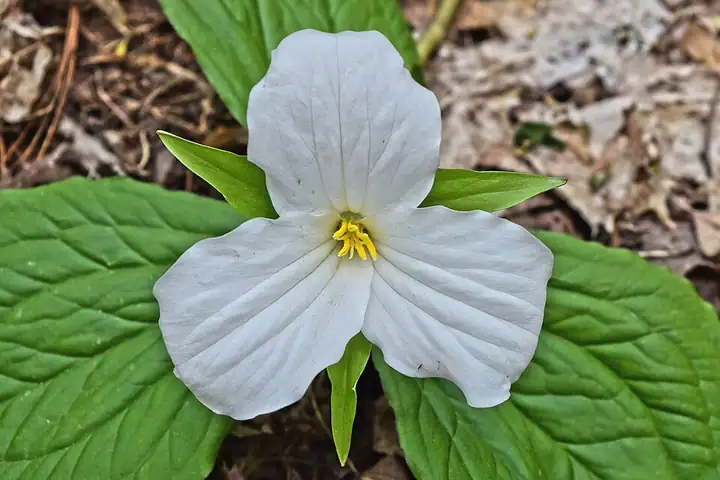
Trillium
Trillium spp.: great white trillium (T. grandiflorum), red trillium or wake-robin (T. erectum) and toadshade (T. sessile), plus yellow (T. luteum), little sweet Betsy (T. cuneatum) and prairie trillium (T. recurvatum) · Bunchflower family (Melanthiaceae)
| Hardiness zones | 4 to 8 |
|---|---|
| Sun | part shade |
| Water | moderate |
| Life cycle | perennial |
| Frost | Hardy: takes frost |
About Trillium
Trilliums are long-lived woodland wildflowers with everything in threes: three leaves, three sepals and three petals. Great white trillium has big white flowers that fade to pink, red trillium has nodding maroon flowers with a wet-dog smell that draws flies, and toadshade holds upright maroon petals over mottled leaves (NC State, wildflower.org). They are native to rich woods of the eastern U.S.: great white from Georgia north to New England, Michigan and Minnesota, red trillium from New England to Kentucky and in the mountains to Georgia, and toadshade from Pennsylvania to Missouri and Arkansas (wildflower.org). They grow very slowly (4-5 years or more from seed to flower), so never dig them from the wild: buy nursery-propagated plants and ask how they were grown (Iowa State, Missouri Extension, wildflower.org).
Great white trillium and toadshade are hardy in zones 4-8, red trillium in 4-7 (and dislikes heat), and prairie trillium in 4-9 (NC State, Missouri Botanical Garden). Native and not invasive.
Planting
Plant nursery-grown trilliums in part to full shade with spring sun; they don't transplant well, so place them once and leave them (NC State, Missouri Extension). From seed it's a long game: sow fresh seed outdoors soon after the berries ripen, about 1/2 inch deep; seed may take two years or more to sprout, great white trillium flowers in its 4th or 5th year, and red trillium can take up to 15 years (wildflower.org, NC State). We found no sourced day count to first bloom.
Soil
Moist, humus-rich, well-drained soil on the acid side (below about pH 6.8); a mulch of shredded leaves at the start and end of the season helps (wildflower.org, NC State).
Give it moist, humus-rich, well-drained, slightly acid soil (wildflower.org, NC State).
Feeding
- Start and end of the growing season (early spring and fall): rotted or shredded leaves as a mulch. A leaf mulch at the start and end of the season keeps the soil rich and moist (wildflower.org).
Look for: a balanced or all-purpose fertilizer at the label rate. Skip high-phosphorus "bloom boosters" unless a soil test shows low phosphorus: most garden soils already have enough, and the extra can wash into streams.
Never cut the leaves or pick the flowers: trilliums often die when their leaves are removed (wildflower.org). Keep the soil moist while they grow and bloom (Missouri Extension).
Harvest
Blooms in spring, April to June depending on species and how far north you are (NC State, wildflower.org); great white trillium flowers fade from white to pink as they age. Don't cut the flowers or leaves: the leaves feed the rhizome, and wildflower.org notes trilliums often die when their leaves are removed. No deadheading needed.
Varieties (7)
Trilliums are sold mostly as species, not cultivars. These are the species and one named form documented by NC State, wildflower.org and Missouri Botanical Garden.
| Variety | Type | Season and days | Zones | Notes |
|---|---|---|---|---|
| T. erectum var. album | Form of red trillium | Spring | 4–8typical for trillium | White-flowered form of red trillium. Sources: [2] |
| Great white trillium (T. grandiflorum) | Species | Spring (April-June) | 4–8 | The largest, showiest trillium: 2-4 in white flowers that turn pink as they age, on 1-1.5 ft plants. Flowers in its 4th or 5th year from seed (wildflower.org). Sources: [1][4][8] |
| Little sweet Betsy (T. cuneatum) | Species | Spring | 5–8 | 1-1.5 ft tall. Sources: [8] |
| Prairie trillium (T. recurvatum) | Species | Spring | 4–9 | 1-1.5 ft tall; native to Missouri. Sources: [8] |
| Red trillium, wake-robin (T. erectum) | Species | Spring (April-June) | 4–7 | Nodding maroon-red flowers with a foul smell that draws flies; 8-18 in tall. Dislikes heat; can take up to 15 years from seed to flower (NC State). Sources: [2][5][8] |
| Toadshade (T. sessile) | Species | April-May | 4–8 | Stalkless, upright maroon petals over mottled leaves; 4-12 in tall, with a strong smell. Sources: [3][6] |
| Yellow trillium (T. luteum) | Species | Spring | 4–8 | Yellow flowers on 1-1.5 ft plants. Sources: [8] |
Good neighbors
Virginia bluebells, Jack-in-the-pulpit
Design pairings only: Wisconsin Extension and UT Gardens pair trillium with Virginia bluebells for a spring show, and Arkansas Extension calls jack-in-the-pulpit a good companion for trilliums and other spring ephemerals.
Pests to watch for
Diseases and problems
In the kitchen
Safety: NC State and wildflower.org list the roots and berries as mildly poisonous; the toxin isn't known, so caution is advised. Don't pick or eat the leaves: besides the risk, removing leaves can kill the plant.
Pets: Not listed by the ASPCA (no Trillium entry on its plant lists; the ASPCA's 'Wake Robin' entry is Arum maculatum, a different plant). NC State lists the roots and berries as mildly poisonous, so keep pets from chewing them.
Sources
- plants.ces.ncsu.edu
- plants.ces.ncsu.edu
- plants.ces.ncsu.edu
- wildflower.org
- wildflower.org
- wildflower.org
- fs.usda.gov
- missouribotanicalgarden.org
- yardandgarden.extension.iastate.edu
- extension.missouri.edu
- hort.extension.wisc.edu
- utianews.tennessee.edu
- uaex.uada.edu
- extension.rutgers.edu
- aspca.org
- aspca.org
- aspca.org
- aspca.org
Photo: Photo: СССР / Wikimedia Commons, CC BY-SA 2.5 CA (CC BY-SA 2.5 CA). Photo resized for the web.

Planting dates and advice are general guidance; check with your local Cooperative Extension office for your area.