
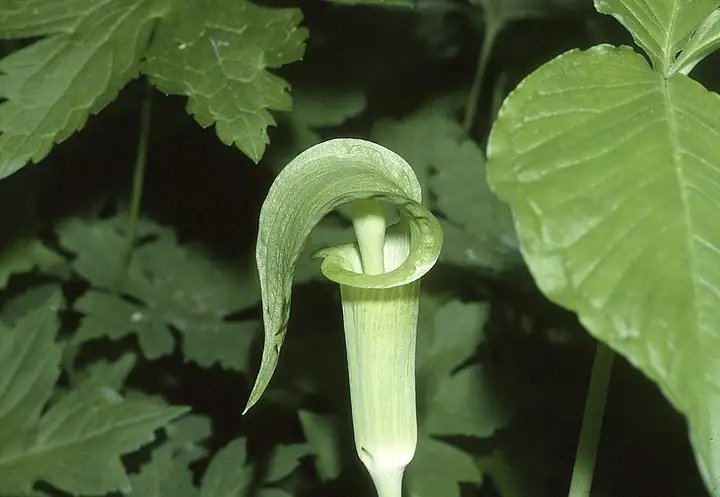
Jack-in-the-pulpit
Arisaema triphyllum · Arum family (Araceae)
When to plant: Seed is cleaned from the berries (wear gloves), never allowed to dry, and sown outdoors in fall about 3/4 inch deep, or chilled 60-90 days in moist material before spring sowing; it can take up to 2 years to sprout and 3-5 years to flower (wildflower.org, USDA Forest Service, Arkansas Extension).
| Hardiness zones | 4 to 9 |
|---|---|
| Sun | part shade |
| Water | high |
| Life cycle | perennial |
| Frost | Hardy: takes frost |
About Jack-in-the-pulpit
Jack-in-the-pulpit is a woodland wildflower with a hooded, striped spathe (the pulpit) curving over a club-like spadix (Jack), under one or two leaves split into three leaflets; female plants follow with a cluster of bright red berries in late summer (NC State, Arkansas Extension). It is native across the eastern U.S. and Canada, from Nova Scotia and Manitoba south to Florida and Texas (wildflower.org), and a corm can live 25 years or more (USDA Forest Service). Young or shaded plants are male and switch to female as the corm grows. All parts contain calcium oxalate crystals that burn the mouth if chewed. Buy nursery-grown corms rather than digging plants from the woods (Iowa State).
Hardy in zones 4-9 (NC State). Native and not invasive; it slowly forms colonies from cormlets.
When to plant
Seed is cleaned from the berries (wear gloves), never allowed to dry, and sown outdoors in fall about 3/4 inch deep, or chilled 60-90 days in moist material before spring sowing; it can take up to 2 years to sprout and 3-5 years to flower (wildflower.org, USDA Forest Service, Arkansas Extension).
Nurseries sell packaged corms, usually in spring (Arkansas Extension). Separate cormlets in fall. We found no sourced day count to first bloom.
Soil
Rich, moist to wet soil high in organic matter; it does poorly in heavy clay and grows best in shady, seasonally wet spots (NC State, wildflower.org).
Choose a shady spot with rich, moist soil high in organic matter; avoid heavy clay (NC State).
Feeding
- Fall and winter: the fallen leaf litter. Leave fallen leaves on the patch over winter rather than raking them off (wildflower.org).
Look for: a balanced or all-purpose fertilizer at the label rate. Skip high-phosphorus "bloom boosters" unless a soil test shows low phosphorus: most garden soils already have enough, and the extra can wash into streams.
Don't let the soil dry out in spring, and wear gloves when handling corms or berries (wildflower.org, USDA Forest Service).
Harvest
Blooms in spring (March-May); female plants ripen clusters of red berries from late summer into fall as the leaves die down (NC State, wildflower.org). Leave the berries for birds and box turtles, and wear gloves if you collect them for seed. No deadheading needed; leave the leaf litter over the patch in winter (wildflower.org).
Varieties (3)
NC State documents these three foliage selections; we found no other sourced cultivars.
| Variety | Season and days | Zones | Notes |
|---|---|---|---|
| Black Jack | Spring | 4–9typical for jack-in-the-pulpit | Shiny, nearly black leaves with a few green veins. Sources: [1] |
| Mrs. French | Spring | 4–9typical for jack-in-the-pulpit | Green leaves with bold white veins. Sources: [1] |
| Starburst | Spring | 4–9typical for jack-in-the-pulpit | Vigorous, about 22 in tall, with white-veined green leaves. Sources: [1] |
Good neighbors
A design pairing only: Arkansas Extension calls it a good companion for trilliums and other spring ephemerals.
In the kitchen
Safety: Don't eat any part. Calcium oxalate crystals in the berries, leaves and corm cause intense burning, swelling of the lips, tongue and throat, and drooling (NC State, wildflower.org). Touching the corm can blister skin, and the leaves and berries can irritate it, so wear gloves (wildflower.org, USDA Forest Service).
Pets: Toxic to dogs, cats and horses (ASPCA): insoluble calcium oxalate crystals cause mouth pain and swelling, heavy drooling, vomiting (not in horses) and trouble swallowing.
Sources
- plants.ces.ncsu.edu
- wildflower.org
- fs.usda.gov
- uaex.uada.edu
- yardandgarden.extension.iastate.edu
- yardandgarden.extension.iastate.edu
- extension.missouri.edu
- aspca.org
- aspca.org
- aspca.org
- aspca.org
Photo: Photo: Robert H. Mohlenbrock, USDA NRCS, Public domain, via Wikimedia Commons. Photo resized for the web.

Planting dates and advice are general guidance; check with your local Cooperative Extension office for your area.