
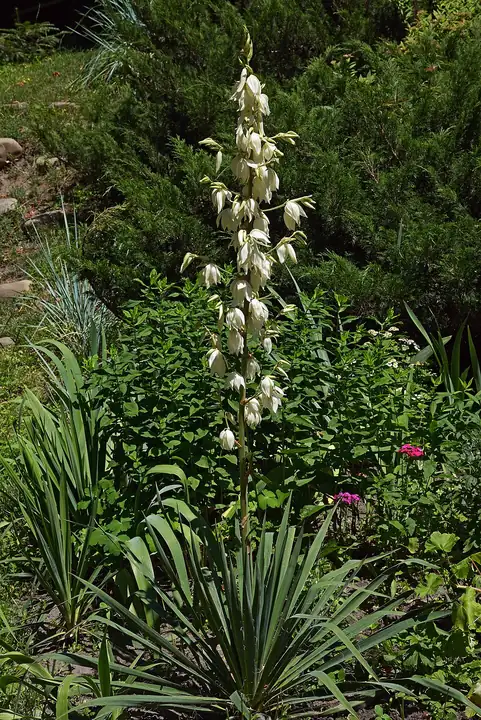
Yucca (Adam's needle)
Yucca filamentosa (Adam's needle) and Y. glauca (soapweed or Great Plains yucca) · Asparagus family (Asparagaceae)
When to plant: Plant potted yuccas from spring through fall (Clemson) in sun and well-drained soil, 3-6 ft apart (NC State).
| Hardiness zones | 4 to 10 |
|---|---|
| Sun | full sun to part shade |
| Water | low |
| Life cycle | perennial |
| Frost | Hardy: takes frost |
| Soil pH | 6.0–8.0 |
| Spacing | 36 to 72 inches |
About Yucca (Adam's needle)
Adam's needle is the tough garden yucca: an evergreen clump of stiff, sword-shaped leaves edged with curly white threads that sends up 5-6 ft stalks of nodding, creamy white bells in late spring and early summer (NC State, Clemson). It is native to the eastern U.S. from Long Island and Pennsylvania south to Florida and Louisiana, and soapweed yucca is native to the Great Plains from Montana and North Dakota south to Texas, New Mexico and Arizona (wildflower.org). Only the little yucca moth pollinates the flowers, and its caterpillars eat some of the seeds in return (NC State, wildflower.org). This is not the cane yucca sold as a houseplant.
Adam's needle is hardy in zones 4-10, and soapweed yucca, one of the most cold-hardy yuccas, in zones 4-8 (NC State). Native and not listed as invasive, though wildflower.org notes Adam's needle escapes from gardens in the northern part of its range.
When to plant
Plant potted yuccas from spring through fall (Clemson) in sun and well-drained soil, 3-6 ft apart (NC State).
Keep them away from walks and patios because the leaf tips are sharp. Make more by dividing offsets, by root cuttings or from fresh seed (NC State, wildflower.org).
Soil
Any well-drained soil, including clay, sand and shallow rocky ground; it can't take waterlogged soil, and wet spots bring leaf spots and blight (NC State, Clemson).
Test the soil first; yucca grows in clay, sand or rocky soil as long as it drains, with pH about 6-8 (NC State, Clemson).
Feeding
- Spring after new growth starts, only if a soil test shows a need: slow-release complete fertilizer in a 3:1:2 ratio, or what the soil test calls for. Spread it evenly over the root zone and water it in; a typical soil-test rate for shrubs is about 2 lb of 12-6-6 per 100 sq ft (Clemson). Follow a soil test.
Look for: mostly nitrogen, in spring as growth starts. Spring feeding grows the new shoots and leaves that carry flowers and fruit; feeding after midsummer pushes soft growth that may not harden before winter.
Wet, poorly drained spots lead to leaf spots and blight (NC State, Clemson). Mature shrubs in decent soil often need no fertilizer, and too much pushes leaves over flowers (Clemson). NC State lists the yucca plant bug as its insect pest.
Harvest
Adam's needle blooms in late spring to early summer (April-June in the South); soapweed yucca blooms June to August (NC State, wildflower.org). Cut the flower stalk off at the base after bloom (Clemson), or leave it if you want the seed pods.
Varieties (6)
Clemson and NC State document 6 named cultivars; we found no others in extension sources.
| Variety | Type | Zones | Notes |
|---|---|---|---|
| Ivory Tower | Adam's needle | 4–10typical for yucca | Flowers face outward instead of hanging down. Sources: [5] |
| Golden Sword | Variegated (often sold as Adam's needle) | 4–10typical for yucca | Yellow leaf centers with green edges. Clemson places it under weakleaf yucca (Y. flaccida), whose leaves are softer and bend down. Sources: [1][5] |
| Bright Edge | Variegated Adam's needle | 4–10typical for yucca | Yellow to gold leaf edges. Sources: [1][5] |
| Color Guard | Variegated Adam's needle | 4–10typical for yucca | Broad creamy yellow stripe down the middle of each leaf, tinted rose-pink in winter. Clemson spells it 'Colour Guard'. Sources: [1][5] |
| Concava Variegata | Variegated Adam's needle | 4–10typical for yucca | Cream-edged leaves that turn pinkish in cold weather. Sources: [5] |
| Garland Gold | Variegated Adam's needle | 4–10typical for yucca | Gold stripe down the center of the leaf. Sources: [1][5] |
Good neighbors
A design pairing, not pest control: NC State suggests a variegated Adam's needle with yellow-flowered baptisia 'Carolina Moonlight'.
Diseases and problems
Leaf spots, Leaf blight
In the kitchen
NC State lists Adam's needle flowers as edible, with a slightly bitter, artichoke-like taste, raw or cooked in soups and stews, and lists the flowers, buds and young pods of soapweed yucca as edible too. Use only unsprayed flowers you are sure of.
Safety: NC State rates soapweed yucca low in toxicity: its saponins are mostly in the roots, and it doesn't cause skin rashes. The stiff, needle-tipped leaves are the real hazard, so Clemson advises keeping yuccas away from walkways; wear gloves when working in the clump.
Pets: Toxic to dogs, cats and horses (ASPCA, Yucca species): its saponins can cause vomiting in dogs and cats, and liver disease and skin irritation in horses.
Sources
- plants.ces.ncsu.edu
- plants.ces.ncsu.edu
- wildflower.org
- wildflower.org
- hgic.clemson.edu
- aspca.org
- extension.rutgers.edu
- hgic.clemson.edu
Photo: Photo: Ввласенко, CC BY-SA 3.0, via Wikimedia Commons (CC BY-SA 3.0). Photo resized for the web.

Planting dates and advice are general guidance; check with your local Cooperative Extension office for your area.