
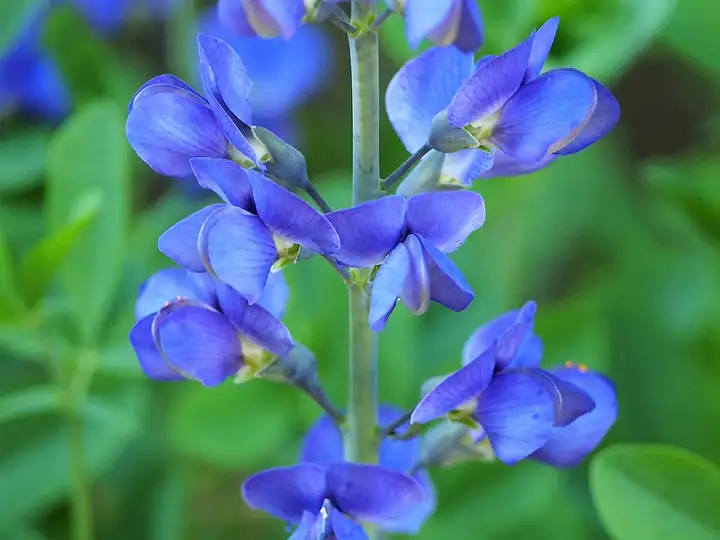
Baptisia (false indigo)
Baptisia australis (blue false indigo, incl. dwarf var. minor) and hybrids such as 'Purple Smoke', the Prairieblues and Decadence series; white false indigo (B. alba) and yellow B. sphaerocarpa are close kin used in many hybrids · Pea family (Fabaceae)
When to plant: Set out nursery plants in spring or fall and pick the spot for good: a deep taproot makes baptisia drought tolerant but hard to move later (NC State, Wisconsin Extension).
| Hardiness zones | 3 to 9 |
|---|---|
| Sun | full sun |
| Water | low |
| Life cycle | perennial |
| Frost | Hardy: takes frost |
About Baptisia (false indigo)
Baptisia is a long-lived native perennial that grows into a shrub-sized clump of blue-green, clover-like leaves, with foot-long spikes of indigo-blue pea flowers in late spring and puffy pods that ripen black and rattle (Wisconsin Extension, NC State). Blue false indigo is native from Pennsylvania to southern Indiana and south to Georgia and Tennessee, with a smaller form (var. minor) from Iowa and southeast Nebraska to Texas (Wildflower Center); it was Perennial Plant of the Year in 2010. It's tough, drought tolerant and seldom touched by deer, but all parts are mildly poisonous if eaten.
Blue false indigo is hardy in zones 3-9 (NC State, Wisconsin Extension); white false indigo in 5-8 and most hybrids in 4-9 (NC State). It isn't listed as invasive anywhere we checked, though it has naturalized in New England (Wildflower Center).
When to plant
Set out nursery plants in spring or fall and pick the spot for good: a deep taproot makes baptisia drought tolerant but hard to move later (NC State, Wisconsin Extension).
From seed, scarify (nick or soak in hot water) and/or give at least 4 weeks of cold before sowing; fresh seed sown outdoors in fall usually sprouts without treatment (Wisconsin Extension, Wildflower Center). Seed-grown plants take about 3-4 years to bloom, so days_to_harvest is empty.
Soil
Any well-drained soil, including clay and poor, rocky or sandy ground; NC State lists acid soil, but Wisconsin Extension says it blooms poorly in very acid soil and lime (per a soil test) can help. It needs no rich soil, since it makes its own nitrogen.
No rich soil needed: just loosen a well-drained spot. If a soil test shows strongly acid soil, add lime as it recommends, since Wisconsin Extension says baptisia blooms poorly in acid soil.
Feeding
Look for: a balanced or all-purpose fertilizer at the label rate. Skip high-phosphorus "bloom boosters" unless a soil test shows low phosphorus: most garden soils already have enough, and the extra can wash into streams.
Skip the fertilizer: as a legume it makes its own nitrogen and needs little feeding (Wisconsin Extension), and Penn State notes that overfed perennials make soft growth and few flowers. Overwatering and shade make stems flop. Don't try to move an established plant; the taproot resents it.
Harvest
Blooms mid to late spring for 2-3 weeks, about a month after the leaves come up (Wisconsin Extension). Cut stems for the vase as the spikes open. Leave the black pods for winter interest and dried arrangements, or cut the plant back by about a third after bloom (or snip just the spent spikes) to stop flopping and self-seeding (Wisconsin Extension, NC State).
Varieties (18)
| Variety | Type | Season and days | Zones | Notes |
|---|---|---|---|---|
| Starlite Prairieblues ('Starlite') | B. x bicolor (B. australis x B. bracteata) | Mid-May into June, 7-10 days before blue false indigo | 4–9 | Violet-lavender buds open to periwinkle flowers with butter-cream keels; a low, broad plant about 3 ft tall and 4 ft wide. Bred by Dr. Jim Ault at the Chicago Botanic Garden. Sources: [17] |
| Twilite Prairieblues ('Twilite') | B. x variicolor (B. australis x B. sphaerocarpa) | Late spring | 3–9typical for baptisia | Smoky violet-purple flowers with a lemon-yellow keel on a big plant, about 4.5 ft tall and 5.5 ft wide in Mt. Cuba's trial. Named in the Chicago Botanic Garden's Starlite release as a fellow Prairieblues baptisia; rated 4.6 of 5 at Mt. Cuba Center. Sources: [3][5][17][18] |
| var. minor (dwarf blue false indigo) | Blue false indigo (B. australis), botanical variety | Late spring | 3–9typical for baptisia | A smaller form only 1-2 ft tall, good for small gardens; native from Iowa and southeast Nebraska to Texas. Sometimes sold as B. minor. Sources: [1][5][6] |
| Pink Truffles | Decadence Deluxe series hybrid | Mid-spring | 4–9 | Soft pink flowers on a compact, 2-3 ft plant. Sources: [4] |
| Blueberry Sundae | Decadence series hybrid | Late spring | 4–9 | Rich blue flowers on a compact plant, about 2.5-3 ft tall and wide. Rated 4.6 of 5 at Mt. Cuba Center. Sources: [4][18] |
| Lemon Meringue | Decadence series hybrid | Late spring | 4–9 | Bright lemon-yellow flowers on a compact, bushy plant about 3 ft tall. Rated 4.8 of 5 at Mt. Cuba Center. Sources: [4][18] |
| Sparkling Sapphires | Decadence series hybrid | Mid-spring | 4–9 | Deep blue flowers on a compact, 2-3 ft plant. Sources: [4] |
| Vanilla Cream | Decadence series hybrid | Mid-spring | 4–9 | Cream-colored flowers on a compact, 2-3 ft plant. 'Vanilla Cream II' is larger with a longer bloom season. Sources: [4] |
| Cherries Jubilee | Decadence series hybrid (B. x variicolor) | Late spring | 4–9 | Flowers open maroon and yellow and age to gold; about 3 ft tall and 4 ft wide. Rated 4.7 of 5 at Mt. Cuba Center. Sources: [4][18] |
| Blue Towers | Hybrid false indigo | Late spring | 3–9typical for baptisia | Lots of blue flower spikes on a big plant, nearly 5 ft tall and wide. Rated 4.7 of 5 at Mt. Cuba Center. Sources: [3][18] |
| Dutch Chocolate | Hybrid false indigo | Late spring | 3–9typical for baptisia | Compact plant about 3 ft tall and 4.5 ft wide. Rated 4.6 of 5 at Mt. Cuba Center; the source we opened doesn't give its flower color. Sources: [18][19] |
| Lunar Eclipse | Hybrid false indigo | Late spring | 3–9typical for baptisia | Pale lemon-cream flower spikes that blush lilac and age to deep violet-purple. Sources: [3] |
| Purple Smoke | Hybrid false indigo | Mid to late spring | 4–9 | Smoky lavender flowers on 18-inch spikes over gray-green leaves and nearly black stems; 3-5 ft tall and wide. Found as a chance seedling at the North Carolina Botanical Garden in the early 1990s; NC State gives its parents as B. australis x B. alba, Wisconsin Extension as B. australis var. minor x B. albescens. A Mt. Cuba Center top performer (4.7 of 5). Sources: [5][18][20] |
| Purple Towers | Hybrid false indigo | Late spring | 3–9typical for baptisia | Lavender flowers on spikes about 2 ft tall. Sources: [3] |
| Carolina Moonlight | Hybrid false indigo (B. sphaerocarpa x B. alba) | Late spring | 4–9 | Soft butter-yellow flowers over blue-green leaves; 3-4 ft tall and wide. A chance seedling from the North Carolina Botanical Garden, introduced in 2002; may take 2-3 years to start blooming. Sources: [1][18][21] |
| Ivory Towers | Hybrid of white false indigo (B. alba) | Late spring | 3–9typical for baptisia | Pure white flowers on tall spikes, about 4 ft tall and 4.5 ft wide. Rated 4.8 of 5 at Mt. Cuba Center. Sources: [3][18] |
| Wayne's World | White false indigo (B. alba var. alba) | Late spring | 3–9typical for baptisia | White flowers on a large plant, about 4.5 ft tall and 5 ft wide. Rated 4.8 of 5 at Mt. Cuba Center. Sources: [18][19] |
| Screamin' Yellow | Yellow wild indigo (B. sphaerocarpa) | Late spring | 3–9typical for baptisia | Compact plant with bright yellow flower spikes, about 3 ft tall and 4.5 ft wide in trial. The top-rated baptisia (5.0 of 5) in Mt. Cuba Center's 2012-2015 trial. Sources: [3][18][19] |
Pests to watch for
In the kitchen
Safety: All parts are poisonous if eaten, though the risk is rated low: the alkaloids baptisin and cytisine can cause nausea, vomiting and diarrhea, and children are most at risk (NC State, Wildflower Center). Don't let kids play with the rattling seed pods as food. It doesn't cause skin rashes (NC State).
Pets: Not listed by the ASPCA (no baptisia, false indigo, wild indigo or blue false indigo entry on its dog, cat or horse lists). NC State lists it as a low-toxicity problem for cats, so keep pets from chewing the plant or pods.
Sources
- plants.ces.ncsu.edu
- plants.ces.ncsu.edu
- plants.ces.ncsu.edu
- plants.ces.ncsu.edu
- hort.extension.wisc.edu
- wildflower.org
- chicagobotanic.org
- aspca.org
- aspca.org
- aspca.org
- aspca.org
- aspca.org
- aspca.org
- aspca.org
- extension.rutgers.edu
- extension.psu.edu
- chicagobotanic.org
- mtcubacenter.org
- mtcubacenter.org
- plants.ces.ncsu.edu
- plants.ces.ncsu.edu
Photo: Photo: Agnieszka Kwiecień, Nova / Wikimedia Commons, CC BY-SA 4.0 (CC BY-SA 4.0). Photo resized for the web.

Planting dates and advice are general guidance; check with your local Cooperative Extension office for your area.