
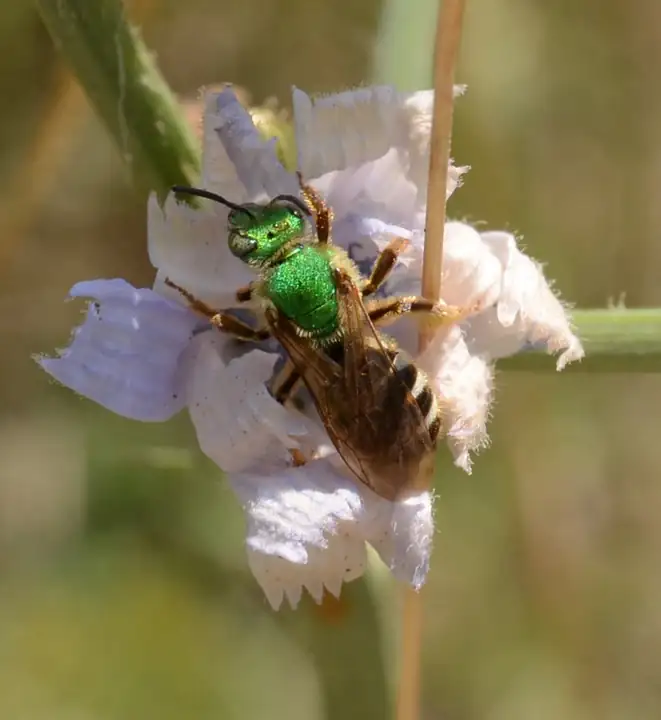
Sweat bees (halictid bees)
Family Halictidae, including metallic green bees (Agapostemon, Augochlora, Augochlorella) and many small dark Lasioglossum and Halictus species
| Type | Insect |
|---|---|
| What it does | Pollinator |
| When | Spring through fall, most often in summer |
| How common it is by region | Very common here: Northeast, Southeast, South Central, Midwest, Great Plains, Mountain West, Southwest, Pacific Northwest, California |
About
Sweat bees are small bees, often shiny metallic green, that nest in bare ground. They are some of the most common bees in gardens and pollinate many wildflowers and crops.
This one is already on your side. Broad sprays kill it along with the pest, which is why the guide puts sprays last.
What it eats
They gather pollen and nectar from many kinds of flowers, especially daisy-family flowers like sunflowers. UF lists stone fruits, apples and pears, alfalfa and sunflower among the crops they pollinate.
Spotting it
How to find it early
Look for small, slender bees, either metallic green, blue or black, sometimes with a green front half and striped abdomen, on open flowers. They sometimes land on sweaty skin to lick salt.
Its young
Larvae grow underground on balls of pollen in small cells, out of sight.
When
Spring through fall, most often in summer
Bringing more of them in
Leave some bare, sunny soil unmulched for nests, plant wildflowers, and keep tilling and insecticide use to a minimum.
Plants that bring it in
Worth knowing
Females can sting, usually when brushed off or pinned against skin, but the sting is only mildly painful for most people. Anyone allergic to bee stings should still take care.
How common it is by region
| Northeast | Very common here |
|---|---|
| Southeast | Very common here |
| South Central | Very common here |
| Midwest | Very common here |
| Great Plains | Very common here |
| Mountain West | Very common here |
| Southwest | Very common here |
| Pacific Northwest | Very common here |
| California | Very common here |
| Alaska | Common here |
| Hawaii | Occasional here |
Sources
Photo: Photo: Mark Nenadov / Wikimedia Commons, CC BY 2.0 (CC BY 2.0). Photo resized for the web.

Planting dates and advice are general guidance; check with your local Cooperative Extension office for your area.