
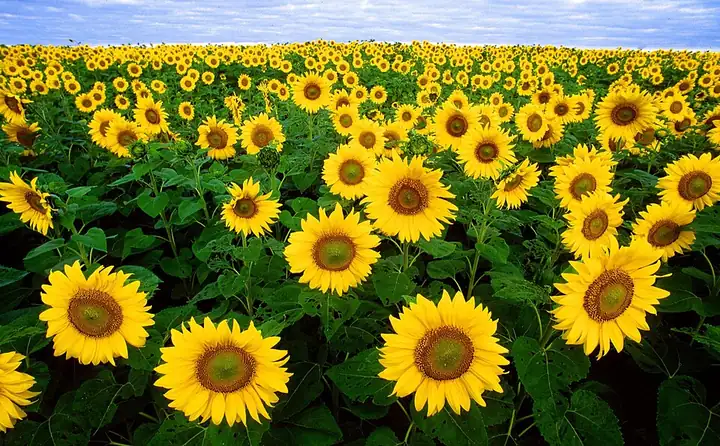
Sunflower
Helianthus annuus · Daisy family (Asteraceae)
When to plant: Sow seeds outdoors up to 3 weeks after the last frost.
| Hardiness zones | 2 to 11 |
|---|---|
| Sun | full sun |
| Water | moderate |
| Life cycle | annual |
| Frost | Tender: killed by frost |
| Soil pH | 6.0–6.8 |
| Spacing | 6 to 24 inches |
| Days to harvest | 50 to 95 days |
| Soil temperature to plant | at least 60°F |
About Sunflower
The common sunflower is a North American annual that ranges from 2-foot dwarfs to 10-foot giants. Its big heads feed bees and other pollinators in summer and finches and other seed-eating birds in fall.
Grown as a summer annual in every zone; frost kills it.
When to plant
Timing is counted from your average last spring frost (and first fall frost). Sow & Tell works out the actual dates for your ZIP code.
- Sow seeds outdoors: up to 3 weeks after the last frost
Days count from sowing to bloom, depending on variety. Sow seed 1 inch deep after all danger of frost, once soil is at least 60 F; seedlings appear in 7-10 days. Space 6 inches for short types, 1 foot for tall ones and 2 feet for giants.
Soil
Moist, well-drained soil; established plants tolerate drought.
Follow a soil test; without one, work in about 2.5 lb of a balanced fertilizer such as 13-13-13 per 100 sq ft (25 lb per 1,000 sq ft). Sunflowers like well-drained soil with a pH of 6.0 to 6.8.
Feeding
- when seedlings have several true leaves: nitrogen fertilizer such as 34-0-0, or an all-purpose slow-release fertilizer. Side-dress about 5 lb of 34-0-0 per 100 ft of row beside the plants and water right away to move it to the roots.
Look for: a balanced or all-purpose fertilizer at the label rate. Skip high-phosphorus "bloom boosters" unless a soil test shows low phosphorus: most garden soils already have enough, and the extra can wash into streams.
Harvest
For seed, cut the head when the back turns from green to yellow-brown and the head nods down, then dry it for several weeks in a warm, airy place. Or leave heads standing for birds.
Varieties (24)
| Variety | Type | Season and days | Notes |
|---|---|---|---|
| Autumn Beauty | Branching | 4-6 ft branching plants with many flowers in autumn shades of orange and red. Sources: [6][7] | |
| Pastiche | Branching | Multi-stemmed 4-5 ft plants with flowers in deep yellow, orange-red and mahogany blends. Sources: [1] | |
| Ring of Fire | Branching | 5 in flowers with a chocolate center, a red ring and golden petal tips on long stems. 2001 All-America Selections winner. Plants were under 3 ft in NC State's 2001 trial. Sources: [6][8] | |
| Sonja | Branching | 2-6 ft branching plants with yellow-orange flowers; used for cutting. In NC State's 2001 trial it germinated poorly and plants were weak. Sources: [2][7][9] | |
| Soraya | Branching | 80 to 90 days | 4-6 ft branching plants with 4-6 in orange flowers with chocolate centers on long stems. 2000 All-America Selections winner, the first sunflower ever to earn an AAS award. Stands without staking; seeds feed birds. Sources: [6][10] |
| Suncredible Yellow | Branching | Bush-type ornamental sunflower with yellow flowers. Took first place in the 2019 NC State Annual Color Trials. Sources: [1][11] | |
| Sunfinity Double Yellow | Branching | 32-40 in plants with double yellow flowers that keep reblooming. NC State describes it as disease resistant; Texas A&M has studied it as a bush-type ornamental. Sources: [1][11] | |
| The Joker | Branching | About 6 ft tall with 4 in double flowers in red and yellow. Sources: [2][6] | |
| Valentine | Branching | About 4 ft tall with pale lemon flowers and dark centers; produces lots of blooms. UF/IFAS notes good uniformity and good flowering in Florida. Sources: [6][9] | |
| Velvet Queen | Branching | About 5-6 ft tall with velvety dark red petals and a chocolate center. Sources: [1][6] | |
| Big Smile | Dwarf | Dwarf, 1-2 ft, with 3-6 in flowers of golden rays around a black center. Extra early to bloom in NC State's 2001 trial. Sources: [1][6] | |
| Suntastic Yellow with Black Center | Dwarf | 2014 All-America Selections winner. Sources: [12] | |
| Teddy Bear | Dwarf | 2-3 ft branching plants with fluffy, golden, pompom-like double flowers. Sources: [1][2][6] | |
| American Giant | Giant | Giant sunflower 8 ft or taller. Sources: [2][7] | |
| Cyclops | Giant | Giant sunflower 8 ft or taller. Sources: [2][7] | |
| Lemon Queen | Giant | Tall sunflower, 8 ft or more, with yellow flowers. The Great Sunflower Project, a citizen-science bee count, asks volunteers to grow this one variety so bee observations can be compared across many locations. The project notes that some other varieties make no pollen, a main reason bees visit. Sources: [2][13] | |
| Mammoth Russian | Giant | Giant type; UMN says giant sunflowers grow 8 feet or taller. Sources: [2][7] | |
| Mongolian Giant | Giant | Very tall, 12-14 ft, with golden heads 16-18 in across. Sources: [1] | |
| Russian Giant | Giant | Up to about 10 ft tall with yellow rays and a dark center. Sources: [1] | |
| ProCut series | Pollenless cut flower | Single-stem, pollenless cut-flower series, 2-8 ft tall, in many colors and forms. Utah State reports the ProCut series has been highly successful on Utah flower farms. Pollenless flowers stay cleaner in a vase but offer bees no pollen. Sources: [2][11][14] | |
| Sunrich series | Pollenless cut flower | Pollenless cut-flower sunflowers; 'Sunrich Orange' reached about 5 ft with 6 in golden-orange flowers, 'Sunrich Lemon' about 4 ft with light green centers. Sources: [2][6][14] | |
| Italian White | Semi-dwarf / mid-height | Mid-height sunflower, 3-8 ft tall. Sources: [2] | |
| Moonwalker | Semi-dwarf / mid-height | 4-5 ft plants with yellow rays around a dark chocolate center. Sources: [1] | |
| Moulin Rouge | Semi-dwarf / mid-height | 4-7 ft plants with dark red flowers and black centers. Sources: [2][6] |
Pests to watch for
Aphids, Stink bugs, Tarnished plant bug, Lace bugs (azalea and chrysanthemum lace bugs), Four-lined plant bug, Leaffooted bugs
Diseases and problems
Powdery mildew, Downy mildew, Rust, Verticillium wilt, Bacterial wilt
In the kitchen
Seeds are eaten as snacks and pressed for oil; petals are edible and young buds can be steamed like artichokes.
Keeping it: Cut in the morning and get stems straight into water; change it every few days. Pollenless kinds keep pollen off the table and last longer.
Pets: Not toxic to dogs, cats or horses (ASPCA 'Sunflower' entry, which names the related Helianthus angustifolius)
Sources
- plants.ces.ncsu.edu
- extension.umn.edu
- fieldreport.caes.uga.edu
- aspca.org
- legis.iowa.gov
- newcropsorganics.ces.ncsu.edu
- extension.missouri.edu
- all-americaselections.org
- ask.ifas.ufl.edu
- all-americaselections.org
- lubbock.tamu.edu
- all-americaselections.org
- greatsunflower.org
- digitalcommons.usu.edu
Photo: Photo: Bruce Fritz, U.S. Department of Agriculture, Public domain (USDA), via Wikimedia Commons. Photo resized for the web.

Planting dates and advice are general guidance; check with your local Cooperative Extension office for your area.