
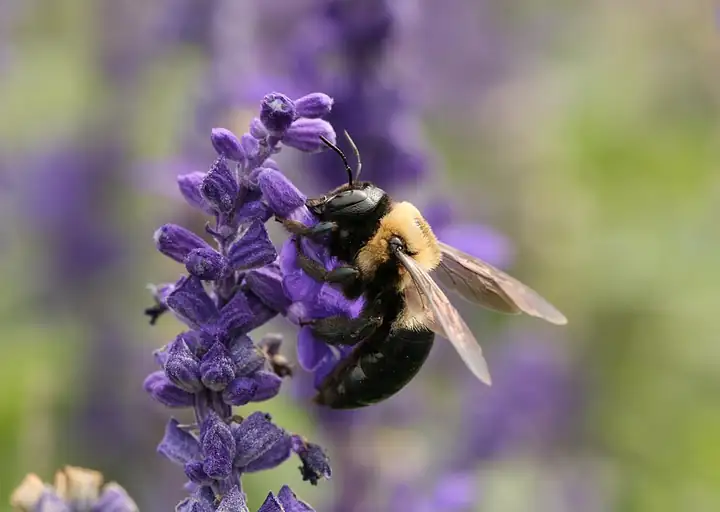
Carpenter bees
Large carpenter bees (Xylocopa), such as the eastern carpenter bee (X. virginica) and the valley carpenter bee (X. varipuncta) in the West; small carpenter bees (Ceratina) are tiny relatives
| Type | Insect |
|---|---|
| What it does | Pollinator |
| How common it is by region | Very common here: Northeast, Southeast, South Central, California |
About
Carpenter bees are big, bumble-bee-sized bees with a shiny, bare black abdomen that drill round holes in wood to nest. They pollinate many plants, but their tunnels can damage decks, eaves and fences over the years.
This one is already on your side. Broad sprays kill it along with the pest, which is why the guide puts sprays last.
What it eats
Adults feed on nectar and pollen and pollinate many crop and wild plants. They do not eat wood; they chew tunnels only to nest.
Spotting it
How to find it early
Look for large bees hovering near eaves, railings or decks and perfectly round, half-inch holes in unpainted wood, often with sawdust or stains below. Males have a pale or yellow face, and the male valley carpenter bee is golden brown.
Its young
Larvae grow in sealed cells stocked with pollen at the ends of tunnels inside wood.
When
Adults emerge in spring to mate and nest; new adults appear in late summer and overwinter in old tunnels
Easy to mistake for
- Bumble bees — Carpenter bees have a shiny, mostly hairless black abdomen and nest in wood; bumble bees have a fuzzy, striped abdomen and nest in the ground.
Bringing more of them in
Enjoy them on flowers, and steer them away from your house by painting or varnishing exposed wood and using hardwood where you can. Plug old holes in fall after the bees have left.
Worth knowing
Males hover and dart at people near nests, but they have no stinger. Females can sting but rarely do unless handled. Tunnels are reused and lengthened year after year, which can weaken wood, and woodpeckers may tear up wood to reach the larvae.
How common it is by region
| Northeast | Very common here |
|---|---|
| Southeast | Very common here |
| South Central | Very common here |
| Midwest | Common here |
| Great Plains | Occasional here |
| Mountain West | Occasional here |
| Southwest | Common here |
| Pacific Northwest | Occasional here |
| California | Very common here |
| Alaska | Not found here |
| Hawaii | Common here |
Sources
- extension.psu.edu
- ipm.ucanr.edu
- fieldreport.caes.uga.edu
- extension.okstate.edu
- ohioline.osu.edu
- extension.oregonstate.edu
Photo: Photo: Daniel Schwen / Wikimedia Commons, CC BY-SA 4.0 (CC BY-SA 4.0). Photo resized for the web.

Planting dates and advice are general guidance; check with your local Cooperative Extension office for your area.