
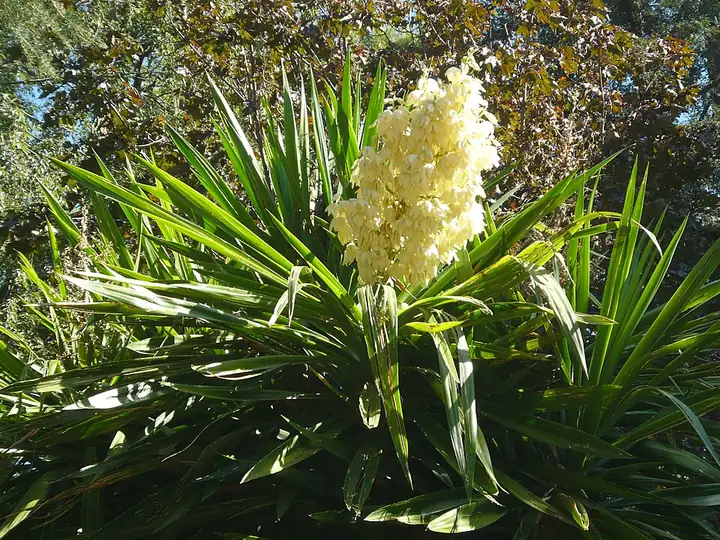
Yucca cane
Yucca gigantea (formerly Y. elephantipes and Y. guatemalensis) · Asparagus family (Asparagaceae)
When to plant: Any time of year, since it grows indoors. Repot only when roots fill the pot, about 1 inch bigger, in a heavy pot that will not tip.
| Hardiness zones | 10 to 12 |
|---|---|
| Sun | full sun |
| Water | low |
| Life cycle | perennial |
| Frost | Tender: killed by frost |
Will it grow in your window?
Pick the window it sits in. This is the same check Sow & Tell runs for every plant in your house.
It wants bright, direct light.
Pick a window above and this will tell you whether the spot suits it.
Watering: water when the top inch is dry — about every 7 days, stretching to every 12 from November to February.
Summering outside? Bring it in before nights drop below 50°F.
About Yucca cane
Yucca cane is the spineless yucca of central Mexico and Central America, sold as thick bare trunks topped with rosettes of stiff, soft-tipped sword leaves. Outdoors in Florida it grows into a 15-30 ft tree, but in a pot it stays compact for years and shrugs off dry air, missed waterings and a sunny window (NC State, UF/IFAS). The one way to lose it is to keep the mix wet.
Hardy outdoors in zones 10-12 (NC State; UF/IFAS says 9b-11); it is grown indoors everywhere and can summer outdoors in sun to part shade, moved out gradually, and should come back in when temperatures drop below 50 F (NC State).
When to plant
Any time of year, since it grows indoors. Repot only when roots fill the pot, about 1 inch bigger, in a heavy pot that will not tip.
Bought as a potted cane, or started from a stem cutting of any size or a sucker from the base, which root easily (NC State, UF/IFAS).
Growing it indoors
- Light: Give it the sunniest window you have, since it prefers full sun and only tolerates part shade (NC State, UF/IFAS); UGA rates it a high-light plant and MU Extension says 'bright'.
- Water: Water when the surface of the mix has dried (UGA), soaking the pot and letting it drain; it is drought tolerant and overwatering is its one real problem, so when in doubt wait, and cut back further in winter (NC State, UF/IFAS).
- Humidity: Dry indoor air is fine; UGA lists it as a low-humidity plant.
- Temperature: Thrives at 70-90 F and should come indoors when temperatures drop below 50 F; keep it away from cold drafts and sudden temperature swings (NC State).
- Feeding: Feed a water-soluble houseplant fertilizer monthly while it is putting out new leaves in spring and summer, at about a quarter of the label rate, and not at all in winter (MU Extension, UGA).
- Repotting: Repot only when the roots fill the pot or grow out the drainage hole, stepping up about 1 in in pot size in a heavy pot that won't tip (UGA, MU Extension).
- More plants: Stem cuttings of any size root easily, as do suckers that sprout from the base of the trunk; seed works too but is slow (NC State, UF/IFAS).
If something looks wrong
| What you see | Likely cause | What to do |
|---|---|---|
| Yellow lower leaves, soft trunk base, mix stays wet | Overwatering and root rot | Let the mix dry out, check the drainage hole, and repot in a grittier mix if the roots are brown and mushy; NC State and UF/IFAS call root rot its main disease. |
| Brown leaf tips | Salt buildup or dry mix left too long | Flush the pot with plain water until it runs out the bottom, tip out the saucer, and water on a steadier rhythm (MU Extension). |
| Pale, floppy new leaves and long gaps on the trunk | Too little light | Move it to a south or west window, turning the pot weekly so it grows straight (NC State, MU Extension). |
| Cottony tufts or brown bumps on leaf bases | Mealybugs or scale | Wipe them off with a cotton swab dipped in rubbing alcohol and wash the leaves; repeat weekly (NC State). |
Soil
A fast-draining mix, NC State suggests 1 part potting mix to 3 parts perlite or coarse sand, in a heavy pot with a drainage hole.
Pot in a fast-draining mix of about 1 part potting mix to 3 parts perlite or coarse sand in a heavy container with a drainage hole (NC State).
Feeding
- Spring and summer, while new leaves are coming: water-soluble houseplant fertilizer. Feed monthly at about a quarter of the label rate (UGA); MU Extension says monthly whenever the plant is producing new growth, after watering.
- Fall and winter: none. Don't feed while no new growth is showing (MU Extension).
Overwatering, not hunger, is its one real problem; feed lightly and let the mix dry (NC State, UF/IFAS).
Varieties (2)
NC State and UF/IFAS name two striped cultivars; most yucca canes are sold as the plain green species.
| Variety | Type | Zones | Notes |
|---|---|---|---|
| Marginata | Variegated | 10+typical for yucca cane | A narrow cream stripe down both leaf edges, small marginal teeth and soft tips. Sources: [1] |
| Variegata | Variegated | 10+typical for yucca cane | Pale green leaves 12-18 in long with broad cream stripes, soft and flexible; UF/IFAS says it is gaining popularity. Sources: [1][2] |
Pests to watch for
Diseases and problems
Root and crown rot, Leaf spots
In the kitchen
The creamy flowers are edible and go into salads in its native range (NC State, UF/IFAS), but a houseplant almost never blooms, and the leaves and roots are not edible.
Safety: Low severity (NC State): the leaves and roots carry saponins that can cause nausea, vomiting, diarrhea, headache and dizziness if eaten, and the sap can give a minor rash. The stiff leaf tips are soft, unlike garden yuccas, but keep the pot where nobody will walk into it.
Pets: Toxic to dogs, cats and horses (ASPCA, Yucca spp.): saponins cause vomiting in dogs and cats, and liver disease and dermatitis in horses.
Sources
Photo: Photo: Cillas, CC BY-SA 4.0, via Wikimedia Commons (CC BY-SA 4.0). Photo resized for the web.

Planting dates and advice are general guidance; check with your local Cooperative Extension office for your area.