
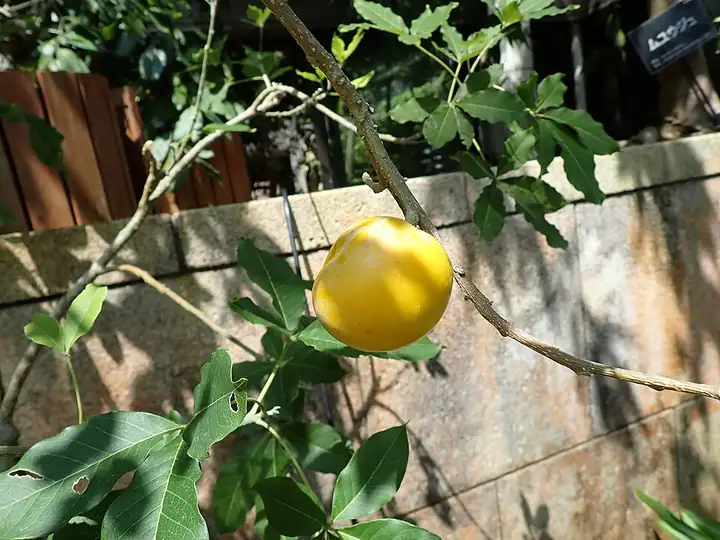
White sapote
Casimiroa edulis (also the woolly-leaf C. tetrameria and hybrids) · Citrus family (Rutaceae)
| Hardiness zones | 9 to 11 |
|---|---|
| Sun | full sun |
| Water | moderate |
| Life cycle | perennial |
| Frost | Half-hardy: takes a light frost |
| Soil pH | 5.5–7.5 |
| Spacing | 300 inches |
About White sapote
White sapote is a mostly evergreen tree from the highlands of central Mexico and Central America, grown for round, thin-skinned green to yellow fruit with sweet, smooth, custardy white flesh. It is grown in home yards in southern California and Florida and is a heavy bearer. Trees get big, and the fruit bruises so easily that it is seldom sold in stores, which makes it a true backyard fruit.
UC Cooperative Extension says it does well anywhere in California that oranges grow, north to Chico but not in the deserts; frost damage starts near 22 F and young trees can be hurt at 30 F. UF/IFAS says young trees are damaged or killed at 24 F and older trees at 26 F, and it fruits best where winters are cool or dry. The zone range is our estimate from those temperatures. The Hawaii-Pacific Weed Risk Assessment rates it low risk, and we found no U.S. invasive or noxious listing.
Planting
Plant a grafted tree in full sun in the warmest spot that doesn't flood, at least 25 ft from other trees, buildings and power lines (UF/IFAS). Grafted trees bear in 3-4 years; seedlings vary a lot and may take 7-8 years (UC Cooperative Extension; UF/IFAS). No source ties planting to a frost date.
Soil
Almost any well-drained soil, including sand, clay and limestone; avoid salty soil and spots that stay wet after summer rain (UF/IFAS; UC Cooperative Extension).
Don't add fertilizer, topsoil or compost to the planting hole; if you amend, mix it no more than half and half with the native soil, and plant on a 2-3 ft mound where water stands (UF/IFAS).
Feeding
- When new growth starts after planting, then every 6-8 weeks through the first year: Young-tree fertilizer such as 6-6-6-2 with minor elements. Start with about 1/4 lb per tree and work up gradually to 1/2, 3/4 and 1 lb per feeding as the tree grows; scatter it under the canopy and water in (UF/IFAS).
Look for: mostly nitrogen, in spring as growth starts. Spring feeding grows the new shoots and leaves that carry flowers and fruit; feeding after midsummer pushes soft growth that may not harden before winter. - April through September, each year: Micronutrient leaf spray with zinc, manganese, boron and molybdenum. Four to six sprays a year for young trees and two to three for bearing trees; follow the label (UF/IFAS).
Look for: mostly nitrogen, in spring as growth starts. Spring feeding grows the new shoots and leaves that carry flowers and fruit; feeding after midsummer pushes soft growth that may not harden before winter. - Bearing trees, 2-3 times a year: Fruit tree fertilizer with phosphate and potash, such as 6-6-6 or 8-3-9. About 2.5-5 lb per feeding for mature trees, spread evenly under the canopy (UF/IFAS); in California, regular nitrogen feedings work well and minor-nutrient shortages are treated as for citrus (UC Cooperative Extension).
Look for: mostly nitrogen, in spring as growth starts. Spring feeding grows the new shoots and leaves that carry flowers and fruit; feeding after midsummer pushes soft growth that may not harden before winter.
Don't overwater with timer-run sprinklers, which can rot the roots, and avoid heavy lawn fertilizing near the tree, which may cut fruiting (UF/IFAS); shallow watering makes surface roots (UC Cooperative Extension).
Harvest
Fruit ripens about 6-9 months after bloom, mostly October-November in California and spring-summer in Florida. Clip it with a bit of stem several days before it would drop, handle it gently, and let it soften at room temperature; underripe and overripe fruit both turn bitter (UC Cooperative Extension; UF/IFAS).
A main crop each year, mostly October-November in California and spring to summer in Florida; 'Suebelle' can bear year-round in California, and some varieties tend to crop heavily only every other year.
Varieties (18)
| Variety | Type | Season and days | Zones | Notes |
|---|---|---|---|---|
| Blumenthal | California selection | 9–11typical for white sapote | Fair to good flavor; creamy white flesh. Pale yellow fruit of about 5-6 oz. Sources: [1] | |
| Chestnut | California selection | 9–11typical for white sapote | Good flavor; the skin is bitter. Yellow-green fruit that can be picked early and ships well; tends to bear heavily every other year. Sources: [2] | |
| Denzler | California selection | 9–11typical for white sapote | Good flavor; yellow flesh. Large yellow fruit, about 11-13 oz. Sources: [1] | |
| Fiesta | California selection | 9–11typical for white sapote | Good flavor. Very small yellow fruit that handles well. Sources: [2] | |
| Lemon Gold | California selection | 9–11typical for white sapote | Excellent flavor. Yellow, average-size fruit that can be picked early. Sources: [2] | |
| May | California selection | 9–11typical for white sapote | Very good flavor. Medium green fruit that changes color very little as it ripens, so check softness. Sources: [2] | |
| McDill | California selection | 9–11typical for white sapote | Good to excellent flavor; creamy white flesh. Very large greenish-yellow fruit, about 12-16 oz. Sources: [1][2] | |
| Pike | California selection | 9–11typical for white sapote | Rich, good, non-bitter flesh; the skin is bitter. Green, medium-size fruit of about 8-9 oz; an older variety. Sources: [1][2] | |
| Reineke Commercial | California selection | 9–11typical for white sapote | Good flavor; yellow flesh. Large golden to orange fruit with few seeds that keeps well, but the tree bears lightly. Also spelled 'Reinikie' or 'Reonecke Commercial' in Extension guides. Sources: [1][2] | |
| Stickley | California selection | 9–11typical for white sapote | Good flavor, sweet even when picked early. Large yellow-green fruit. Sources: [2] | |
| Suebelle | California selection | Bears year-round in California | 9–11typical for white sapote | Excellent, sweet flavor. Small to medium yellow-green fruit on a small tree; UC calls it the best home variety. Also called 'Hubbell'. Sources: [1][2] |
| Vernon | California selection | 9–11typical for white sapote | Green, medium-size fruit that doesn't turn bitter when overripe; tends to bear every other year. Sources: [2] | |
| Yellow | California selection | 9–11typical for white sapote | Good flavor; pale yellow flesh. Bright yellow fruit, about 9-10 oz. Sources: [1] | |
| Cuccio | Florida selection | 9–11typical for white sapote | Excellent flavor. Light green, average-size fruit that holds well on the tree; bears early. Also called 'Florida'. Sources: [2] | |
| Dade | Florida selection | 9–11typical for white sapote | Good, non-bitter flavor; creamy white flesh. Golden-yellow fruit tinged green, about 6-7 oz. Sources: [1] | |
| Homestead | Florida selection | 9–11typical for white sapote | Good, non-bitter flavor; creamy white flesh. Yellow-green fruit, about 7 oz. Sources: [1] | |
| Smathers | Florida selection | 9–11typical for white sapote | Fair flavor; yellow flesh. Greenish-yellow fruit, about 8-9 oz. Sources: [1] | |
| Golden (Mac's Golden) | Woolly-leaf white sapote (C. tetrameria) | 9–11typical for white sapote | Strong, unusual flavor with some bitterness; some people dislike it. Yellow-green fruit of about 4-5 oz with few seeds. Sources: [1][2] |
Pests to watch for
Scale insects, Mealybugs, Aphids, Garden ants, Brown garden snail
Diseases and problems
In the kitchen
Eaten fresh with a spoon, or blended into milkshakes and desserts; cooking dulls its flavor (UF/IFAS; UC Cooperative Extension).
Keeping it: Let firm fruit soften at room temperature, then keep it in the refrigerator and use it within about 7-10 days; handle gently, because bruised flesh turns bitter.
Safety: The seeds are poisonous and should never be eaten (UF/IFAS); an older reference quoted in the Hawaii weed-risk assessment calls them possibly fatal if eaten raw. The seeds and leaves contain sedative compounds, so don't use them as a home remedy. We found no research-based guidance on pregnancy, drug interactions or allergies for the fruit.
Pets: Not listed by the ASPCA. Keep the poisonous seeds away from pets (UF/IFAS).
Sources
Photo: Photo: M108t, CC BY 4.0, via Wikimedia Commons (CC BY 4.0). Photo resized for the web.

Planting dates and advice are general guidance; check with your local Cooperative Extension office for your area.