
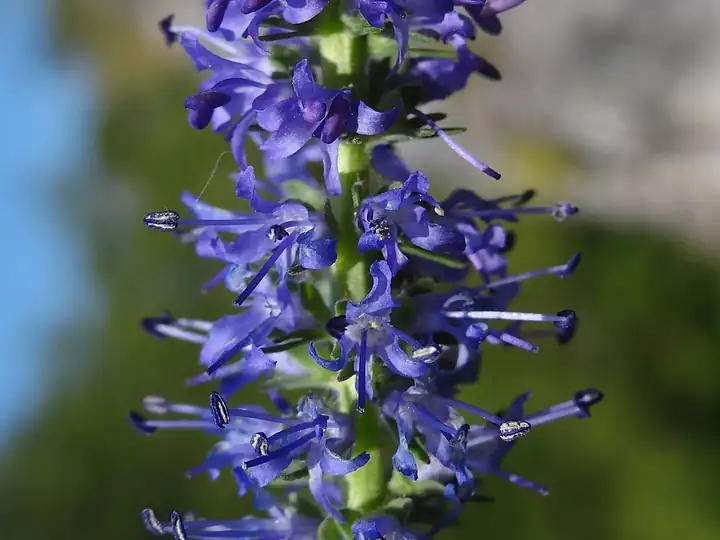
Veronica (speedwell)
Veronica spicata and other garden Veronica species · Plantain family (Plantaginaceae)
| Hardiness zones | 3 to 8 |
|---|---|
| Sun | full sun |
| Water | moderate |
| Life cycle | perennial |
| Frost | Hardy: takes frost |
| Spacing | 12 to 36 inches |
About Veronica (speedwell)
Garden speedwells make neat clumps with tall spikes of small blue, purple, pink or white flowers from late spring into summer, and some creeping kinds make low groundcovers. Bees and butterflies visit, and deer and rabbits leave them alone. A few other speedwells are lawn weeds, but the upright garden kinds are well-behaved.
Spike speedwell is hardy in zones 3-8; the genus runs to zone 9.
Planting
Grow from divisions, cuttings or seed; named cultivars need to be divided or grown from cuttings to stay true (NC State).
Soil
Moist, well-drained soil; roots can rot in soggy winter soil (NC State).
Follow a soil test; work 2-3 inches of compost into the top 4-6 inches of soil (Clemson).
Feeding
- early spring, before new growth starts: slow-release complete fertilizer such as 12-6-6. Scatter 1-2 lb per 100 sq ft and water it in (Clemson).
Look for: a balanced or all-purpose fertilizer at the label rate. Skip high-phosphorus "bloom boosters" unless a soil test shows low phosphorus: most garden soils already have enough, and the extra can wash into streams.
Wet winter soil can rot the roots (NC State).
Harvest
Blooms late spring to midsummer. Shear back to the leafy base after the first flush for another round of flowers in fall (NC State). The spikes make good cut flowers.
Varieties (7)
Extension sources we could open name only a few speedwell cultivars.
| Variety | Type | Season and days | Zones | Notes |
|---|---|---|---|---|
| Waterperry Blue | Creeping speedwell | Late April-May, with scattered later bloom | 4–8 | Low 4-6 in evergreen groundcover with lavender-blue, dark-veined flowers; tolerates foot traffic. Sources: [2][3] |
| Moody Blues Dark Blue ('Novaverblu') | Speedwell | 3–8typical for veronica | Dark blue flowers. Sources: [2] | |
| Icicle | Spike speedwell (V. spicata) | 3–8typical for veronica | White flower spikes. Sources: [1] | |
| Purpleicious | Spike speedwell (V. spicata) | 3–8typical for veronica | Purple flower spikes. Sources: [1] | |
| Rosea | Spike speedwell (V. spicata) | 3–8typical for veronica | Pink flower spikes. Sources: [1] | |
| Royal Candles | Spike speedwell (V. spicata) | 3–8typical for veronica | Compact plant with purple spikes. Sources: [1] | |
| Tickled Pink | Spike speedwell (V. spicata) | 3–8typical for veronica | Pink flower spikes. Sources: [1] |
Pests to watch for
Diseases and problems
In the kitchen
Pets: We found no ASPCA entry for veronica (speedwell), so we can't say it is pet-safe; discourage pets from chewing it.
Sources
- plants.ces.ncsu.edu
- plants.ces.ncsu.edu
- plants.ces.ncsu.edu
- aspca.org
- aspca.org
- aspca.org
- hgic.clemson.edu
Photo: Photo: Jerzy Opioła, CC BY-SA 4.0, via Wikimedia Commons (CC BY-SA 4.0). Photo resized for the web.

Planting dates and advice are general guidance; check with your local Cooperative Extension office for your area.