
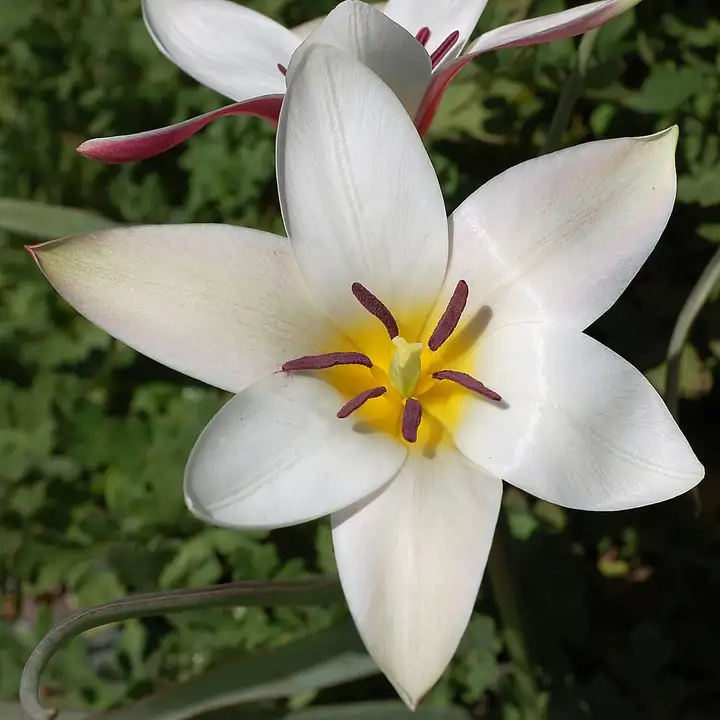
Tulip
Tulipa species and hybrids · Lily family (Liliaceae)
When to plant: Plant bulbs in fall once the soil has cooled below about 60 F: mid-September to mid-October in Minnesota, October in Iowa, and late December or early January in coastal South Carolina (UMN, Iowa State, Clemson).
| Hardiness zones | 3 to 8 |
|---|---|
| Sun | full sun |
| Water | moderate |
| Life cycle | perennial |
| Frost | Hardy: takes frost |
| Soil pH | 6.0–7.0 |
| Spacing | 4 to 6 inches |
About Tulip
Tulips are fall-planted bulbs that bloom in mid to late spring in almost every color except true blue. Big hybrid tulips usually bloom well for only a few years, so many gardeners treat them as annuals, while small species tulips come back more reliably. Deer and rabbits browse them, squirrels dig up new bulbs, and mice and voles eat the bulbs.
NC State lists zones 3-8; tulips need 12-16 weeks of winter cold, so in the warm South chill the bulbs in the fridge (away from fruit) until planting and expect one season of bloom (Clemson).
When to plant
Plant bulbs in fall once the soil has cooled below about 60 F: mid-September to mid-October in Minnesota, October in Iowa, and late December or early January in coastal South Carolina (UMN, Iowa State, Clemson).
Get them in early enough to root before the ground freezes (South Dakota State says 4-6 weeks before), and set them 6-8 inches deep, pointed end up.
Soil
Well-drained soil rich in organic matter; bulbs rot in wet ground, and species tulips handle heavy clay better than big hybrids (NC State, Iowa State, Wisconsin Extension).
Loosen well-drained soil about a foot deep and mix in 2-3 inches of compost; aim for pH 6-7 (Clemson, Penn State). If a soil test calls for it, Iowa State works in 2-3 lb of 5-10-5 or 3-4 lb of bone meal per 100 sq ft.
Feeding
- Early spring, when shoots come up (bulbs you plan to keep for years): balanced fertilizer such as 10-10-10. Clemson suggests 1-2 lb per 100 sq ft, given each fall and again as shoots appear; Illinois uses about 5 Tbsp per 10 sq ft. Follow a soil test and water it in.
Look for: a balanced or all-purpose fertilizer at the label rate. Skip high-phosphorus "bloom boosters" unless a soil test shows low phosphorus: most garden soils already have enough, and the extra can wash into streams. - Right after the flowers fade: fertilizer such as 5-10-5. Iowa State applies 2-3 lb per 100 sq ft after bloom while the leaves are still green; Rutgers and Illinois advise against feeding once flowering has started, so keep it light.
Look for: a balanced or all-purpose fertilizer at the label rate. Skip high-phosphorus "bloom boosters" unless a soil test shows low phosphorus: most garden soils already have enough, and the extra can wash into streams.
Don't cut, braid or tie up leaves until they turn brown, and don't bother feeding after the leaves die back, since the bulb can't use it then (Iowa State, Colorado State). Extra nitrogen and wet leaves encourage botrytis blight (Utah State).
Harvest
Tulips bloom from early April to late May, depending on the type (Iowa State). Snap off faded flowers so the plant doesn't make seed, but leave the leaves until they turn yellow-brown, about six weeks (Clemson). They make good cut flowers (NC State).
Varieties (23)
| Variety | Type | Season and days | Zones | Notes |
|---|---|---|---|---|
| Apeldoorn | Darwin Hybrid tulip | Midspring | 3–8typical for tulip | Red flowers. Sources: [2] |
| Daydream | Darwin Hybrid tulip | Midspring | 3–8typical for tulip | Orange and yellow flowers. Sources: [2] |
| Golden Apeldoorn | Darwin Hybrid tulip | Midspring | 3–8typical for tulip | Yellow flowers. On Utah State's list of tulips that rebloom for several years in cold climates. Sources: [2][7] |
| Olympic Flame | Darwin Hybrid tulip | Midspring | 3–8typical for tulip | Red flowers streaked with yellow. Sources: [2] |
| Parade | Darwin Hybrid tulip | Midspring | 3–8typical for tulip | Dark red with a black base edged in yellow. On Utah State's list of tulips that rebloom for several years in cold climates. Sources: [2][7] |
| Orange Emperor | Fosteriana tulip | Early spring | 3–8 | Orange flowers on 6-20 inch stems. On Utah State's list of tulips that rebloom for several years in cold climates. Sources: [7][15] |
| Red Emperor | Fosteriana tulip | Early spring | 3–8 | Poppy-like red flowers. Sources: [15] |
| Red Riding Hood | Greigii tulip | Early spring | 4–7 | Bright scarlet with a small black heart; purple-streaked leaves. Sources: [16] |
| Toronto | Greigii tulip | Early spring | 4–7 | Pink flowers over leaves streaked purple-maroon. On Utah State's list of tulips that rebloom for several years in cold climates. Sources: [7][16] |
| Ancilla | Kaufmanniana (waterlily) tulip | Early spring | 3–8 | Creamy white with a red ring inside. Sources: [17] |
| Showwinner | Kaufmanniana (waterlily) tulip | Early spring | 3–8 | Bright red flowers on short stems. On Utah State's list of tulips that rebloom for several years in cold climates. Sources: [7][17] |
| Cynthia | Lady tulip (Tulipa clusiana) | March-April | 3–7 | Pale yellow with pink-to-red edged outer petals and bluish leaves. Sources: [18] |
| Peppermint Stick | Lady tulip (Tulipa clusiana) | March-April | 3–7 | Petals alternate bright pink and white; 9-12 inches tall; naturalizes easily. Sources: [18] |
| Tinka | Lady tulip (Tulipa clusiana) | March-April | 3–7 | Yellow inside, red on the outer petals. Sources: [18] |
| Marilyn | Lily-flowered tulip | Late spring | 3–8typical for tulip | White flowers streaked rosy pink. Sources: [2] |
| West Point | Lily-flowered tulip | Late spring | 3–8typical for tulip | Yellow flowers with pointed petals. Sources: [2] |
| White Triumphator | Lily-flowered tulip | Late spring | 3–8typical for tulip | White flowers with pointed petals. Sources: [2] |
| Halcro | Single Late tulip | Late spring | 3–8typical for tulip | Bright red flowers. Sources: [2] |
| Maureen | Single Late tulip | Late spring | 3–8typical for tulip | Pure white flowers. Sources: [2] |
| Menton | Single Late tulip | Late spring | 3–8typical for tulip | Apricot-pink outside with a poppy-red inside. Sources: [2] |
| Queen of Night | Single Late tulip | Late spring | 3–8typical for tulip | Very dark maroon, nearly black flowers. Sources: [2] |
| Temple of Beauty | Single Late tulip | Late spring | 3–8typical for tulip | Salmon-rose flowers. Sources: [2] |
| Lilac Wonder | Species tulip (Tulipa bakeri) | Spring | 3–8typical for tulip | Small, star-like lilac-pink flowers with a yellow heart. Utah State says it can be slow to bloom or hurt by frost in cold climates. Sources: [2][7] |
Pests to watch for
Aphids, Slugs, Brown garden snail, Deer, Rabbits, Tree squirrels, Voles, Eriophyid mites (rust, bud, blister and gall mites), Chipmunks, Narcissus bulb fly
Diseases and problems
Gray mold (Botrytis), Mosaic viruses, Bulb rot
In the kitchen
NC State says tulip petals are edible, with a mild taste like lettuce, peas or cucumber. The bulbs are toxic; people ate them only in wartime famine.
Safety: All parts can upset the stomach if eaten, and the bulbs have the most toxin. Handling bulbs can cause an itchy, tingling skin rash in some people, so wear gloves (NC State).
Pets: Toxic to dogs, cats and horses (ASPCA): tulipalin can cause vomiting, drooling, diarrhea and depression, and the bulb is the most toxic part.
Sources
- plants.ces.ncsu.edu
- hgic.clemson.edu
- yardandgarden.extension.iastate.edu
- extension.umn.edu
- extension.sdstate.edu
- hort.extension.wisc.edu
- extension.usu.edu
- njaes.rutgers.edu
- extension.missouri.edu
- aspca.org
- aspca.org
- extension.psu.edu
- extension.illinois.edu
- extension.colostate.edu
- plants.ces.ncsu.edu
- plants.ces.ncsu.edu
- plants.ces.ncsu.edu
- plants.ces.ncsu.edu
Photo: Photo: Derek Ramsey (Ram-Man), CC BY-SA 3.0, via Wikimedia Commons (CC BY-SA 3.0). Photo resized for the web.

Planting dates and advice are general guidance; check with your local Cooperative Extension office for your area.