
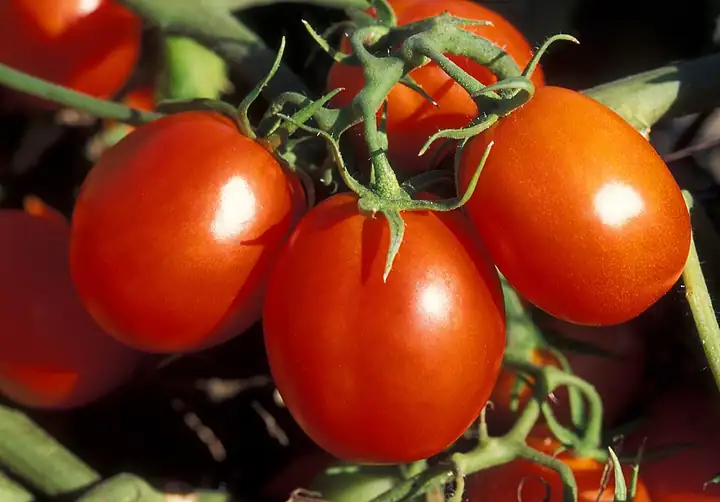
Tomato
Solanum lycopersicum · Nightshade family (Solanaceae)
When to plant: Start seeds indoors 6 to 8 weeks before the last frost and set out plants 1 to 2 weeks after the last frost.
| Hardiness zones | 3 to 11 |
|---|---|
| Sun | full sun |
| Water | moderate |
| Life cycle | tender perennial (grown as an annual) |
| Frost | Tender: killed by frost |
| Soil pH | 6.0–6.5 |
| Spacing | 24 to 36 inches |
| Days to harvest | 52 to 90 days |
| Soil temperature to plant | at least 50°F |
About Tomato
Tomatoes are the most popular home-garden vegetable, grown for fruit that tastes far better vine-ripened than store-bought. Bush (determinate) types stay 2 to 3 feet tall and ripen their crop over a few weeks, while vining (indeterminate) types keep growing and bearing until frost.
Grown as a warm-season annual in every zone; it is killed by frost, so plant it out after the danger of frost has passed.
When to plant
Timing is counted from your average last spring frost (and first fall frost). Sow & Tell works out the actual dates for your ZIP code.
- Start seeds indoors: 6 to 8 weeks before the last frost
- Set out plants: 1 to 2 weeks after the last frost
Days to harvest count from setting out transplants (52 to 90 days depending on variety). Stake or cage plants when you set them out, and give them about an inch of water a week.
Soil
Well-drained soil improved with compost, in a spot where tomatoes and their relatives have not grown for 3 to 4 years.
Follow a soil test; aim for pH 6.0 to 6.5, work in compost or composted manure, and till any pre-plant fertilizer about 6 inches into the soil.
Feeding
- 3 to 4 weeks after setting out transplants: nitrogen fertilizer such as calcium nitrate (15.5-0-0). Spread about 1 lb per 100 sq ft (about 30 ft of row) 4 to 6 inches from the stems and water it in; on sandy soil split it into two feedings 3 to 4 weeks apart.
Look for: nitrogen, in a light feeding. Early on the plant needs leaves to feed its fruit later, but too much nitrogen makes a big leafy plant that is slow to flower. Later, when flowers open and the first small fruits form, switch to a lower-nitrogen fertilizer such as 5-10-15 or 6-12-12. - when the first fruits start to grow: a lower-nitrogen fertilizer such as 5-10-15 or 6-12-12. Use the bag's rate for vegetables, scatter it beside the plants (not against the stems) and water it in.
Look for: lower nitrogen, more phosphorus and potassium, such as 5-10-15 or 6-12-12. Now the plant should put its energy into flowers and fruit. Extra nitrogen at this stage grows leaves instead and can make blossoms drop; phosphorus helps only if your soil is short of it (a soil test tells you).
Too much nitrogen makes big leafy plants that are slow to fruit; skip extra phosphorus unless a soil test calls for it, and never use weed-and-feed products.
Harvest
Pick when fruit has full color but is still firm. Fruit picked at the first blush of color will finish ripening indoors with good flavor, which helps avoid cracking and pests.
Indeterminate (vining) tomatoes keep flowering and ripening fruit until cold weather; determinate (bush) types ripen a set crop over 4 to 6 weeks and then stop. When frost threatens, bring in fruit that is full-size or starting to turn white or pink to ripen indoors.
Varieties (60)
| Variety | Type | Season and days | Notes |
|---|---|---|---|
| Sungold | Cherry (hybrid) | Early · 57 days | Very sweet, tangerine-orange cherries. Strong indeterminate vines. Resistant to Fusarium wilt and tomato/tobacco mosaic virus; some sources also list V. Often spelled 'Sun Gold'. Sources: [2][11][12][13][14][15] |
| Supersweet 100 | Cherry (hybrid) | Early-midseason · 65 to 70 days | Small, very sweet red cherries. Indeterminate vines bear long, branched clusters of half-inch fruit all summer. Resistant to V and F; UF also lists nematode resistance. An improved version of the older 'Sweet 100'. Sources: [2][11][12][16][17][18] |
| Sweet Baby Girl | Cherry (hybrid) | 65 days | Sweet, dark red cherries. Long clusters of small fruit. Resistant to tobacco mosaic virus. Sources: [17][19][20] |
| Sweet 100 | Cherry (indeterminate hybrid) | 60 to 65 days | Vigorous vines bear large clusters of 1-inch round red cherries. The older parent of Supersweet 100. Florida notes it sets fruit in the heat. Sources: [18][21][22][23][24] |
| Black Cherry | Cherry (indeterminate) | 64 to 75 days | Small, deep dark red cherries on vigorous vines that need a tall cage. No disease resistance noted by Clemson. Sources: [2][12][21] |
| Matt's Wild Cherry | Cherry (wild-type) | Early · 60 days | Top taste score among varieties in Cornell's late blight trials. Indeterminate vines with tiny red cherries. Tolerant of early and late blight. Gave outstanding late blight control in Cornell trials. Sources: [2][25] |
| SunSugar | Cherry, orange (hybrid) | 62 days | Kansas State rates the flavor excellent. Orange-yellow cherry on indeterminate vines. Resistant to F and TMV; fruit can crack. Maryland lists it among heat-tolerant hybrids. Sources: [13][14][26][27][28] |
| Jolly | Cherry, pink (hybrid) | 70 to 75 days | Georgia Extension calls the fruit juicy and sweet. Pink, slightly pear-shaped fruit about 1.5 ounces, borne in big clusters. 2001 All-America Selections winner. Sources: [17][29] |
| Sweet Treats | Cherry, pink (indeterminate) | 65 days | Known for sweetness; Florida calls the flavor outstanding. Deep pink cherries in grape-like clusters; firm and crack resistant. Resistant to F, ToMV and leaf mold, with some resistance to gray leaf spot. Sources: [12][13][30] |
| Mountain Magic | Cocktail / campari-type (hybrid) | Very good flavor; scored among the highest for taste in Cornell trials. Compact indeterminate plant with small, round, crack-resistant red fruit and long shelf life. High late blight resistance, moderate early blight resistance, plus F (races 1-2) and V. Bred at NC State University; suited to organic as well as conventional growing. Sources: [13][25][31] | |
| Patio | Compact container slicer (hybrid) | 70 days | Compact plant with dark green, crinkled leaves and fruit of about 4 ounces. Easy to grow in pots, containers and small gardens. Sources: [30] |
| Mountain Majesty | Determinate beefsteak (hybrid) | 78 days | Large-fruited NC State hybrid with improved color. Resistant to TSWV, V, Fusarium (races 1 and 2) and early blight. Released by North Carolina State University. Sources: [2][32] |
| Plum Crimson | Determinate paste (hybrid) | 80 days | Red paste tomato. Kentucky lists resistance to viruses, Fusarium (races 1 to 3) and early blight. Sources: [13][14][29] |
| Amelia | Determinate slicer (hybrid) | Midseason · 75 days | Large to extra-large red fruit. Resistant to tomato spotted wilt virus (TSWV) plus V and several Fusarium races. A good pick in the Southeast where TSWV is common. Sources: [2][13][14][17][18] |
| Bella Rosa | Determinate slicer (hybrid) | 75 days | Good-sized, attractive red fruit. Resistant to V, F, nematodes and Alternaria; Florida lists TSWV resistance. Texas trial gardeners found it no more heat tolerant than other varieties on their list. Sources: [11][20] |
| BHN 444 (Southern Star) | Determinate slicer (hybrid) | 75 days | Georgia Extension notes it is not as flavorful as older varieties. Smooth, red, globe-shaped fruit. Resistant to V, F and tomato spotted wilt virus (TSWV). Sometimes sold as 'Southern Star'. Florida Extension recommends it where TSWV is a problem. Sources: [17][19][20] |
| BHN 640 | Determinate slicer (hybrid) | 75 days | Builds on BHN 444 and adds tolerance to a third race of Fusarium wilt. Resistant to V, F and TSWV. Sources: [17][19][20] |
| Bush Celebrity | Determinate slicer (hybrid) | 67 days | A more compact version of Celebrity with the same size fruit. Resistant to V, F (races 1 and 2), N, T and A. Sources: [17][33] |
| Celebrity | Determinate slicer (hybrid) | Midseason · 70 to 72 days | Firm, flavorful red fruit; some Texas trial gardeners found it less sweet than other slicers. Bushy plant with 7- to 12-ounce red globes. Broad disease package (V, F, N, T; also Alternaria stem canker). 1984 All-America Selections winner. Texas A&M calls it semi-determinate; a reliable performer in trials. Sources: [2][11][16][17][30] |
| Defiant PhR | Determinate slicer (hybrid) | Midseason | Small to medium red slicer. Resistant to late blight, early blight, V and F. Gave excellent late blight suppression and the highest yield among red slicers in Cornell's trials. Sources: [13][15][25] |
| Mountain Fresh Plus | Determinate slicer (hybrid) | Mid-late season · 78 to 79 days | West Virginia Extension describes the fruit as sweet, firm, smooth and flavorful. Smooth, firm 8- to 12-ounce red fruit with good leaf cover against sunscald. Resistant to V, F and nematodes. Can be grown as a bush or staked. Sources: [13][14][18][27][30] |
| Mountain Merit | Determinate slicer (hybrid) | Midseason to late | Large (about 10-ounce) deep red, flattened-globe fruit that resists cracking. Resistant to late blight (Ph-2, Ph-3), TSWV, V, F races 1-3 and root-knot nematode. Released by NC State University (2010). Cornell trials found it strongly suppressed late blight. Sources: [13][25][32][34] |
| Mountain Pride | Determinate slicer (hybrid) | 77 days | Medium to large, slightly flattened deep red fruit averaging about 7 ounces. Resistant to Fusarium (races 1 and 2), V, Alternaria stem canker and gray leaf spot. Sources: [17][19][24][33] |
| Mountain Spring | Determinate slicer (hybrid) | Midseason · 72 days | Bright red fruit of 8 to 10 ounces, red all the way through. Resistant to V and F; resists cracking and blossom-end rot. Sources: [13][14][17][26][33] |
| Red Deuce | Determinate slicer (hybrid) | Midseason · 72 to 75 days | Missouri Extension notes good size, flavor and appearance. High-yielding, globe-shaped red fruit. Resistant to V, F and tobacco mosaic; Mississippi also lists TSWV, gray leaf spot and Alternaria stem canker. Popular with commercial growers. Sources: [13][16][18][27] |
| Carolina Gold | Determinate slicer, yellow (hybrid) | Midseason · 72 to 75 days | Orange-yellow beefsteak-type fruit. Resistant to V and F (races 1 and 2). Sources: [2][13][14][29] |
| Oregon Spring | Early determinate slicer | 52 days | Determinate slicing tomato that ripens very early. Recommended for Utah and Wisconsin gardens. Sources: [22][33] |
| Bush Early Girl | Early determinate slicer (hybrid) | 54 days | Compact bush form of Early Girl with fruit a bit larger than the original. Resistant to V, F and nematodes (Georgia also lists T). Good for small gardens; Georgia calls it the 'little sister' of Early Girl. Sources: [11][17][27][33] |
| Stupice | Early heirloom (indeterminate) | 60 to 65 days | Early-ripening heirloom on indeterminate vines. NDSU recommends it among heirlooms for North Dakota. Sources: [21][27] |
| Early Girl | Early indeterminate slicer (hybrid) | Early · 52 to 60 days | Medium red fruit of 4 to 6 ounces on vining plants. Resistant to V and F. One of the earliest slicers; a compact 'Bush Early Girl' (about 54 days) is also sold for small spaces. Sources: [2][11][16][17][30] |
| Cupid | Grape | 71 days | Red grape tomato. Resistant to Alternaria stem canker and Fusarium; Kentucky also lists Stemphylium (gray leaf spot). Sources: [13][29] |
| Juliet | Grape / mini-plum (hybrid) | Early · 60 days | Sweet, elongated fruit that resists cracking. Vigorous indeterminate vines need strong support. Fruit about 1 ounce, roughly twice the size of a typical grape tomato. 1999 All-America Selections winner. Some lists show blight resistance, but Cornell used it as the susceptible check in late blight trials, where it was badly infected. Sources: [11][12][13][17][25] |
| Florida 91 | Heat-tolerant determinate slicer (hybrid) | Mid-late season | Red, heat-tolerant slicer. Resistant to V, F, Alternaria stem canker and gray leaf spot. Sources: [13][14][28] |
| Heat Wave II | Heat-tolerant slicer | Heat-tolerant slicing tomato for summer planting in hot climates. Florida Extension suggests it for the hotter months. Oklahoma and North Texas list a 'Heatwave' (resistant to V and F; North Texas also lists it for fall). Sources: [20][23][24][35] | |
| Porter | Heat-tolerant, small-fruited (open-pollinated) | Open-pollinated, heat-tolerant indeterminate; North Texas lists it among small-fruited tomatoes. A Texas favorite; Texas A&M lists the 'Porter Improved' selection at about 78 days. Sources: [26][28][35] | |
| Jaune Flammé | Heirloom (indeterminate) | 70 to 85 days | Indeterminate heirloom that Texas A&M lists among standard-size tomatoes for Central Texas. Sources: [21] |
| Mortgage Lifter | Heirloom beefsteak (pink) | Late · 80 days | Excellent flavor. Indeterminate vines with large pink-red fruit. West Virginia heirloom. Mulch and even watering help prevent cracking. Sources: [13][14][30] |
| Brandywine | Heirloom beefsteak (pink, potato-leaf) | Late · 78 to 100 days | Rich, full tomato flavor; Arkansas Extension calls it one of the best-tasting tomatoes. Indeterminate plant with coarse, potato-like leaves. Large, meaty pink fruit up to about a pound. No listed disease resistance. Low, uneven yields; prone to cracking, catfacing and green shoulders. Dates to an 1886 seed listing and was revived through Seed Savers Exchange in 1982. Sources: [2][13][26][30][36] |
| Cherokee Purple | Heirloom beefsteak (purple) | Midseason · 72 to 90 days | Sweet, rich and juicy, with deep red-brown flesh. Indeterminate vine with dusky purple-rose, often lobed fruit and green shoulders. Tolerates mid-South heat and humidity. Tennessee heirloom introduced to seed exchanges in 1993. Yields can be light and fruit may crack; too vigorous for containers. Sources: [2][11][13][14][37] |
| Kellogg's Breakfast | Heirloom beefsteak, yellow (indeterminate) | 85 days | West Virginia Extension describes it as very sweet. Large yellow beefsteak-type heirloom with good yield and disease tolerance. Sources: [30] |
| Yellow Pear | Heirloom cherry (pear-shaped) | Late | Mild flavor. Vigorous indeterminate vines with small yellow pear-shaped fruit. Keeps producing through summer. Sources: [12][13] |
| Rutgers | Heirloom slicer / canning | Midseason · 75 to 82 days | Deep red, juicy fruit with good flavor. Resistant to V, F and Alternaria stem canker. Clemson lists it as indeterminate; UGA lists it as determinate. An old canning favorite; less disease resistant than newer hybrids. Sources: [2][15][17] |
| Green Zebra | Heirloom slicer, green-striped (indeterminate) | Midseason | Medium globe fruit, yellow-gold with dark green stripes when ripe. Recommended heirloom for Florida gardens. Sources: [13][20][23] |
| Black Krim | Heirloom slicer, purple (indeterminate) | 75 days | Dark red-purple fruit; Kansas State says it yields more than most heirlooms. Recommended by Texas Master Gardeners. Sources: [11][14][21][33] |
| Costoluto Fiorentino | Heirloom, ribbed (indeterminate) | 83 days | Deeply lobed, ribbed red fruit on big plants; fruit size shrinks as the season goes on. Texas trial gardeners found it as heat tolerant as any heat-tolerant tomato and suggest it for stuffing. Sources: [11] |
| Beefmaster | Indeterminate beefsteak (hybrid) | Late · 80 days | Solid, meaty and flavorful. Red fruit can reach 2 pounds. Resistant to V, F and root-knot nematode. Sources: [17] |
| Big Beef | Indeterminate beefsteak (hybrid) | Midseason · 70 to 75 days | Smooth red beefsteaks of 10 to 12 ounces. Wide disease package including V, F (races 1-3), N, ToMV and gray leaf spot. 1994 All-America Selections winner. Texas A&M notes it keeps producing in heat when others stop; vines get tall. Sources: [2][11][16][17][18][30] |
| Big Boy | Indeterminate beefsteak (hybrid) | Midseason · 78 days | Meaty fruit with long-favored flavor. Very large, smooth scarlet fruit on vining plants. Sources: [17] |
| Supersauce | Indeterminate paste (hybrid) | Giant pear-shaped paste fruit that can reach 2 pounds. Georgia Extension recommends it for sauce. Sources: [17][19] | |
| Better Boy | Indeterminate slicer (hybrid) | Midseason · 70 to 75 days | Smooth, bright red, flavorful fruit. Vigorous vines with large globes of about 8 to 16 ounces. Resistant to V, F and root-knot nematode (VFN). Sources: [2][11][16][17][26] |
| Jet Star | Indeterminate slicer (hybrid) | Meaty, flavorful and relatively low in acid. About 8-ounce, crack-resistant red fruit. Resistant to V and F. Sources: [14][15][16] | |
| Lemon Boy | Indeterminate slicer, yellow (hybrid) | Midseason · 72 days | Firm, light yellow fruit of 6 to 7 ounces. Resistant to V, F and root-knot nematode. Sources: [13][16] |
| Amish Paste | Paste (heirloom) | Late · 85 days | Bright red, heart-shaped paste fruit that is meaty and juicy with few seeds. A classic choice for sauce and paste. Sources: [30] |
| Granadero | Paste / plum | 75 days | Plump, oval, meaty Roma-type fruit. Resistant to ToMV, Fusarium (races 1 and 2), V and TSWV. Top-rated paste tomato in NDSU's 2023 home garden trial: earlier and higher yields than San Marzano. Clemson spells it 'Grandero'. Sources: [2][27][38] |
| Mariana | Paste / plum | 74 days | Red plum tomato. Resistant to V, F, nematodes and Alternaria stem canker; Clemson also lists Stemphylium. Clemson lists it as indeterminate; Maryland lists it as determinate. Sources: [2][13] |
| Roma | Paste / plum | Midseason · 75 to 80 days | Bush-type (determinate) plant with red, egg-shaped paste fruit. The 'Roma VF' strain carries Verticillium and Fusarium resistance. Classic sauce tomato; Kansas State describes Roma VF as semi-determinate. Sources: [2][14][26][39] |
| San Marzano | Paste / plum (heirloom) | Midseason · 80 days | Indeterminate vines with long, bright red fruit, slimmer than Roma with a pointed tip. No listed disease resistance. A traditional sauce tomato. Sources: [2][30] |
| Plum Dandy | Paste / plum (hybrid) | 76 days | Red Roma-type fruit. Resistant to V and F; Kentucky also lists early blight. Kentucky and Maryland list it as determinate; Kansas lists it as indeterminate. Sources: [13][14][29] |
| Plum Regal | Paste / plum (hybrid) | Midseason · 75 days | Determinate plant with red plum fruit. Resistant to late blight, early blight, TSWV, V and F. Bred at NC State University. It carries only one late blight gene (Ph-3), so Cornell saw more blight on it than on two-gene varieties. Sources: [2][13][25][32] |
| Iron Lady | Slicer (hybrid) | Red slicer carrying two late blight genes (Ph-2, Ph-3) plus resistance to early blight and Septoria leaf spot. Came out of Cornell's breeding program; flavor scored lower than other blight-resistant types in 2013 taste tests. Sources: [15][25] |
Good neighbors
Basil, Marigold, Lettuce, Spinach
UMN Extension says only a few studies suggest basil and marigolds help with thrips on tomatoes; tucking early lettuce or spinach around young plants is mainly a way to save space.
Pests to watch for
Tomato hornworm, Aphids, Flea beetles, Colorado potato beetle, Cutworms, Stink bugs, Root-knot nematodes, Corn earworm (tomato fruitworm), Cabbage looper, Whiteflies, Thrips, Leafminers, Slugs, Brown garden snail, Harlequin bug, Tarnished plant bug, Eriophyid mites (rust, bud, blister and gall mites), Mole crickets, Mice (house mice and deer mice), Chipmunks, Potato psyllid (tomato psyllid), Broad mite, Tomato pinworm, Beet armyworm, European corn borer, Pepper maggot, Leaffooted bugs, Fungus gnats, Blister beetles, Voles, Groundhog (woodchuck), Tree squirrels
Diseases and problems
Early blight, Septoria leaf spot, Late blight, Bacterial spot, Fusarium wilt, Verticillium wilt, Tomato spotted wilt virus, Blossom end rot, Heat stress (blossom drop), Edema (oedema), Transplant shock, Too little light (leggy plants), Leaf sunburn, Catfacing, Blotchy ripening and yellow shoulders, Phosphorus deficiency, Magnesium deficiency, Black walnut toxicity, Ozone injury, Sunscald, Fruit cracking, Nutrient deficiency, Herbicide injury, Frost and freeze injury, Tomato yellow leaf curl, Bacterial canker of tomato, Mosaic viruses, Powdery mildew, Bacterial wilt, Anthracnose, Gray mold (Botrytis), Damping-off, White mold, Southern blight, Root and crown rot, Sooty mold, Tomato brown rugose fruit virus, Tobacco mosaic and tomato mosaic, Cucumber mosaic, Impatiens necrotic spot, Curly top, Potato virus Y, Tomato and tobacco ringspot, Alfalfa mosaic
In the kitchen
Eaten fresh in salads and sandwiches, or cooked down into sauces, soups and salsas.
Keeping it: Keep ripe tomatoes on the counter out of direct sun and use them within about 5 days; the fridge dulls their flavor and texture. Let fruit picked at first blush finish ripening on the counter.
Safety: Only the ripe fruit is eaten. The leaves and stems contain the alkaloids tomatine and solanine and can cause stomach upset if eaten in large amounts, though real poisonings are extremely rare (NC State).
Pets: Toxic to dogs, cats and horses (ASPCA): the green parts contain solanine and can cause drooling, severe stomach upset, weakness and a slow heart rate; ripe fruit is non-toxic.
Sources
- extension.umn.edu
- hgic.clemson.edu
- extension.unh.edu
- extension.colostate.edu
- extension.umn.edu
- aspca.org
- extension.psu.edu
- plants.ces.ncsu.edu
- hgic.clemson.edu
- extension.oregonstate.edu
- agrilifeextension.tamu.edu
- gardeningsolutions.ifas.ufl.edu
- extension.umd.edu
- bookstore.ksre.ksu.edu
- vegetables.cornell.edu
- extension.missouri.edu
- fieldreport.caes.uga.edu
- extension.msstate.edu
- fieldreport.caes.uga.edu
- ask.ifas.ufl.edu
- agrilifeextension.tamu.edu
- extension.usu.edu
- gardeningsolutions.ifas.ufl.edu
- extension.okstate.edu
- vegetables.cornell.edu
- agrilifeextension.tamu.edu
- ndsu.edu
- marylandgrows.umd.edu
- publications.mgcafe.uky.edu
- extension.wvu.edu
- plantbreeding.ncsu.edu
- plantbreeding.ncsu.edu
- florence.extension.wisc.edu
- vegetables.ces.ncsu.edu
- agrilife.org
- uaex.uada.edu
- uaex.uada.edu
- ndsu.edu
- extension.umn.edu
Photo: Photo: Penny Greb, USDA ARS, Public domain (USDA ARS), via Wikimedia Commons. Photo resized for the web.

Planting dates and advice are general guidance; check with your local Cooperative Extension office for your area.