
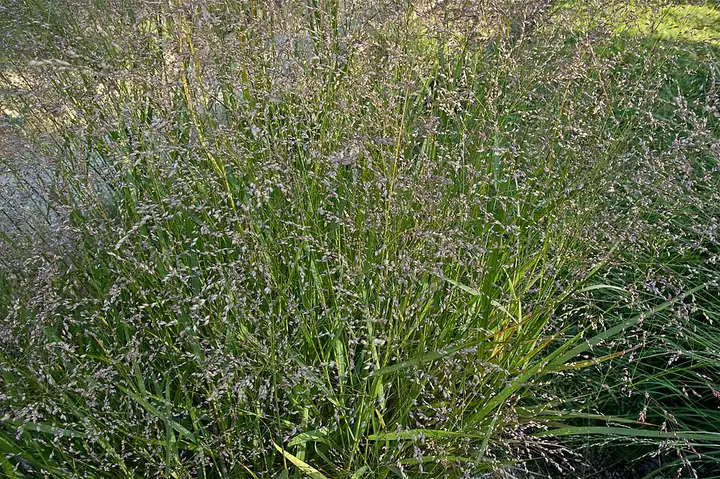
Switchgrass
Panicum virgatum · Grass family (Poaceae)
When to plant: Plant warm-season grasses like this in spring, with the crown even with the soil surface (Clemson).
| Hardiness zones | 4 to 9 |
|---|---|
| Sun | full sun |
| Water | moderate |
| Life cycle | perennial |
| Frost | Hardy: takes frost |
| Soil temperature to plant | at least 60°F |
About Switchgrass
Switchgrass is a native tallgrass-prairie grass that makes upright clumps with airy, see-through seed heads in late summer. Ornamental kinds have blue, red-tipped or burgundy leaves and gold to red fall color (NC State). It feeds songbirds in winter and hosts skipper butterflies, and it reseeds a little but is not invasive (Clemson).
NC State lists zones 5-9, but it is native across most of North America up into Canada and is hardy to zone 4 or colder.
When to plant
Plant warm-season grasses like this in spring, with the crown even with the soil surface (Clemson).
From seed, USDA NRCS says spring seeding works best once the soil reaches about 60 F. In shade it gets floppy.
Soil
Adaptable: clay or sand, moist to wet, and it handles drought, flooding, air pollution and some salt once settled (NC State, Clemson).
No special prep; set the crown even with the soil surface (Clemson).
Feeding
- Spring, only if a soil test shows a need: fertilizer only as a soil test recommends. Most ornamental grasses need very little fertilizer; base any feeding on a soil test (Clemson).
Too much nitrogen makes grasses weak, floppy and prone to disease (Clemson). Water thoroughly after planting and watch closely the first few weeks; established clumps want about 1 inch of water a week from rain or irrigation. USDA NRCS advises no nitrogen in the first year when starting it from seed.
Varieties (15)
| Variety | Type | Zones | Notes |
|---|---|---|---|
| Cave-in-Rock | Conservation release (Missouri) | 4–9typical for switchgrass | Forage, habitat and erosion-control selection. Sources: [3] |
| Carthage | Conservation release (New Jersey) | 4–9typical for switchgrass | Regional selection for conservation plantings. Sources: [3] |
| Shelter | Conservation release (New York) | 4–9typical for switchgrass | Regional selection for conservation plantings. Sources: [3] |
| Blue Tower | Ornamental | 4–9typical for switchgrass | About 8 ft; blue-green leaves. Sources: [1] |
| Cape Breeze | Ornamental | 4–9typical for switchgrass | Compact and salt tolerant. Sources: [3] |
| Cloud Nine | Ornamental | 5–9 | 5-7 ft (heads add 1-2 ft); blue-green leaves; airy pink flowers. Sources: [1][2][3] |
| Dallas Blues | Ornamental | 4–9typical for switchgrass | About 5 ft; powder-blue leaves; copper fall color. Sources: [1] |
| Heavy Metal | Ornamental | 5–9 | 4-5 ft, stiff and upright; metallic blue leaves turn yellow in fall; oldest ornamental selection. Sources: [1][2][3] |
| Northwind | Ornamental | 4–9typical for switchgrass | About 5 ft; blue-green leaves; gold fall color. Sources: [1][3] |
| Prairie Fire | Ornamental | 4–9typical for switchgrass | About 5 ft; leaves turn deep red in summer. Sources: [1] |
| Prairie Sky | Ornamental | 4–9typical for switchgrass | 4-5 ft; very blue leaves. Sources: [1] |
| Red Sunset | Ornamental | 4–9typical for switchgrass | Red foliage in late summer or fall. Sources: [3] |
| Rotstrahlbusch | Ornamental | 5–9 | 4-5 ft, upright and narrow; red fall color; good disease resistance. Sources: [1][2] |
| Shenandoah | Ornamental | 5–9 | About 3-4 ft; red-tipped leaves, burgundy fall color; good resistance to phytophthora. Sources: [1][2][3] |
| Thundercloud | Ornamental | 4–9typical for switchgrass | Tall, upright, blue-tinted leaves (NRCS lists it about 8 ft). Sources: [1][3] |
Pests to watch for
Diseases and problems
In the kitchen
Pets: Not listed as toxic by the ASPCA. USDA NRCS warns its saponins can cause sun sensitivity (photosensitization) and liver damage in horses, sheep and goats that eat it, so don't use it as horse forage or bedding.
Sources
Photo: Photo: Jebulon / Wikimedia Commons, CC0 (CC0). Photo resized for the web.

Planting dates and advice are general guidance; check with your local Cooperative Extension office for your area.