
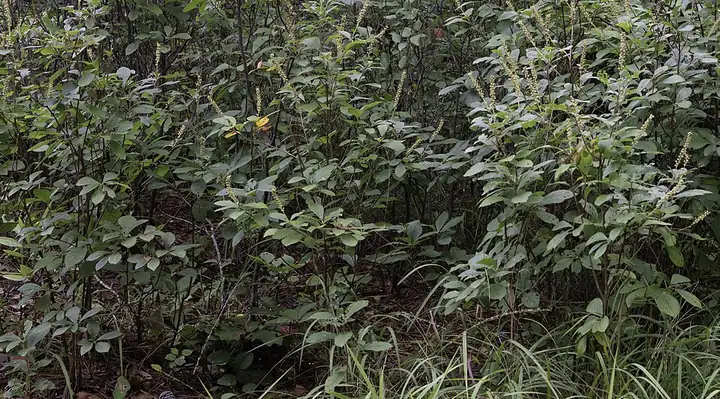
Summersweet (Clethra)
Clethra alnifolia · Clethra family (Clethraceae)
When to plant: Plant container shrubs in spring or fall and water deeply until established, which takes at least two growing seasons (UMN).
| Hardiness zones | 3 to 9 |
|---|---|
| Sun | full sun to part shade |
| Water | high |
| Life cycle | perennial |
| Frost | Hardy: takes frost |
About Summersweet (Clethra)
Summersweet, or sweet pepperbush, is a native shrub of the eastern US that blooms in mid to late summer, when few shrubs do, with spikes of spicy-sweet white or pink flowers. It thrives in moist to wet soil and part shade, draws bees, butterflies and hummingbirds, and slowly spreads by suckers into small thickets (NC State, Morton Arboretum).
Native from Maine to Florida and Texas; hardy in zones 3-9 (NC State). It does poorly on hot, dry sites.
When to plant
Plant container shrubs in spring or fall and water deeply until established, which takes at least two growing seasons (UMN).
It leafs out late in spring (NC State).
Soil
Moist to wet, acid soil rich in organic matter; it tolerates short floods, compacted soil and salt spray (NC State, Morton Arboretum).
Test the soil before planting; mature shrubs in decent soil need little or no fertilizer (Clemson).
Feeding
- Spring to early summer after new growth starts, only if a soil test shows a need: slow-release complete fertilizer in a 3:1:2 ratio, or what the soil test calls for. Spread evenly from the trunk out to the drip line and water it in; a typical soil-test rate for shrubs is about 2 lb of 12-6-6 per 100 sq ft (Clemson). Follow a soil test.
Look for: mostly nitrogen, in spring as growth starts. Spring feeding grows the new shoots and leaves that carry flowers and fruit; feeding after midsummer pushes soft growth that may not harden before winter.
Water is what new shrubs need most: daily for the first 2 weeks, every 2-3 days through week 12, then weekly until the roots spread (at least two growing seasons), using about a quarter to a third of the nursery pot's volume each time (UMN). Summersweet wants moist soil and dislikes hot, dry sites; spider mites show up in dry conditions (NC State).
Harvest
Blooms June to August on new growth, in spikes 2-6 inches long. Prune in late winter or early spring if needed (Morton Arboretum, NC State).
Varieties (9)
NC State and Morton Arboretum document these.
| Variety | Type | Zones | Notes |
|---|---|---|---|
| Hummingbird | Compact | 3–9typical for summersweet | 2-3 ft, rounded; white flower clusters larger than the species and earlier. Sources: [1][2] |
| Sixteen Candles | Compact | 3–9typical for summersweet | 2-3 ft; white. Sources: [1][2] |
| White Doves | Compact | 3–9typical for summersweet | Low, 2-3 ft; white. Sources: [1] |
| September Beauty | Late-blooming | 3–9typical for summersweet | Flowers late in the season. Sources: [1] |
| Pinkspire | Pink-flowered | 3–9typical for summersweet | Pink flowers. Sources: [1] |
| Rosea | Pink-flowered | 3–9typical for summersweet | Pink flowers. Sources: [1] |
| Ruby Spice | Pink-flowered | 3–9typical for summersweet | 4-6 ft; darkest pink of the pink cultivars, holds color even at the coast. Sources: [1][2] |
| Sherry Sue | White-flowered | 3–9typical for summersweet | White flowers and bright red stems. Sources: [1] |
| Vanilla Spice ('Caleb') | White-flowered | 3–9typical for summersweet | 4-6 ft tall; large white flowers. Sources: [2] |
Pests to watch for
In the kitchen
Safety: No toxicity is listed in the extension sources we used.
Pets: Not on the ASPCA toxic plant lists.
Sources
- plants.ces.ncsu.edu
- mortonarb.org
- extension.umn.edu
- aspca.org
- aspca.org
- extension.rutgers.edu
- hgic.clemson.edu
Photo: Photo: PumpkinSky / Wikimedia Commons, CC BY-SA 4.0 (CC BY-SA 4.0). Photo resized for the web.

Planting dates and advice are general guidance; check with your local Cooperative Extension office for your area.