
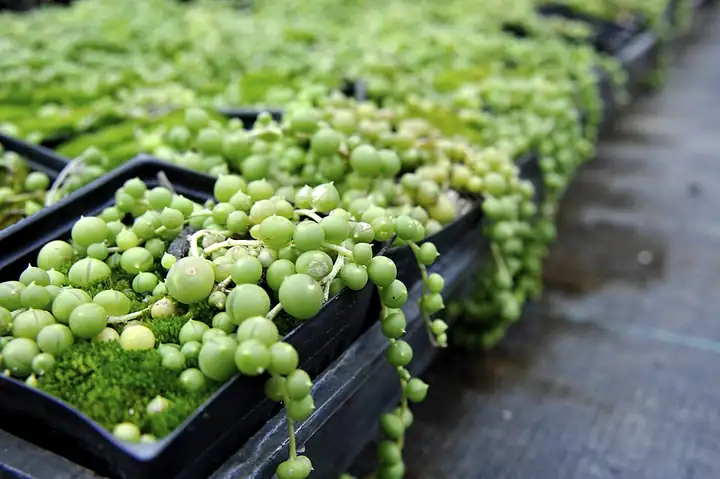
String of pearls
Curio rowleyanus (formerly Senecio rowleyanus) · Aster family (Asteraceae)
When to plant: Any time of year, since it grows indoors. Repot every year or two into a shallow pot only a little wider.
| Hardiness zones | 9 to 12 |
|---|---|
| Sun | part shade |
| Water | low |
| Life cycle | perennial |
| Frost | Tender: killed by frost |
Will it grow in your window?
Pick the window it sits in. This is the same check Sow & Tell runs for every plant in your house.
It wants bright, indirect light.
Pick a window above and this will tell you whether the spot suits it.
Watering: soak it, then let it dry right out — about every 14 days, stretching to every 28 from November to February.
Summering outside? Bring it in before nights drop below 50°F.
About String of pearls
String of pearls is a trailing succulent from the dry eastern Cape of South Africa, where it creeps under bushes and rocks and roots wherever a stem touches the ground. Each pea-sized leaf has a translucent 'window' that lets light in, and the thin stems spill 1-3 ft over the edge of a hanging basket (NC State, Wisconsin Horticulture). It is grown for the look, not for toughness: it rots fast if overwatered, scorches in hot sun, and old plants die back after a few years, so keep cuttings going.
Hardy outdoors only in zones 9b-12 (NC State); it is grown indoors everywhere and can summer outdoors in bright shade, sheltered from rain, once nights stay above about 50 F, coming back in well before frost (NC State, Wisconsin Horticulture).
When to plant
Any time of year, since it grows indoors. Repot every year or two into a shallow pot only a little wider.
Bought as a nursery plant in a hanging pot, or started from a 3-5 in stem cutting laid on moist mix; seed is rarely sold (NC State, Wisconsin Horticulture).
Growing it indoors
- Light: Give it the bright light of an east or lightly curtained south window; direct hot sun scorches the beads, and in too little light the stems go thin and bare (NC State, Wisconsin Horticulture).
- Water: Water thoroughly, then let the mix dry out completely before watering again; the beads shrivel slightly when it is thirsty, which is your cue (Wisconsin Horticulture). Overwatering and root rot are the usual cause of death, so water much less in winter when it barely grows, and never let it sit in a saucer of water.
- Humidity: Ordinary dry room air suits this desert plant; it doesn't need misting or a pebble tray.
- Temperature: NC State gives 70-80 F in summer and a cool 50-60 F winter rest (Wisconsin says 55-60 F); it can't take frost, so bring it in before the first fall frost.
- Feeding: Feed lightly once in spring with a diluted liquid houseplant fertilizer, about once a year (Wisconsin Horticulture); NC State gives no feeding advice.
- Repotting: Repot every year or two into a shallow pot only a little wider, with fresh fast-draining mix (Wisconsin Horticulture); older plants are best replaced with fresh cuttings rather than repotted.
- More plants: Cut 3-5 in stem tips, strip the bottom few beads, lay the bare nodes on moist cactus mix and mist until roots form; a single leaf dropped on the mix can root too but is slow and unreliable (NC State, Wisconsin Horticulture).
If something looks wrong
| What you see | Likely cause | What to do |
|---|---|---|
| Beads going mushy and yellow, stems collapsing, mix stays wet | Overwatering and root rot | Stop watering, move it to bright light, and restart from healthy stem cuttings in fresh dry mix; a rotted plant rarely recovers (NC State, Wisconsin Horticulture). |
| Beads shriveled and flat, mix bone dry | Underwatering | Soak the pot thoroughly and let it drain; the beads plump back up within a day or two (Wisconsin Horticulture). |
| Long bare stretches of stem, thin growth | Too little light | Move it to a brighter window and pin the bare stems back onto the mix so they root along their length (NC State, Wisconsin Horticulture). |
| White cottony tufts in the stems, or sticky leaves | Mealybugs or aphids | Dab them with a cotton swab dipped in rubbing alcohol and repeat weekly until clean (NC State, Wisconsin Horticulture). |
Soil
A very well-drained cactus mix, or potting mix cut with up to half sand, perlite, pumice or poultry grit, in a shallow clay pot that dries quickly (NC State, Wisconsin Horticulture).
Pot in a very well-drained cactus mix, or potting mix cut up to half with sand, perlite, pumice or poultry grit, in a shallow clay pot with a drainage hole (NC State, Wisconsin Horticulture).
Feeding
- Spring, as growth restarts: diluted liquid houseplant fertilizer. Feed lightly once, about once a year (Wisconsin Horticulture); water first so the roots are moist.
- Summer through winter: none. No further feeding; it grows slowly and rests cool and dry in winter (Wisconsin Horticulture).
Rich mix and frequent feeding make soft growth that rots; the real killer is water, not hunger (Wisconsin Horticulture, NC State).
Varieties (1)
NC State names one cultivar.
Pests to watch for
Diseases and problems
In the kitchen
Safety: NC State rates it low severity: the leaves and sap contain pyrrolizidine alkaloids, eating the beads can cause vomiting and diarrhea, and the sap can cause a skin rash, so wear gloves when you take cuttings and keep it out of reach of small children.
Pets: Toxic (ASPCA): the ASPCA's succulent guide says string of pearls causes stomach upset, mostly vomiting, and lethargy if eaten; NC State lists it as a problem for dogs, cats and horses.
Sources
Photo: Photo: MeganEHansen, CC BY-SA 2.0, via Wikimedia Commons (CC BY-SA 2.0). Photo resized for the web.

Planting dates and advice are general guidance; check with your local Cooperative Extension office for your area.