
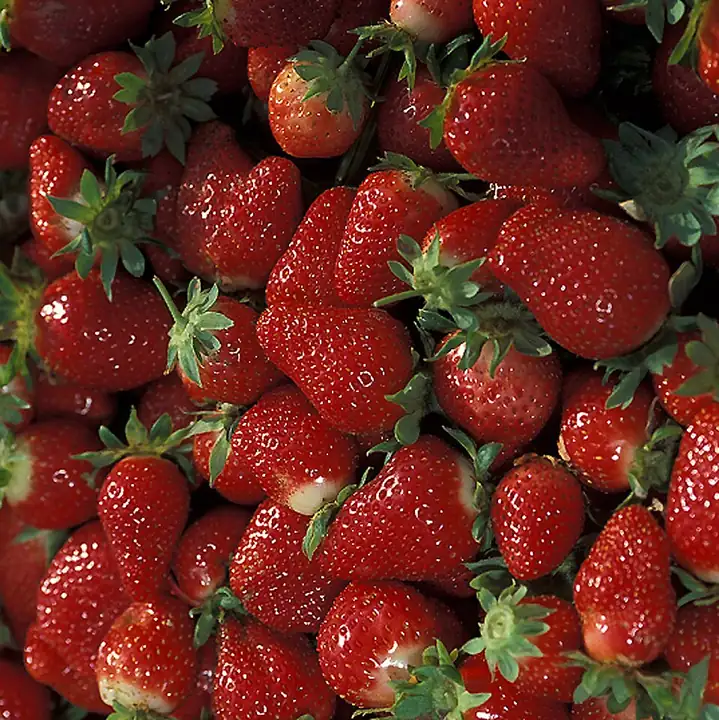
Strawberry
Fragaria x ananassa · Rose family (Rosaceae)
When to plant: Set out plants from 4 weeks before to 2 weeks after the last frost.
| Hardiness zones | 3 to 9 |
|---|---|
| Sun | full sun |
| Water | moderate |
| Life cycle | perennial |
| Frost | Hardy: takes frost |
| Soil pH | 6.0–6.5 |
| Spacing | 18 to 24 inches |
About Strawberry
The garden strawberry is a low perennial that spreads by runners and gives the first fruit of the season. June-bearing types give one big crop in early summer, while day-neutral types give smaller pickings over most of the season.
NC State lists zones 5-9, and with 4-6 inches of straw mulch over winter strawberries are grown throughout Minnesota (University of Minnesota); crowns can die at about 15 F without it.
When to plant
Timing is counted from your average last spring frost (and first fall frost). Sow & Tell works out the actual dates for your ZIP code.
- Set out plants: from 4 weeks before to 2 weeks after the last frost
Plant dormant bare-root plants in early spring as soon as the soil can be worked; set out potted plants after the risk of frost has passed. Pinch off flowers for the first weeks after planting. June-bearers give their first real crop the year after planting; day-neutrals can fruit later that first summer.
Soil
Well-drained, sandy loam rich in organic matter; plants are shallow-rooted and struggle in heavy clay. Give about 1 inch of water a week.
Test the soil and aim for a pH of about 5.6-6.5; work in 1-2 inches of compost or other organic matter, and use raised beds on heavy clay.
Feeding
- First year: 1-2 weeks after planting: balanced fertilizer such as 16-16-16, or nitrogen fertilizer such as 21-0-0. About 0.2 oz of actual nitrogen per 10 feet of row, spread along the row and watered in.
Look for: mostly nitrogen, in spring as growth starts. Spring feeding grows the new shoots and leaves that carry flowers and fruit; feeding after midsummer pushes soft growth that may not harden before winter. - First year: about 1 month after the first feeding: balanced fertilizer such as 16-16-16, or nitrogen fertilizer such as 21-0-0. About 0.2-0.4 oz of actual nitrogen per 10 feet of row, spread along the row and watered in.
Look for: mostly nitrogen, in spring as growth starts. Spring feeding grows the new shoots and leaves that carry flowers and fruit; feeding after midsummer pushes soft growth that may not harden before winter. - First year: about 2 months after planting: balanced fertilizer such as 16-16-16, or nitrogen fertilizer such as 21-0-0. About 0.1-0.2 oz of actual nitrogen per 10 feet of row, spread along the row and watered in.
Look for: mostly nitrogen, in spring as growth starts. Spring feeding grows the new shoots and leaves that carry flowers and fruit; feeding after midsummer pushes soft growth that may not harden before winter. - Each year right after harvest, when renovating June-bearing beds (Colorado adds a second feeding in September): nitrogen fertilizer such as 21-0-0. About 0.4-0.6 oz of actual nitrogen per 10 feet of row for June-bearers; follow a soil test.
Look for: mostly nitrogen, in spring as growth starts. Spring feeding grows the new shoots and leaves that carry flowers and fruit; feeding after midsummer pushes soft growth that may not harden before winter.
Do not feed June-bearers with nitrogen in spring before they fruit: it gives lots of leaves, soft berries and more fruit rot.
Harvest
Pick berries when they are fully red, leaving the cap on, every other day or so. Fruit ripens about 30 days after bloom.
June-bearers give one big crop over about four weeks in early summer; everbearers give an early-summer crop and a second one in early fall, and day-neutrals keep flowering and fruiting from early summer until frost. Pick ripe berries every other day or so, and side-dress everbearing and day-neutral plants with compost in midsummer to keep them going.
Varieties (48)
| Variety | Type | Season and days | Zones | Notes |
|---|---|---|---|---|
| Albion | Day-neutral | June until frost | 4–8 | Sweet, excellent flavor; UC calls it the industry's flavor standard. Large, long, conical, very firm dark red berries. Resists verticillium wilt and Phytophthora crown rot and is fairly resistant to anthracnose. Bred in California (US Plant Patent 16,228). Makes many runners to trim. Watch for spider mites. Only fair hardiness in Minnesota. Sources: [3][5][7][8][9][10][11] |
| Aromas | Day-neutral | Heavy late-season crop | 3–9typical for strawberry | Excellent flavor. Large berries and high yields; resists mildew and tolerates spider mites well. Sources: [7] |
| Mara des Bois | Day-neutral | 3–9typical for strawberry | Very aromatic; people tend to love it or dislike it. Small gourmet berries on low-vigor plants; very prone to anthracnose fruit rot. Sources: [6][8][10] | |
| Monterey | Day-neutral | 3–9typical for strawberry | Sweet, with a sweet aftertaste. Vigorous plants with berries slightly larger and softer than Albion; prone to powdery mildew. Clemson lists it for higher elevations in the South Carolina Piedmont. Sources: [7][10][12] | |
| Portola | Day-neutral | 3–9typical for strawberry | Excellent and consistent. Vigorous plants with berries about as big as Albion but lighter and shinier; a bit less tolerant of rain. Sources: [7] | |
| San Andreas | Day-neutral | Late spring through fall | 4–8 | Sources disagree: UC calls it outstanding, while Oregon State found it bland in the Northwest. Large, firm, attractive berries; makes few runners. Good disease resistance in California, but susceptible to anthracnose in Oregon trials. Bred in California (US Plant Patent 19,975). Best suited to high-density plantings. Sources: [5][7][9][10] |
| Seascape | Day-neutral | Early summer through fall | 4–8 | Sweet, good flavor, but bland if picked before fully ripe. Large, bright red berries, red inside and out. Makes few runners; can split in wet weather and is susceptible to verticillium wilt. Bred in California (US Plant Patent 7,614). Good in containers. May lack winter hardiness in cold areas. Sources: [3][5][8][9][10][13] |
| Tribute | Day-neutral | Summer and fall | 3–9typical for strawberry | Good to very good flavor, milder than Tristar but still a little tart. Medium, glossy, bright red, firm berries. Resists red stele and verticillium wilt and tolerates leaf diseases. A USDA release from Maryland. Good winter hardiness; may suit colder regions. Small but vigorous plants with many runners. Sources: [6][8][9][10][13] |
| Tristar | Day-neutral | Summer and fall | 3–9typical for strawberry | Excellent, sweet flavor; can be tart. Small to medium, glossy, bright red, firm berries; small in hot weather. Resists red stele and verticillium wilt and tolerates leaf diseases. A USDA release from Maryland. Good winter hardiness. Maine rates it among the best for home gardens, though yields are modest. Sources: [6][8][9][10][13] |
| Fort Laramie | Everbearing | 3–7 | Colorado State recommends it for Colorado because it is hardier than many everbearers. Sources: [5][6] | |
| Ogallala | Everbearing | Early summer and again in fall | 3+ | Rich flavor. Soft, deep red berries on vigorous, drought-tolerant plants. Very cold hardy (rated excellent in Minnesota); Colorado State lists it as one of the hardier everbearers. UMN rates it excellent in zone 4 and very good in zone 3; no upper zone given. Sources: [3][6] |
| Ozark Beauty | Everbearing | 3–9 | An everbearing variety on Colorado State's home garden list. Sources: [5][6] | |
| Quinault | Everbearing | 4–9 | Very flavorful. Large, soft berries; makes many runners. Good disease resistance except for gray mold. Sources: [5][7] | |
| AC Valley Sunset | June-bearing | Late | 4–7 | Good flavor. Large, uniform, bright red berries that are a bit soft; resistant to leaf spot and scorch but can get anthracnose crown rot. Bred in Nova Scotia. Listed as 'AC Valley'. Sources: [5][8][9] |
| AC Wendy | June-bearing | Very early | 3–8 | Good flavor with nice color and firmness. Medium-size berries on vigorous plants with many runners. Some resistance to red stele and leaf diseases, but can get angular leaf spot. Bred in Nova Scotia. Sold as 'Wendy' or 'A.C. Wendy'. Plants can be touchy under stress. Sources: [5][6][8][9] |
| Allstar | June-bearing | Midseason to late midseason | 4–8 | Good, sweet flavor for fresh eating. Large, glossy, conical berries that stay light orange-red when ripe. Resists red stele and verticillium wilt and tolerates leaf diseases. A USDA release from Maryland. Handles heavier soils. Vigorous plants but makes fewer runners than most. Sources: [5][8][9][13] |
| Annapolis | June-bearing | Early | 3–8 | Mild, sweet, good flavor. Medium to large, light red berries on vigorous plants that make lots of runners. Some red stele resistance; can get leaf spot and powdery mildew. Bred in Nova Scotia. Dense beds can raise gray mold (Botrytis), so thin runners. Sources: [3][5][8][9][13] |
| Brunswick | June-bearing | Early to midseason | 3–9typical for strawberry | Somewhat tart unless fully ripe. Very high yields of medium to large, blocky, dark red berries that are a bit tender; some red stele resistance. Bred in Nova Scotia. Sources: [9] |
| Cabot | June-bearing | Midseason to late | 3–9typical for strawberry | Huge berries and high yields; first berries can be oddly shaped or hollow. Few runners, some red stele resistance, and short-lived beds. Bred in Nova Scotia. Colorado State lists it among June-bearers for Colorado. Sources: [6][8][9] |
| Cavendish | June-bearing | Early-midseason, long harvest | 3+ | Very good flavor. Large, firm berries that may ripen unevenly in hot weather. Resists red stele and verticillium wilt; makes plenty of runners. Bred in Nova Scotia. Very cold hardy (rated excellent in Minnesota). Plants can be hard to find. UMN rates it excellent in zone 4 and very good in zone 3; no upper zone given. Sources: [3][8][9] |
| Darselect | June-bearing | Midseason | 3–9typical for strawberry | Good flavor. Large, uniform, glossy, light red berries with big green caps. Susceptible to leaf diseases and anthracnose fruit rot. Bred in France. Vigorous plants need fertile soil; yields can be lower than expected. Sources: [8][9] |
| Earliglow | June-bearing | Early | 4–8 | Known for classic, rich strawberry flavor; Penn State rates it the best early variety for flavor. Firm, glossy, medium berries that get smaller as the season goes on. Resists red stele and verticillium wilt; vigorous and makes many runners. A long-time favorite with home gardeners and a good choice for beginners. Freezes well. Yields are modest. Sources: [3][5][8][9][12][13] |
| Flavorfest | June-bearing | Midseason | 3–9typical for strawberry | Very good flavor. Vigorous plants with large, bright red berries; resistant to leaf spot and leaf scorch with some red stele resistance. Released by the USDA in Maryland. Sources: [8][9] |
| Galletta | June-bearing | Early | 3–9typical for strawberry | Good flavor. Large berries with concentrated ripening; resistant to red stele, leaf spot and anthracnose. Makes few runners. Bred in North Carolina. Sources: [8][9] |
| Honeoye | June-bearing | Early to early-midseason | 3–8 | Aromatic, often described as perfumed; flavor can turn tart or flat in hot weather. Large, glossy, bright red, firm berries and heavy yields. Not resistant to red stele or verticillium wilt, and prone to root rot in wet soil. Bred in New York. Very cold hardy (rated excellent in Minnesota). Does best in cooler areas; berries darken and soften in heat. Freezes well. Sources: [3][5][8][9][10][13] |
| Hood | June-bearing | Early | 6–9 | Excellent flavor. Medium-large, bright red berries that cap easily. Short-lived plantings and sensitive to viruses. A Pacific Northwest classic. Oregon State lists it as suitable for home gardens despite poor durability. Sources: [5][10] |
| Jewel | June-bearing | Midseason to mid-late | 4–8 | Very good flavor. Large, firm, glossy, wedge-shaped berries and good yields. Tolerates fruit molds and some leaf disease, but has no red stele or verticillium resistance. Bred in New York. Penn State calls it an all-around good performer. May be hurt by very cold winters. Sources: [3][5][6][8][9][13] |
| Keepsake | June-bearing | Midseason | 3–9typical for strawberry | Excellent when fully ripe. Vigorous plants with average yields; resistant to leaf spot and scorch but prone to angular leaf spot. Sources: [8] |
| Lateglow | June-bearing | Late | 3–9typical for strawberry | Very good flavor. Very large, very firm berries with high yield potential; winter hardy and resistant to red stele, but prone to powdery mildew. Sources: [13] |
| Marys Peak | June-bearing | Midseason to late | 6–9 | Excellent flavor. Medium to large berries for fresh use or processing; durable plants. Patented as USPP 29,370. Listed as 'Mary's Peak'. Sources: [5][10] |
| Mira | June-bearing | Early to midseason | 3–9typical for strawberry | Good quality. Vigorous plants with large, light red berries and high yield potential; some resistance to red stele and leaf diseases. Bred in Nova Scotia. Sources: [9] |
| Puget Crimson | June-bearing | Very late | 3–9typical for strawberry | Excellent flavor. Very large berries early in the harvest that shrink as the season goes on; vigorous plants. Patented as USPP 22,781. Sources: [10] |
| Rainier | June-bearing | Midseason to late | 3–9typical for strawberry | Excellent flavor. Medium to large berries for fresh eating; durable plants. Sources: [10] |
| Redchief | June-bearing | Early to midseason | 3–9typical for strawberry | Sweet, with very high quality. Medium-large berries that freeze well; resistant to several red stele strains and to verticillium wilt, but prone to leaf spot. Sources: [6][13] |
| Ruby June | June-bearing | Early to midseason | 3–9typical for strawberry | Sweet; rated high for flavor in Arkansas. Medium berries for fresh use or processing; durable plants. Clemson lists it for all regions of South Carolina. Sources: [10][11][12] |
| Shuksan | June-bearing | Midseason | 4–9 | Very good flavor. Medium to large berries for fresh use; durable plants. Oregon State rates it for western Oregon and Washington. Sources: [5][10] |
| Sparkle | June-bearing | Mid-late to late | 3–9typical for strawberry | Excellent, old-fashioned flavor. Medium, dark red, soft berries. Some red stele resistance but prone to leaf diseases and verticillium wilt. A home-garden favorite. Late bloom can help it escape spring frost. Makes lots of runners; berries shrink late in the season. Sources: [8][9][13] |
| Surecrop | June-bearing | Early to midseason | 3+ | Tart, fair quality. One of the most productive and vigorous varieties, with large, light-colored berries; highly disease resistant, including red stele. Clemson lists it for the South Carolina Piedmont and central regions. University of Wyoming lists it for zone 3; no upper zone given. Sources: [12][13][14] |
| Sweet Sunrise | June-bearing | Early | 6–9 | Excellent flavor. Medium to large berries for fresh use or processing; durable and adaptable in Oregon, Washington and British Columbia. Patented as USPP 25,223. Sources: [5][10] |
| Tillamook | June-bearing | Midseason | 3–9typical for strawberry | Good, but bland if picked underripe. Large to very large berries for fresh use or processing; very durable plants. Sources: [10] |
| Totem | June-bearing | Midseason | 3–9typical for strawberry | Very good flavor. Medium to large berries, mainly for processing; durable plants. Sources: [10] |
| Camarosa | June-bearing (short-day) | Early (California); mid to late (Arkansas plasticulture) | Excellent flavor. Large to very large, firm berries with high yields. More disease tolerant than Chandler. Grown as an annual in California and the Southeast; handles shipping better than Chandler. Sources: [7][11][12][15] | |
| Chandler | June-bearing (short-day) | Early to midseason | Sweet and flavorful. Medium to large, firm berries. Susceptible to anthracnose and root rots and to winter injury in the North. Bred in California. A standard in the Southeast and California, usually grown as an annual: planted in fall and picked the next spring. Sources: [7][9][11][12][13][15] | |
| Sweet Charlie | June-bearing (short-day) | Very early (winter to early spring in Florida) | Noticeably sweet, with a high sugar-to-acid ratio. Medium berries. Highly resistant to anthracnose fruit rot; bruises easily and does not ship well. Released by the University of Florida (US Plant Patent 8,729, 1994). Good for the Southeast coastal plain; yields are lower than newer types. Sources: [11][12][15][16] | |
| Camino Real | Short-day (June-bearing) | Early to mid-late depending on region | Very good flavor. Large berries, darker than Camarosa, that store well after harvest. Resists verticillium wilt and Phytophthora crown rot; prone to leaf spot and powdery mildew. Clemson lists it for all regions of South Carolina. Sources: [7][11][12] | |
| Fronteras | Short-day (June-bearing) | Midseason | Large, vigorous, disease-tolerant plants with very large, very uniform berries. Suited to the California coast and grown in Arkansas. Sources: [7][11] | |
| Sequoia | 3–9typical for strawberry | High quality. Big, vigorous plants with large wedge-shaped berries that get soft when ripe. Recommended for Arizona's low desert. Sources: [17] | ||
| Tioga | 3–9typical for strawberry | Medium quality. Very large, vigorous plants with very large, firm, wedge-shaped berries. Recommended for Arizona's low desert. Sources: [17] |
Pests to watch for
Tarnished plant bug, Slugs, Spotted wing drosophila, Twospotted spider mite, Aphids, Brown garden snail, European earwig, Pillbugs and sowbugs, White grubs, Boxelder bugs, Mole crickets, Opossum, Chipmunks, Garden symphylan, Cyclamen mite, Strawberry sap beetle, Strawberry clipper (strawberry bud weevil), Rose chafer, Tree squirrels, Foliar nematodes
Diseases and problems
Gray mold (Botrytis fruit rot), Anthracnose fruit rot, Leaf blotch, Phosphorus deficiency, Common leaf spot of strawberry, Iron chlorosis, Herbicide injury, Frost and freeze injury, Verticillium wilt, Tomato and tobacco ringspot
In the kitchen
Eaten fresh, in desserts and jams, or frozen; the flower petals are edible too.
Keeping it: Refrigerate berries right after picking, unwashed and with caps on, and eat them within a few days. Wash and hull just before using.
Pets: Not toxic to dogs, cats or horses (ASPCA)
Sources
- content.ces.ncsu.edu
- plants.ces.ncsu.edu
- extension.umn.edu
- aspca.org
- extension.oregonstate.edu
- extension.colostate.edu
- ucanr.edu
- extension.psu.edu
- extension.umaine.edu
- extension.oregonstate.edu
- uaex.uada.edu
- hgic.clemson.edu
- extension.missouri.edu
- uwyo.edu
- hgic.clemson.edu
- patents.google.com
- extension.arizona.edu
Photo: Photo: Ken Hammond, USDA ARS, Public domain (USDA ARS), via Wikimedia Commons. Photo resized for the web.

Planting dates and advice are general guidance; check with your local Cooperative Extension office for your area.