
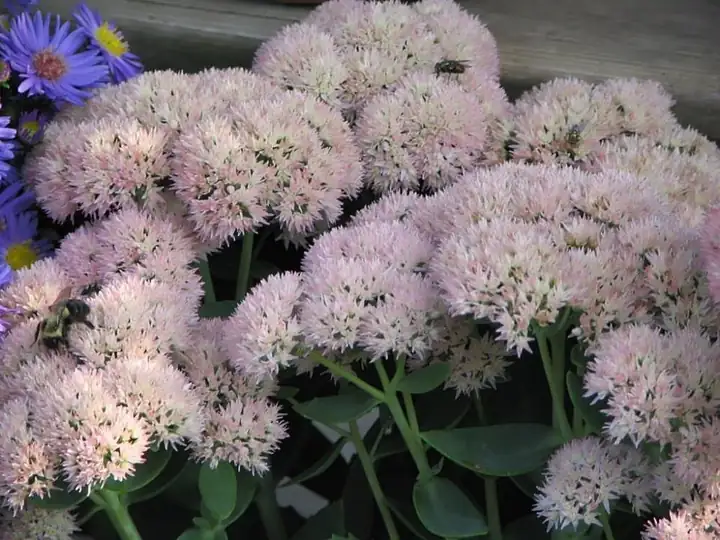
Sedum (stonecrop)
Hylotelephium spectabile (showy stonecrop), H. telephium and hybrids such as 'Herbstfreude' ('Autumn Joy'); formerly Sedum · Stonecrop family (Crassulaceae)
When to plant: Divide clumps every 3-4 years in early spring to keep them vigorous (NC State Beaufort County).
| Hardiness zones | 3 to 9 |
|---|---|
| Sun | full sun |
| Water | low |
| Life cycle | perennial |
| Frost | Hardy: takes frost |
| Soil pH | 6.0–8.0 |
| Spacing | 12 to 36 inches |
About Sedum (stonecrop)
Upright stonecrops like 'Autumn Joy' are succulent perennials with fleshy blue-green leaves and flat heads of tiny star flowers that open pink, deepen to red and age to coppery rust. They thrive on neglect in sun and dry, lean soil, and bees and butterflies crowd the flowers in late summer and fall. Dried seed heads stand through winter.
NC State lists 'Autumn Joy' for zones 3-10 and showy stonecrop for 4-9; UF/IFAS lists 'Autumn Joy' for 5-9. Plants die back to the ground in winter and regrow from the roots.
When to plant
Divide clumps every 3-4 years in early spring to keep them vigorous (NC State Beaufort County).
Start new plants from stem cuttings or by division (NC State; UF/IFAS).
Soil
Well-drained soil of average to low fertility, including clay and shallow rocky ground; overly moist or rich soil leads to rot and floppy stems (NC State).
Plant in well-drained soil of average to low fertility; rocky or sandy ground is fine. Don't enrich it heavily (NC State).
Feeding
Look for: a balanced or all-purpose fertilizer at the label rate. Skip high-phosphorus "bloom boosters" unless a soil test shows low phosphorus: most garden soils already have enough, and the extra can wash into streams.
Rich or moist soil makes stonecrop floppy and prone to rot (NC State); overwatering is a bigger risk than drought (NC State Beaufort County). No fertilizer is normally needed.
Harvest
Buds form in summer and open from late summer into fall, peaking around late September. No deadheading is needed; leave the dried heads for winter interest and cut them off in spring. Pinching or cutting stems back in early spring keeps plants bushy; cutting in summer makes them shorter but delays bloom (NC State).
Varieties (19)
| Variety | Type | Season and days | Zones | Notes |
|---|---|---|---|---|
| Autumn Delight | Orpine (H. telephium) | 3–9typical for sedum | Chartreuse leaves edged in blue-green, with light pink flowers. Sources: [4] | |
| Matrona | Orpine (H. telephium) | 3–9typical for sedum | Purple stems, bronze-tinged gray-green leaves and pale dusty-rose flowers. Sources: [3][4][7] | |
| Munstead Dark Red | Orpine (H. telephium) | 3–9typical for sedum | Dark pink flowers. NC State's genus page lists it as 'Munstead Red'. Sources: [3][4] | |
| Picolette | Orpine (H. telephium) | 3–9typical for sedum | Bronze and dark green leaves with rose-mauve flowers. Sources: [4] | |
| Purple Emperor | Orpine (H. telephium) | 3–9typical for sedum | Dusky purple leaves with pink to mauve flowers. RHS Award of Garden Merit 2006 (NC State). Sources: [4] | |
| Red Cauli | Orpine (H. telephium) | 3–9typical for sedum | Purplish-green leaves and pink flowers. RHS Award of Garden Merit 2006 (NC State). Sources: [4] | |
| Xenox | Orpine (H. telephium) | 3–9typical for sedum | Deep purple leaves and pink flowers. RHS Award of Garden Merit 2006 (NC State). Sources: [4] | |
| Xenox Yellow | Orpine (H. telephium) | 3–9typical for sedum | Dark plum leaves and peach-apricot flowers. Sources: [4] | |
| Autumn Fire | Showy stonecrop (H. spectabile) | 3–9typical for sedum | Bluish-green leaves and dusky pink flowers. Sources: [2] | |
| Brilliant | Showy stonecrop (H. spectabile) | 3–9typical for sedum | Pale grayish-green leaves and starry carmine-pink flowers, brighter than 'Autumn Joy'. Sources: [2][7] | |
| Carl | Showy stonecrop (H. spectabile) | 3–9typical for sedum | Bluish-green leaves with small pink flowers. Sources: [2] | |
| Hot Stuff | Showy stonecrop (H. spectabile) | 3–9typical for sedum | Pale green leaves and bright purplish-pink flowers. Sources: [2] | |
| Iceberg | Showy stonecrop (H. spectabile) | 3–9typical for sedum | Pale green leaves and bright white flowers. Sources: [2] | |
| Meteor | Showy stonecrop (H. spectabile) | 3–9typical for sedum | Gray-green leaves and deep rose flowers. Sources: [2] | |
| Neon | Showy stonecrop (H. spectabile) | 3–9typical for sedum | Light green leaves and vivid rosy-magenta flowers. Sources: [2][7] | |
| Rosenteller | Showy stonecrop (H. spectabile) | 3–9typical for sedum | Light green leaves and pink flowers. Sources: [2] | |
| Autumn Joy ('Herbstfreude') | Upright hybrid stonecrop | Late summer-fall | 3–10 | 1.5-2.5 ft clump of gray-green leaves; flower heads open pink, deepen to red and age to coppery rust. RHS Award of Garden Merit 1993 (NC State). Hardy zones 3-10 per NC State (UF/IFAS: 5-9). Sources: [1][2][5][6][7] |
| Mr Goodbud | Upright hybrid stonecrop | 3–9typical for sedum | Red stems and large purple flower heads. RHS Award of Garden Merit 2003 (NC State). Sources: [3] | |
| Thundercloud | Upright hybrid stonecrop | 3–9typical for sedum | Compact plant with white flowers. Sources: [7] |
Pests to watch for
Aphids, Mealybugs, Scale insects, Slugs, Brown garden snail, Deer
Diseases and problems
Southern blight, Root rot
In the kitchen
NC State notes that very young leaves and stems have been eaten raw, or briefly cooked before the plant flowers, and taste bland. It also lists the plant as mildly toxic, so treat it as an ornamental.
Safety: NC State rates showy stonecrop and 'Autumn Joy' low in toxicity: all parts contain alkaloids (sedine, sedamine) that may upset the stomach if eaten. It does not irritate skin.
Pets: Not listed by name by the ASPCA. The ASPCA lists a related sedum, burro's tail (Sedum morganianum), as non-toxic to dogs, cats and horses; NC State rates showy stonecrop low in toxicity (possible stomach upset).
Sources
- plants.ces.ncsu.edu
- plants.ces.ncsu.edu
- plants.ces.ncsu.edu
- plants.ces.ncsu.edu
- ask.ifas.ufl.edu
- botanicgardens.uw.edu
- beaufort.ces.ncsu.edu
- aspca.org
- aspca.org
- homesoiltest.msu.edu
Photo: Photo: David J. Stang, CC BY-SA 4.0, via Wikimedia Commons (CC BY-SA 4.0). Photo resized for the web.

Planting dates and advice are general guidance; check with your local Cooperative Extension office for your area.