
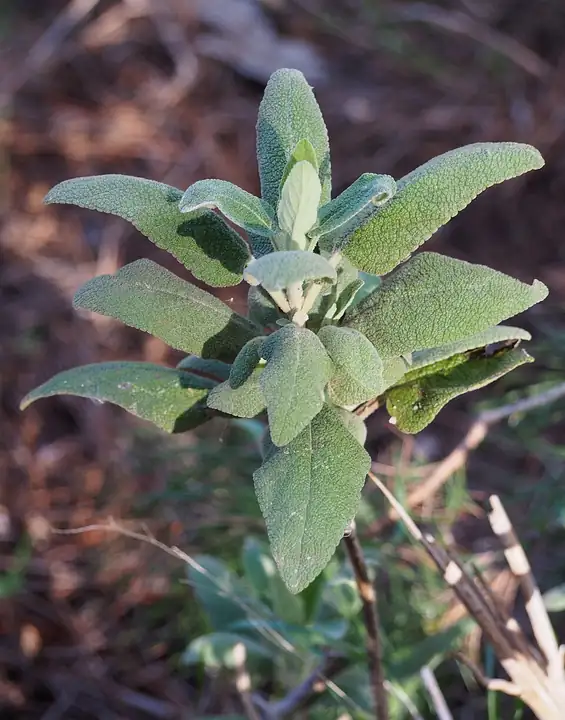
Sage
Salvia officinalis · Mint family (Lamiaceae)
| Hardiness zones | 4 to 8 |
|---|---|
| Sun | full sun |
| Water | low |
| Life cycle | perennial |
| Frost | Hardy: takes frost |
| Soil pH | 6.0–7.5 |
| Spacing | 24 to 30 inches |
About Sage
Common sage is a shrubby perennial with soft gray-green leaves, a classic for stuffing and poultry. It needs good drainage and a light hand with pruning, since old woody stems rarely resprout.
NC State lists common sage as hardy in zones 4-8.
Planting
Grow from seed, stem cuttings or layering. Harvest lightly the first year so the plant can establish, and do not prune into old woody stems.
Soil
Well-drained loam, sandy or rocky soil; it will not tolerate wet, poorly drained ground.
Plant in full sun in very well-drained soil worked with some compost; sage tolerates poor soil. Like most herbs it does best at a pH of 6.0 to 7.5; base fertilizer on a soil test.
Feeding
- once during the growing season, only if the soil is poor or plants look pale: complete fertilizer such as 5-10-5. Scatter about 3 oz per 10 ft of row beside the plants and water it in; potted plants outdoors can get half-strength liquid fertilizer every 3-4 weeks.
Look for: a light, all-purpose or nitrogen fertilizer. Herbs are grown for fresh leaves to pick, so a little nitrogen keeps new growth coming; most need only light feeding.
Rich soil or heavy feeding gives fast, lush growth with less essential oil, so leaves have weaker flavor and scent.
Harvest
Pick leaves as needed through the season; pinching and light pruning in spring keep the plant from getting leggy.
Pick leaves in spring and summer (lightly in the first year), and prune in spring and during the season to keep it from getting leggy. Don't cut into old woody stems, which seldom resprout.
Varieties (12)
Extension sources document 11 garden sage cultivars plus the species. Hardiness ratings for the colored-leaf types vary between sources.
| Variety | Type | Zones | Notes |
|---|---|---|---|
| Berggarten | Garden sage | 5–10 | Large, round, silvery gray-green leaves on a bushy plant that stays full to the base; rarely blooms and resists mildew. Sources disagree on flavor: WSU calls it superior, NC State calls it subpar. Clemson says it handles heat better than the species. Rated hardy to zone 5a; upper limit is the common sage range on the same page. Sources: [1][9][10][11][12][13] |
| Extrakta | Garden sage | 4–10typical for Common (garden) sage (Salvia officinalis) | Seed-grown sage with gray leaves and high essential oil content. Sources: [9] |
| Holt's Mammoth | Garden sage | 4–10typical for Common (garden) sage (Salvia officinalis) | Fast-growing, up to 3 feet, with large gray-green leaves 4-5 inches long. Sources: [9][12] |
| Purple sage (Purpurascens) | Garden sage | 6–10 | Strongly flavored and used in cooking. New leaves flushed purple, maturing toward gray-green; about 18 inches tall. Less winter hardy than common sage. Wisconsin rates it to zone 6, WSU lists zones 8-10, and Illinois says it isn't dependable in zone 5. Also sold as 'Purpurea'. Less hardy than common sage (to zone 6); upper limit is the common sage range on the same page. Sources: [1][9][10][12][13] |
| White-flowered sage (Albiflora) | Garden sage | 4–10typical for Common (garden) sage (Salvia officinalis) | Pure white flowers on a plant about 16 inches tall; grown from seed. Sources: [9][12] |
| Compacta | Garden sage (dwarf) | 4–10typical for Common (garden) sage (Salvia officinalis) | Same sage flavor as the species. Smaller leaves on a compact plant about 10 inches tall; grown from cuttings. Sources: [1][9] |
| Nana | Garden sage (dwarf) | 4–10 | Half the size of common sage or less, with narrow leaves; good in containers. Sources: [12] |
| Golden sage (Aurea) | Garden sage (ornamental) | 6–10 | May be milder than common sage. Compact plant with chartreuse-yellow leaves marked darker green along the veins. Hardy only to about zone 5b-6a; not dependable in zone 5. Less hardy than common sage (to zone 5b or 6a); upper limit is the common sage range on the same page. Sources: [9][10][12] |
| Common sage | Garden sage (Salvia officinalis) | 4–8 | Classic sage flavor for stuffing, poultry, soups and stews. Small evergreen shrub with broad, oval gray-green leaves. Sources: [1][11] |
| Icterina | Garden sage (variegated) | 4–10typical for Common (garden) sage (Salvia officinalis) | Gray-green leaves edged in yellow or gold; seldom blooms; often grown as an ornamental. WSU Extension calls it the hardiest sage cultivar (zones 2-10); other sources give no rating. WSU Extension lists this cultivar for zones 2-10; the common sage range is used here. Sources: [1][9][12][13] |
| Purpurascens Variegata | Garden sage (variegated) | 4–10typical for Common (garden) sage (Salvia officinalis) | Purple sage with leaves splashed pink and creamy white. Purple-leaved sages are less winter hardy than common sage (about zone 6). Sources: [9][12] |
| Tricolor | Garden sage (variegated) | 6–10 | Green leaves with white edges and rose-pink streaks, pinkest on new growth; decorative. Hardy only to about zone 5b-6a (Wisconsin). Less hardy than common sage (to zone 5b or 6a); upper limit is the common sage range on the same page. Sources: [1][9][10][12][13] |
Pests to watch for
In the kitchen
Leaves season meat, vegetable and egg dishes and poultry stuffing, and can be used in tea; flowers are edible in small amounts.
Keeping it: Stand fresh sprigs in a glass with an inch of water in the fridge, loosely covered, and change the water daily; use within about a week or freeze them. Dried leaves keep best airtight in a cool, dark cupboard.
Safety: Common sage contains thujone, which can be toxic in large amounts. NCCIH says sage may be unsafe in pregnancy, and the European Medicines Agency does not recommend medicinal sage in pregnancy, while breastfeeding or for anyone under 18. Studies have used it safely for up to 8 weeks; ask a doctor before combining it with medicines.
Pets: Not toxic to dogs, cats or horses (ASPCA)
Sources
- plants.ces.ncsu.edu
- extension.umn.edu
- nccih.nih.gov
- ema.europa.eu
- extension.umn.edu
- aspca.org
- ema.europa.eu
- aggie-hort.tamu.edu
- hort.extension.wisc.edu
- extension.illinois.edu
- hgic.clemson.edu
- s3.wp.wsu.edu
- purdue.edu
Photo: Photo: Agnieszka Kwiecień, Nova, CC BY-SA 4.0, via Wikimedia Commons (CC BY-SA 4.0). Photo resized for the web.

Planting dates and advice are general guidance; check with your local Cooperative Extension office for your area.