
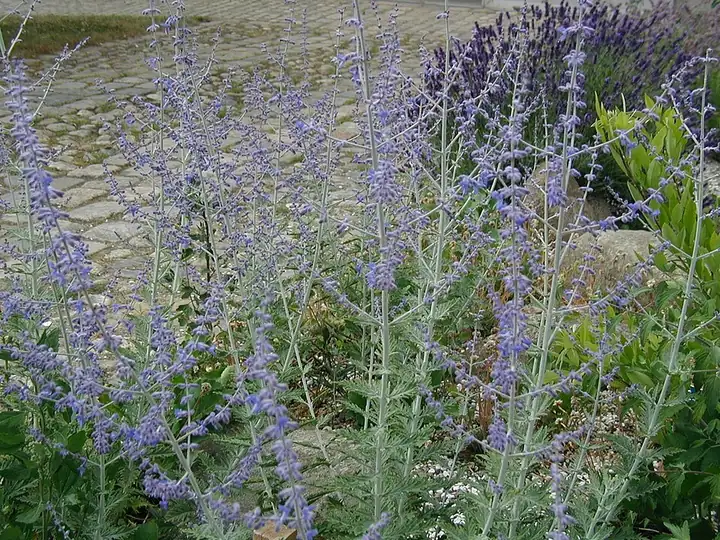
Russian sage
Salvia yangii (formerly Perovskia atriplicifolia) and hybrids with P. abrotanoides · Mint family (Lamiaceae)
When to plant: Plant potted Russian sage in early spring, or through summer until about a month before a hard freeze, and water regularly the first season (Wisconsin).
| Hardiness zones | 4 to 9 |
|---|---|
| Sun | full sun |
| Water | low |
| Life cycle | perennial |
| Frost | Hardy: takes frost |
| Spacing | 18 to 36 inches |
About Russian sage
Russian sage is a woody-based, shrubby perennial (a subshrub) from Central Asia, not Russia, with silvery, scented leaves and airy lavender-blue spires from midsummer into fall. It shrugs off heat, drought and deer, and bees work the flowers constantly. It was the 1995 Perennial Plant of the Year and now belongs in the genus Salvia.
Wisconsin lists zones 4-9 and NC State 5-9; in Chicago stems die back to a few inches each winter, but plants in well-drained soil survived -23 F.
When to plant
Plant potted Russian sage in early spring, or through summer until about a month before a hard freeze, and water regularly the first season (Wisconsin).
Cultivars are started from 3-4 inch softwood cuttings in summer; seed takes 1-4 months to sprout at 60-65 F (a short cold spell first helps), and seedlings vary a lot. Space about 18 inches apart (Wisconsin); NC State allows 3 feet or more.
Soil
Well-drained sandy or loamy soil of any pH; wet soil, especially in winter, rots the roots (Wisconsin; NC State; Chicago Botanic Garden).
Choose a sunny spot with well-drained, even gravelly soil; good drainage and air in the soil help it survive wet winters (Wisconsin).
Feeding
- early spring, before new growth begins: balanced fertilizer such as 10-10-10, applied lightly. Wisconsin Extension advises feeding before new growth starts in spring. Use a light hand; MSU advises no more than 1 lb of nitrogen per 1,000 sq ft for perennials. Water it in, and follow a soil test.
Look for: a balanced or all-purpose fertilizer at the label rate. Skip high-phosphorus "bloom boosters" unless a soil test shows low phosphorus: most garden soils already have enough, and the extra can wash into streams.
Wet soil rots the roots (Wisconsin), and extra fertilizer and shade make the stems flop (Chicago Botanic Garden; MSU).
Harvest
Blooms from July into October, with color lasting because the fuzzy purple calyces stay after the flowers drop. No deadheading needed. Leave stems up over winter, then cut them back to 6-12 inches in spring before new growth starts (Wisconsin; Chicago Botanic Garden).
Varieties (17)
| Variety | Type | Season and days | Zones | Notes |
|---|---|---|---|---|
| Blue Haze | Russian sage (Salvia yangii / Perovskia) | 4–9typical for russian sage | Pale blue flowers and leaves without lobes. Sources: [3] | |
| Blue Jean Baby | Russian sage (Salvia yangii / Perovskia) | Early Jul-early Oct | 4–9typical for russian sage | Lavender-blue flowers; about 28 in tall and 32 in wide in Chicago's trial. Chicago Botanic Garden rating: excellent (5 stars). Dense flowers and a uniform, compact shape. Sources: [2] |
| Blue Mist | Russian sage (Salvia yangii / Perovskia) | 4–9typical for russian sage | Listed by NC State without details. Sources: [3] | |
| Blue Spire | Russian sage (Salvia yangii / Perovskia) | 4–9typical for russian sage | About 3 ft, upright, with deeply lobed leaves and deep purple flowers on large spikes. Sources: [1][3] | |
| Blue Spritzer ('Balperobritz') | Russian sage (Salvia yangii / Perovskia) | Mid Jul-early Oct | 4–9typical for russian sage | Light lavender-blue flowers; about 30 in tall and 36 in wide in Chicago's trial. Chicago Botanic Garden rating: excellent (5 stars). Vase-shaped habit, oval uncut leaves. Sources: [1][2] |
| Blue Steel | Russian sage (Salvia yangii / Perovskia) | Mid Jul-early Oct | 4–9typical for russian sage | Dark lavender-blue flowers; about 32 in tall and 34 in wide in Chicago's trial. Chicago Botanic Garden rating: excellent (5 stars). Seed-grown cultivar with citrus-scented leaves; NC State notes silver stems. Sources: [2][3] |
| CrazyBlue | Russian sage (Salvia yangii / Perovskia) | Early Jul-mid Oct | 4–9typical for russian sage | Dark lavender-blue flowers; about 35 in tall and 48 in wide in Chicago's trial. Chicago Botanic Garden rating: good (4 stars). Survived to the snowline in some winters; NC State calls it compact. Sources: [2][3] |
| Denim 'n Lace | Russian sage (Salvia yangii / Perovskia) | Mid Jul-mid Oct | 4–9typical for russian sage | Lavender-blue flowers; about 33 in tall and 48 in wide in Chicago's trial. Chicago Botanic Garden rating: excellent (5 stars). Dense, upright spikes with heavy pollinator activity. Sources: [1][2][3] |
| Filigran | Russian sage (Salvia yangii / Perovskia) | Early Jul-mid Oct | 4–9typical for russian sage | Lavender-blue flowers; about 48 in tall and 64 in wide in Chicago's trial. Chicago Botanic Garden rating: fair (3 stars). Older cultivar with lacy, finely cut leaves (Wisconsin); crowns got patchy by year five. Sources: [1][2] |
| Lacey Blue ('Lisslitt') | Russian sage (Salvia yangii / Perovskia) | Mid Jul-early Oct | 4–9typical for russian sage | Medium lavender-blue flowers; about 22 in tall and 48 in wide in Chicago's trial. Chicago Botanic Garden rating: poor (2 stars). Rated down because the stems kept flopping. Sources: [2] |
| Little Lace ('Novaperlac') | Russian sage (Salvia yangii / Perovskia) | Early Jul-early Oct | 4–9typical for russian sage | Medium lavender-blue flowers; about 32 in tall and 38 in wide in Chicago's trial. Chicago Botanic Garden rating: excellent (5 stars). Compact and fine-textured with deeply cut leaves. Sources: [1][2] |
| Little Spire | Russian sage (Salvia yangii / Perovskia) | 4–9typical for russian sage | Compact, about 18-24 in tall, with lavender-blue flowers. Sources: [1][3] | |
| Longin | Russian sage (Salvia yangii / Perovskia) | Mid Jul-mid Oct | 4–9typical for russian sage | Light lavender-blue flowers; about 48 in tall and 45 in wide in Chicago's trial. Chicago Botanic Garden rating: fair (3 stars). Stiff, upright, formal habit (Wisconsin; NC State); crowns broke apart over time in Chicago. Sources: [1][2][3] |
| Peek-a-Blue ('WALppb') | Russian sage (Salvia yangii / Perovskia) | Mid Jul-early Oct | 4–9typical for russian sage | Lavender-blue flowers; about 22 in tall and 30 in wide in Chicago's trial. Chicago Botanic Garden rating: fair (3 stars). Silvery calyces and narrow flower spikes. Sources: [2] |
| Rocketman | Russian sage (Salvia yangii / Perovskia) | Early Jul-early Oct | 4–9typical for russian sage | Lavender flowers; about 22 in tall and 22 in wide in Chicago's trial. Chicago Botanic Garden rating: good (4 stars). The smallest cultivar in the trial. Sources: [2][3] |
| Species form (P. atriplicifolia) | Russian sage (Salvia yangii / Perovskia) | Early Jul-mid Oct | 4–9typical for russian sage | Lavender-blue flowers; about 55 in tall and 58 in wide in Chicago's trial. Chicago Botanic Garden rating: fair (3 stars). The wild type; Wisconsin says named cultivars are generally better than seed-grown plants. Sources: [1][2] |
| Superba | Russian sage (Salvia yangii / Perovskia) | Early Jul-early Oct | 4–9typical for russian sage | Light lavender-blue flowers; about 50 in tall and 60 in wide in Chicago's trial. Chicago Botanic Garden rating: good (4 stars). Older cultivar; stems can get lax. Sources: [2] |
Good neighbors
Black-eyed Susan, Coreopsis (tickseed)
Wisconsin Extension suggests Russian sage with ornamental grasses, white phlox, black-eyed Susan and coreopsis; these are design pairings, not pest-control companions.
Diseases and problems
Leaf spot, Stem canker, Root rot, Southern blight
In the kitchen
Safety: The sources we checked list no toxic parts and no research-based guidance on pregnancy, drug interactions or allergies. It is an ornamental, not a cooking sage.
Pets: The ASPCA calls Russian sage (Perovskia atriplicifolia) non-toxic to pets (ASPCA fall plants article, 2022).
Sources
Photo: Photo: Sten Porse, CC BY-SA 3.0, via Wikimedia Commons (CC BY-SA 3.0). Photo resized for the web.

Planting dates and advice are general guidance; check with your local Cooperative Extension office for your area.