
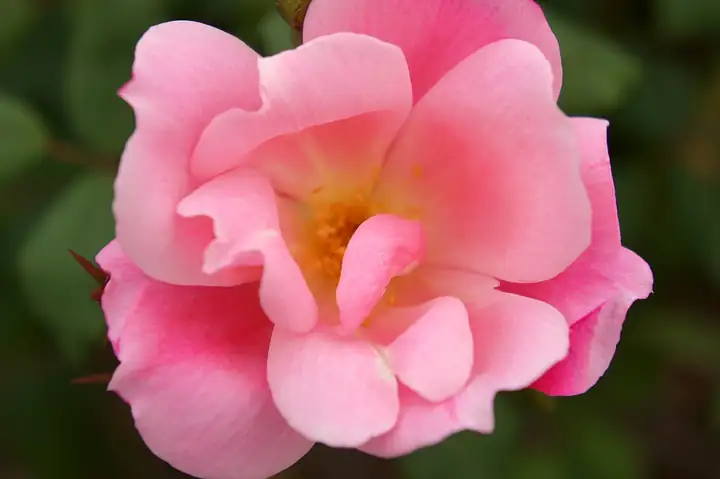
Rose (garden and landscape roses)
Rosa hybrids (hybrid tea, floribunda, grandiflora, shrub, climbing and miniature roses) · Rose family (Rosaceae)
When to plant: Plant bare-root roses while dormant (late winter or early spring in most places; December-January in Florida) and container roses any time the soil can be worked (Clemson, Oklahoma State, UF).
| Hardiness zones | 3 to 10 |
|---|---|
| Sun | full sun |
| Water | high |
| Life cycle | perennial |
| Frost | Hardy: takes frost |
| Spacing | 24 to 48 inches |
About Rose (garden and landscape roses)
Garden roses are thorny flowering shrubs and climbers. Hybrid teas carry one large, shapely bloom on a long stem for cutting; floribundas are shorter and bloom in clusters; shrub roses like Knock Out are tough, disease-resistant landscape plants that bloom all season. The old apothecary rose has its own entry.
Hardiness depends on the type: Canadian Explorer and Minnesota-bred shrub roses survive zone 3 winters (UMN), while hybrid teas and tea roses are more tender (University of Missouri). UF/IFAS grows roses across Florida and suggests grafted plants there be on Fortuniana rootstock.
When to plant
Plant bare-root roses while dormant (late winter or early spring in most places; December-January in Florida) and container roses any time the soil can be worked (Clemson, Oklahoma State, UF).
Set the graft union just above the soil in the South (Clemson, UGA) or 2 inches below in cold areas (Missouri). Space hybrid teas and floribundas 2-4 ft apart, vigorous types 4-6 ft, climbers 6-10 ft (Oklahoma State).
Soil
Loose, well-drained soil with plenty of organic matter; Oklahoma State puts the ideal pH near 6.0. Morning sun helps dry the leaves and cut disease (Clemson).
Mix plenty of organic matter into loose, well-drained soil (Clemson suggests about one part peat moss or rotted manure to three parts native soil; UGA at least 4 inches of organic matter); Oklahoma State targets pH about 6.0.
Feeding
- When plants leaf out in spring (Oklahoma State: about April 1, or 4-6 weeks after planting): rose fertilizer or slow-release shrub fertilizer; UGA uses 16-4-8 or 12-4-8. UGA: about 3 Tbsp per plant scratched into moist soil in a circle around the plant, then watered in; follow a soil test.
Look for: a balanced or all-purpose fertilizer at the label rate. Skip high-phosphorus "bloom boosters" unless a soil test shows low phosphorus: most garden soils already have enough, and the extra can wash into streams. - After each flush of bloom (UGA: monthly March-September): the same fertilizer. Repeat after each bloom cycle; Clemson suggests about half rates in June, July and August.
Look for: a balanced or all-purpose fertilizer at the label rate. Skip high-phosphorus "bloom boosters" unless a soil test shows low phosphorus: most garden soils already have enough, and the extra can wash into streams. - Late season: stop feeding. Stop about six weeks before your first fall frost (Clemson); Oklahoma State stops after July 15. Composted manure can be used as a top dressing.
Look for: a balanced or all-purpose fertilizer at the label rate. Skip high-phosphorus "bloom boosters" unless a soil test shows low phosphorus: most garden soils already have enough, and the extra can wash into streams.
Late feeding keeps plants soft going into winter. Wet leaves in the evening invite black spot; water at the soil with a soaker hose (Clemson).
Harvest
Repeat bloomers flower from late spring to frost; once-bloomers and many climbers bloom only in spring. Deadhead by cutting just above a five- or seven-leaf leaflet, and stop deadheading late in the season so plants can harden (Clemson, NC State). Prune repeat bloomers in early spring as buds swell; prune once-bloomers right after they flower (Clemson).
Varieties (21)
| Variety | Type | Season and days | Zones | Notes |
|---|---|---|---|---|
| Mutabilis | China rose | Repeat bloom | 6–10 | Flowers change color as they age; 5-6 ft. Earth-Kind designated; recommended for Florida by UF/IFAS. Sources: [1][9][11] |
| New Dawn | Climber (large-flowered) | Repeat bloom | 5–9 | Vigorous climber, 10-20 ft; tolerates some shade. Earth-Kind designated. Sources: [1][5][11] |
| Sea Foam | Climber (mannerly) | Repeat bloom | 4–9 | 8-10 ft climber. Earth-Kind designated. Sources: [11] |
| Sexy Rexy | Floribunda | Repeat bloom | 3–10typical for rose | Resists black spot and powdery mildew. Sources: [1][3] |
| Sunsprite | Floribunda | Repeat bloom | 3–10typical for rose | Recommended for Georgia by UGA. Sources: [5] |
| Queen Elizabeth | Grandiflora | Repeat bloom | 3–10typical for rose | Recommended for Georgia by UGA. Sources: [5] |
| Chrysler Imperial | Hybrid tea | Repeat bloom | 3–10typical for rose | Recommended for Georgia by UGA. Sources: [5] |
| Pride 'n' Joy | Hybrid tea | Repeat bloom | 3–10typical for rose | Resists black spot and powdery mildew. Sources: [3] |
| Louis Philippe | Old garden rose | Repeat bloom | 3–10typical for rose | Recommended for Florida by UF/IFAS. Sources: [9] |
| Cecile Brunner | Polyantha | Repeat bloom | 3–10typical for rose | Small shrub with tiny hybrid-tea-shaped buds; about 4 ft. Earth-Kind designated. Sources: [11] |
| Belinda's Dream | Shrub rose | Repeat bloom | 3–10typical for rose | Medium shrub, 5-6 ft. Earth-Kind designated for heat, drought and pest tolerance (Texas A&M program). Sources: [11] |
| Bonica | Shrub rose | Repeat bloom | 3–10typical for rose | Recommended for Georgia by UGA. Sources: [5] |
| Caldwell Pink | Shrub rose | Repeat bloom | 3–10typical for rose | Small shrub, about 4 ft. Earth-Kind designated. Sources: [11] |
| Carefree Beauty | Shrub rose | Repeat bloom | 3–10typical for rose | Semi-double pink, fragrant, disease resistant, very winter hardy, with winter hips. A Griffith Buck rose from Iowa State University; Earth-Kind designated. Sources: [6][8][11] |
| Knock Out ('Radrazz') | Shrub rose | Late spring to frost, nearly continuous | 3–10typical for rose | Red flowers; about 3 ft tall and wide in the patent (Missouri says up to 6 ft); excellent resistance to black spot and rust; winter hardy. Bred by William Radler from 'Carefree Beauty' ancestry; US Plant Patent 11,836 (2001); 2000 All-America Rose Selections winner; an Earth-Kind rose. Sources: [6][11][12] |
| Northern Accents Lena | Shrub rose | Repeat bloom | 3–10typical for rose | Pink-and-white five-petal flowers; 3-4 ft. University of Minnesota release (2008). Sources: [13] |
| Northern Accents Sven | Shrub rose | Repeat bloom | 3–10typical for rose | Fragrant double flowers, pink to pale violet; 3-4 ft. University of Minnesota release (2008); survived -47 F without protection. Sources: [8][13] |
| Summer Waltz | Shrub rose | Repeat bloom | 3–10typical for rose | Medium pink double, cupped 3.5-inch flowers with a light scent; 4-4.5 ft. University of Minnesota release (2012). Sources: [13] |
| Champlain | Shrub rose (Canadian Explorer) | May to frost | 3+ | Compact, rich velvety red, extremely hardy. Explorer roses are hardy to zone 3 and disease resistant (UMN). Sources: [6][8] |
| Marie Daly | Shrub rose (polyantha) | Repeat bloom | 3–10typical for rose | Dwarf pink shrub, 3-4 ft; resists spider mites. Earth-Kind designated. Sources: [11] |
| The Fairy | Shrub rose (polyantha) | Repeat bloom | 3–10typical for rose | Dwarf, cascading shrub with light pink flowers, 3-4 ft. Earth-Kind designated. Sources: [11] |
Pests to watch for
Japanese beetle, Rose chafer, Aphids, Twospotted spider mite, Thrips, Leafhoppers, Sawflies (garden sawflies), Eriophyid mites (rust, bud, blister and gall mites), Mice (house mice and deer mice), Rose sawflies (roseslugs), Rose midge, Four-lined plant bug, Tobacco budworm (geranium or petunia budworm), Bagworm, Winter moth
Diseases and problems
Black spot, Powdery mildew, Rose rosette, Rust, Botrytis blight, Cane canker, Crown gall, Nitrogen deficiency, Rose mosaic
In the kitchen
Rose hips can go into jelly, jam and tea (NC State).
Keeping it: Recut stems and change the water every couple of days; keep the vase cool and away from fruit.
Safety: The ASPCA lists roses as non-toxic; the main hazard is the thorny canes, so wear gloves.
Pets: Not toxic to dogs, cats or horses (ASPCA)
Sources
- hgic.clemson.edu
- hgic.clemson.edu
- hgic.clemson.edu
- plants.ces.ncsu.edu
- fieldreport.caes.uga.edu
- extension.missouri.edu
- extension.okstate.edu
- extension.umn.edu
- gardeningsolutions.ifas.ufl.edu
- aspca.org
- hgic.clemson.edu
- patents.google.com
- mnhardy.umn.edu
Photo: Photo: T.Kiya, CC BY-SA 2.0, via Wikimedia Commons (CC BY-SA 2.0). Photo resized for the web.

Planting dates and advice are general guidance; check with your local Cooperative Extension office for your area.