
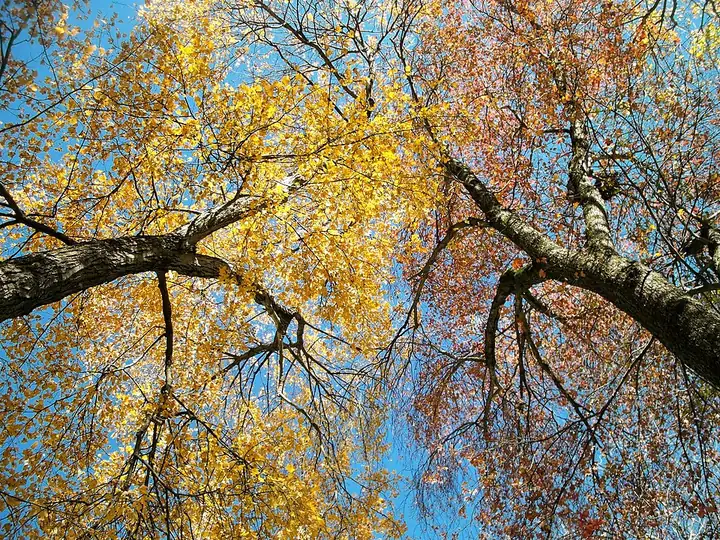
Red maple
Acer rubrum · Soapberry family (Sapindaceae; maples were formerly Aceraceae)
When to plant: Container trees can go in any time the ground can be worked, but fall is the best season in the South because roots keep growing through mild weather (Clemson).
| Hardiness zones | 2 to 9 |
|---|---|
| Sun | full sun to part shade |
| Water | moderate |
| Life cycle | perennial |
| Frost | Hardy: takes frost |
About Red maple
Red maple is a fast-growing native shade tree of eastern North America. It has red flowers in late winter, red leaf stalks and twigs, and dependable red, orange or yellow fall color, and it handles wet or dry sites. Its shallow roots can lift sidewalks and make it hard to grow plants under it, and its wilted leaves are poisonous to horses.
Hardy in zones 2-9 (NC State). In alkaline soil the leaves often yellow from a manganese shortage.
When to plant
Container trees can go in any time the ground can be worked, but fall is the best season in the South because roots keep growing through mild weather (Clemson).
Plant container or balled-and-burlapped trees. Dig the hole no deeper than the root ball and at least twice as wide, keep the top roots level with the soil, and mulch 2-4 inches without touching the trunk. Give it room (NC State suggests 60 ft or more) and keep it away from sidewalks, driveways and septic lines. Wind and ice can break branches.
Soil
Clay, loam or sand; best in moist, slightly acidic soil. It tolerates occasional flooding, compaction, drought, heat and city conditions (NC State).
Test the soil first. Loosen a wide planting area and mix 10-20 percent compost into the native soil you dig out; don't use uncomposted bark, and don't dig deeper than the root ball (Clemson).
Feeding
- Spring to early summer, after the tree is established, and only if a soil test or pale leaves and weak twig growth show a need: slow-release nitrogen fertilizer with a ratio near 3-1-1 or 3-1-2 (3-0-1 or 3-0-2 if the soil test shows enough phosphorus). Spread it evenly from just outside the trunk flare to the dripline and water it in. Clemson cites 2-4 lb of slow-release nitrogen per 1,000 sq ft per year, split into a spring and a late-summer feeding; follow your soil test.
Look for: mostly nitrogen, in spring as growth starts. Spring feeding grows the new shoots and leaves that carry flowers and fruit; feeding after midsummer pushes soft growth that may not harden before winter. - Late summer to early fall, the second half of the year's split feeding (only if a soil test calls for it): slow-release nitrogen fertilizer, same as spring. Clemson advises giving red and sugar maples only part of the year's amount late in the season; water in, and skip it if the tree is drought-stressed.
Look for: mostly nitrogen, in spring as growth starts. Spring feeding grows the new shoots and leaves that carry flowers and fruit; feeding after midsummer pushes soft growth that may not harden before winter.
First-year watering matters far more than fertilizer: water daily for the first 1-2 weeks, every 2-3 days until week 12, then weekly, using about 1-1.5 gallons per inch of trunk diameter, until the tree is established, roughly 1.5 years per inch of trunk (UMN). Don't count on rain unless it was over an inch. Alkaline soil causes yellow leaves from manganese shortage; fix the pH rather than adding more fertilizer (Clemson, NC State). Too much fertilizer can burn roots and push soft growth that pests and cold injure (Clemson).
Varieties (13)
NC State documents these cultivars; most are selected for form and fall color.
| Variety | Type | Zones | Notes |
|---|---|---|---|
| Armstrong Gold | Columnar | 2–9typical for red maple | Narrow, dense, compact column with improved fall color. Sources: [1] |
| Bowhall | Columnar | 2–9typical for red maple | Narrow, tight pyramid with brilliant fall color. Sources: [1] |
| Red Rocket | Columnar | 2–9typical for red maple | Narrow column with consistent red fall color. Sources: [1] |
| Karpick | Narrow | 2–9typical for red maple | Male tree about 20 ft wide; yellow or red fall color. Sources: [1] |
| Autumn Fantasy | Shade tree | 2–9typical for red maple | Fast-growing with good branch angles and steady red fall color. Sources: [1] |
| Autumn Radiance | Shade tree | 2–9typical for red maple | Good shade tree with reliable red fall color; does poorly in alkaline soil. Sources: [1] |
| Brandywine | Shade tree | 2–9typical for red maple | Male (seedless) tree with intense, dependable fall color. Sources: [1] |
| Embers | Shade tree | 2–9typical for red maple | Fast-growing, dense rounded crown; showy spring flowers and fall color. Sources: [1] |
| October Glory | Shade tree | 2–9typical for red maple | Female tree with exceptional fall color. Sources: [1] |
| Red Sunset | Shade tree | 2–9typical for red maple | Brilliant orange-scarlet fall color that comes early; a good shade tree. Sources: [1] |
| Somerset | Shade tree | 2–9typical for red maple | About 23 ft tall; long-lasting red fall color. Sources: [1] |
| Summer Red | Shade tree | 2–9typical for red maple | 35-40 ft tall; leaves emerge burgundy-red, then yellow, orange and purple in fall. Sources: [1] |
| Sun Valley | Shade tree | 2–9typical for red maple | Male tree, smaller and more symmetrical. Sources: [1] |
Pests to watch for
Aphids, Leafhoppers, Scale insects, Annual cicadas (dog-day cicadas), Boxelder bugs, Asian longhorned beetle, Winter moth, Cankerworms (fall and spring cankerworms)
Diseases and problems
Verticillium wilt, Canker, Leaf spot, Root rot, Chlorosis, Drought stress, Leaf scorch, Winter injury, Mechanical damage (mower, trimmer and tie wounds), Girdling roots, Bacterial leaf scorch
In the kitchen
The sap can be boiled into maple syrup, though it gives about half as much as sugar maple (NC State).
Pets: Toxic to horses (ASPCA): wilted leaves are the most dangerous; tannins and gallic acid damage red blood cells and can cause weakness, dark gums, discolored urine, laminitis and abortion. Not toxic to dogs or cats (ASPCA).
Sources
Photo: Photo: EgorovaSvetlana / Wikimedia Commons, CC BY-SA 4.0 (CC BY-SA 4.0). Photo resized for the web.

Planting dates and advice are general guidance; check with your local Cooperative Extension office for your area.