
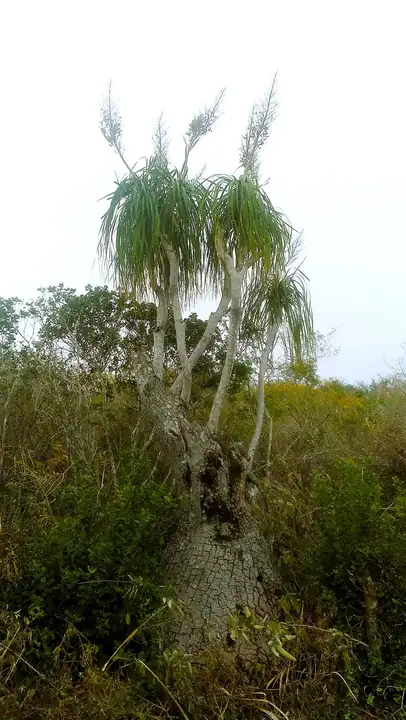
Ponytail palm
Beaucarnea recurvata · Asparagus family (Asparagaceae)
When to plant: Any time of year, since it grows indoors. It can stay in the same pot for many years; repot only when you want it to grow bigger.
| Hardiness zones | 10 to 11 |
|---|---|
| Sun | full sun |
| Water | low |
| Life cycle | perennial |
| Frost | Tender: killed by frost |
Will it grow in your window?
Pick the window it sits in. This is the same check Sow & Tell runs for every plant in your house.
It wants bright, direct light.
Pick a window above and this will tell you whether the spot suits it.
Watering: soak it, then let it dry right out — about every 14 days, stretching to every 28 from November to February.
Summering outside? Bring it in before nights drop below 50°F.
About Ponytail palm
The ponytail palm is not a palm but a slow-growing desert plant from the rocky hills of eastern Mexico, with a swollen water-storing base (the 'elephant foot') and a fountain of long, narrow, curling leaves. It is one of the easiest houseplants for a sunny window: it tolerates heated winter air, needs water only now and then, and can live for decades in the same pot (NC State, Wisconsin Horticulture). The ASPCA lists it as non-toxic to cats, dogs and horses.
Hardy outdoors only in zones 10-11 (NC State); it is grown indoors everywhere and can summer outdoors on a protected patio, moved into sun gradually, once nights stay above 50 F, which NC State gives as its cold limit.
When to plant
Any time of year, since it grows indoors. It can stay in the same pot for many years; repot only when you want it to grow bigger.
Bought as a nursery plant; seed is the only way to raise a new one, and seed is rarely sold (Wisconsin Horticulture).
Growing it indoors
- Light: It is a desert plant adapted to bright light, so give it the brightest, sunniest window you have (NC State, Wisconsin Horticulture); MU Extension says filtered to bright light will do.
- Water: In summer water deeply but infrequently and let the mix dry out completely between waterings; in winter cut watering back sharply, since it prefers a dry winter and winter overwatering rots the roots (NC State, Wisconsin Horticulture). Overwatering is the most common cause of failure, and a pot without a drainage hole is asking for it (UGA).
- Humidity: It tolerates the dry heated air that stresses most houseplants (NC State).
- Temperature: Hardy to 50 F (NC State); move it outdoors only when nights are above that, and adjust it to temperature changes gradually.
- Feeding: Feed once or twice during the growing season with a houseplant fertilizer, and not at all in winter (Wisconsin Horticulture).
- Repotting: It can go many years in the same pot; repot only when you want it to grow bigger, since a larger pot lets the trunk thicken and the plant gain height (Wisconsin Horticulture).
- More plants: Seed sown in spring at 68 F or warmer germinates readily, but it is seldom available; the offsets that form on the base will not root into new plants, and cutting the top off a small plant makes it branch (Wisconsin Horticulture).
If something looks wrong
| What you see | Likely cause | What to do |
|---|---|---|
| Soft, spongy trunk base and yellowing leaves, mix stays wet | Root or stem rot from overwatering, especially in winter | Stop watering until the mix is bone dry, check the drainage hole, and repot into dry cactus mix if the base is still firm (Wisconsin Horticulture, NC State). |
| Brown leaf tips | Too much or too little water, too much fertilizer, or salt buildup | Trim the dead tips, flush the pot with plain water, and ease up on fertilizer (Wisconsin Horticulture). |
| Cottony tufts or brown bumps down in the leaf bases | Mealybugs or scale | Dab them with a cotton swab dipped in rubbing alcohol and repeat weekly (NC State, Wisconsin Horticulture). |
Soil
A well-drained cactus and succulent mix, or regular potting mix with sharp sand or fine gravel added, in a pot with a drainage hole (NC State, Wisconsin Horticulture, UGA).
Pot in a cactus and succulent mix, or potting mix with sharp sand or fine gravel added, in a container with a drainage hole (Wisconsin Horticulture, NC State, UGA).
Feeding
- Growing season, late spring and summer: houseplant fertilizer. Feed once or twice during the growing season (Wisconsin Horticulture); water first.
- Fall and winter: none. No feeding while it rests dry (Wisconsin Horticulture).
Excess fertilizer and salt buildup brown the leaf tips; flush the pot with plain water now and then (Wisconsin Horticulture).
Pests to watch for
Diseases and problems
Root and crown rot, Stem rot, Leaf spots
In the kitchen
Safety: NC State lists no poison hazard and tags it pet friendly; the only caution is that the fine-toothed leaf edges can cut skin, so handle the leaves with care (Wisconsin Horticulture).
Pets: Non-toxic to dogs, cats and horses (ASPCA, listed under bottle palm, Beaucarnea recurvata).
Sources
Photo: Photo: tereso30, CC BY 4.0, via Wikimedia Commons (CC BY 4.0). Photo resized for the web.

Planting dates and advice are general guidance; check with your local Cooperative Extension office for your area.