
Pipicha
Porophyllum linaria (also sold as P. tagetoides) · Daisy family (Asteraceae)
When to plant: It is a warm-climate Mexican herb (UNAM), so plant it after the last frost as you would pápalo.
| Hardiness zones | 3 to 11 |
|---|---|
| Sun | full sun |
| Water | moderate |
| Life cycle | annual |
| Frost | Tender: killed by frost |
About Pipicha
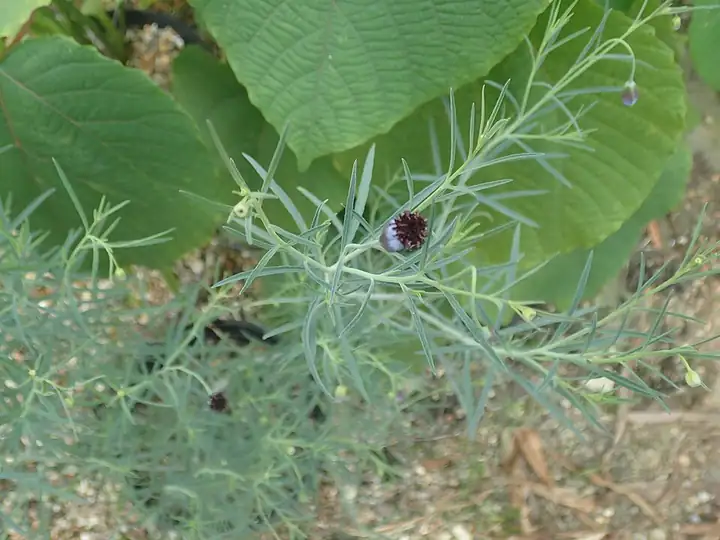
Pipicha (also pepicha or chepiche) is a small Mexican herb, about 4 to 20 inches tall, with thin, needle-like leaves and red-purple flower heads. Its strong scent mixes cilantro, lemon, anise, pine and mint, and the young leaves are eaten fresh in salsas, stews and tamales in Mexico. It is pápalo's slender cousin and is rarely covered by U.S. garden sources, so expect to experiment.
Grown as a summer annual in every zone; frost kills it. No source we opened gives a hardiness range or U.S. growing guide. It is native only to Mexico and is a warm-climate plant; Mexican university sources call it an annual in one study and a perennial in another, so in the U.S. treat it as a summer herb planted after frost.
When to plant
It is a warm-climate Mexican herb (UNAM), so plant it after the last frost as you would pápalo.
We found no university planting guide for pipicha.
Soil
No source we found describes its soil needs; its close cousin pápalo grows best in sun and well-drained soil (U.S. Botanic Garden), so start there.
No source gives soil or fertilizer advice for pipicha; well-drained soil with a little compost, as for pápalo, is a reasonable start, and follow a soil test.
Feeding
Look for: a light, all-purpose or nitrogen fertilizer. Herbs are grown for fresh leaves to pick, so a little nitrogen keeps new growth coming; most need only light feeding.
Harvest
Pick the young, tender leaves and stems; these have the best flavor (UNAM).
In the kitchen
Eat the young leaves fresh as a seasoning in salsas, stews and tamales; the flavor is intense, like cilantro with lemon and anise (UNAM).
Keeping it: Pick young leaves and stems just before using; like other tender herbs, they keep only a few days in the refrigerator.
Safety: We found no NIH or MSKCC review of pipicha, and a 2021 review of the Porophyllum genus says very few toxicity studies exist. Use it in normal food amounts as a fresh herb.
Pets: Not listed by the ASPCA
Sources
Photo: Photo: peganum, CC BY-SA 2.0, via Wikimedia Commons (CC BY-SA 2.0). Photo resized for the web.

Planting dates and advice are general guidance; check with your local Cooperative Extension office for your area.