
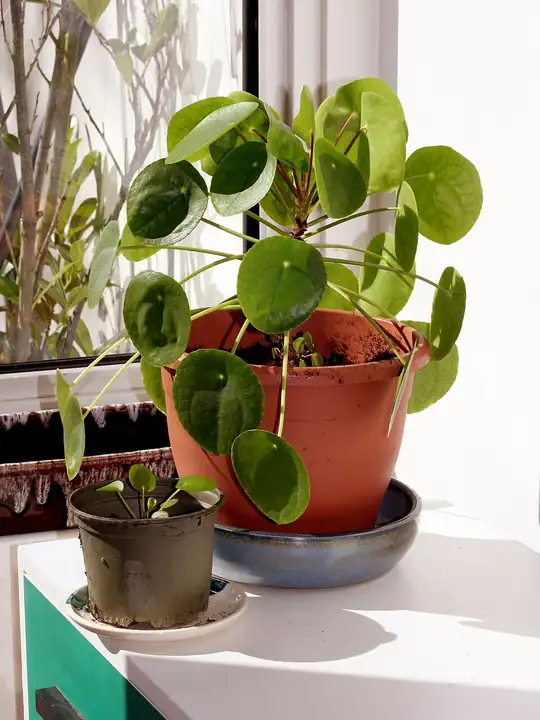
Pilea (Chinese money plant)
Pilea peperomioides · Nettle family (Urticaceae)
When to plant: Any time of year, since it grows indoors. Repot in spring when roots fill the pot and pot up the pups then; spring and early summer are best for cuttings.
| Hardiness zones | 9 to 11 |
|---|---|
| Sun | part shade |
| Water | moderate |
| Life cycle | perennial |
| Frost | Tender: killed by frost |
Will it grow in your window?
Pick the window it sits in. This is the same check Sow & Tell runs for every plant in your house.
It wants bright, indirect light.
Pick a window above and this will tell you whether the spot suits it.
Watering: water when the top inch is dry — about every 7 days, stretching to every 12 from November to February.
About Pilea (Chinese money plant)
The Chinese money plant is a compact, fast-growing houseplant from the cool, shady mountains of Yunnan in southern China, with round, glossy, coin-shaped leaves held on long stalks that attach at the center of each leaf, so the leaves seem to float (NC State). It makes pups around its base that are easy to pot up and give away, which is why it is also called the friendship or missionary plant. NC State calls it safe for pets and children.
Hardy outdoors only in zones 9-11 (NC State); it is grown indoors everywhere and can summer outdoors in shade while nights stay above about 50 F, coming in before fall nights dip toward 45-50 F (UMN Extension's general cutoff for tender houseplants).
When to plant
Any time of year, since it grows indoors. Repot in spring when roots fill the pot and pot up the pups then; spring and early summer are best for cuttings.
Usually bought as a nursery plant or started from a pup or stem cutting from someone else's plant (NC State).
Growing it indoors
- Light: Bright, indirect light suits it best; too little light makes it leggy, with long bare stalks (NC State), while dappled light or a few hours of gentle direct sun are fine.
- Water: Keep the mix lightly moist but never soggy: water thoroughly when the top inch feels dry, let it drain and empty the saucer (Wisconsin's finger test), since overwatering rots the roots (NC State). Water less in winter, when growth slows.
- Humidity: It thrives in moderate to high humidity but does fine in ordinary home air (NC State).
- Temperature: NC State gives no number, only to keep it away from cold drafts and heat sources; MU Extension's table puts pileas at about 65 F nights, though that entry is for the aluminum plant cousin.
- Feeding: NC State gives no feeding advice; the general Extension rule is a complete houseplant fertilizer such as 20-20-20 about monthly while it is making new leaves and none in winter (MU Extension, Wisconsin).
- Repotting: Repot in spring when roots poke out of the drainage holes or the mix dries much faster than before, one pot size up in fresh soilless mix (Wisconsin's general rule); it is also a good time to pull off pups.
- More plants: Pups (offsets) that come up around the base can be cut off and potted, and stem cuttings root too; spring and early summer, while it is growing, are the best times (NC State).
If something looks wrong
| What you see | Likely cause | What to do |
|---|---|---|
| Long bare leaf stalks, small leaves, plant leaning toward the window | Too little light | Move it to brighter indirect light (NC State). |
| Yellow, drooping leaves and soggy mix | Overwatering and root rot | Let the mix dry, check the drainage hole, and repot in fresh mix if the roots are brown and mushy (NC State, Wisconsin). |
| Spots on the leaves | Leaf spot from wet foliage | Water the mix, not the leaves, and pick off badly spotted leaves (NC State). |
| Fine webbing and stippled leaves, or cottony tufts | Spider mites or mealybugs | Wash or wipe the leaves; spider mites like hot, dry rooms, so raising the humidity helps keep them down (NC State, Wisconsin). |
Soil
A moist but well-drained potting mix in a pot with a drainage hole; NC State lists a sandy or loamy mix, acid to neutral.
Pot in a moist but well-drained soilless potting mix in a container with a drainage hole (NC State, Wisconsin).
Feeding
- Spring through summer, while new leaves and pups are coming: complete houseplant fertilizer such as 20-20-20. About once a month (MU Extension) or every one to two months (Wisconsin), following the label; NC State gives no rate for this plant.
- Winter, or any time no new growth is showing: none. Skip feeding until growth starts again (MU Extension, Wisconsin).
Overfeeding can burn the leaves (Wisconsin), and feeding a plant in soggy mix or dim light won't fix problems caused by water or light.
Pests to watch for
Twospotted spider mite, Mealybugs, Fungus gnats, Scale insects
Diseases and problems
Root and crown rot, Leaf spots (wet leaves)
In the kitchen
Safety: NC State describes it as safe for pets and children and gives it no poison rating. As with any houseplant, keep small children from chewing the leaves.
Pets: Not listed by the ASPCA under this species; the ASPCA lists its cousins aluminum plant (Pilea cadierei) and friendship plant (P. involucrata) as non-toxic to dogs, cats and horses, and NC State calls the Chinese money plant safe for pets.
Sources
Photo: Photo: Husky, CC0, via Wikimedia Commons (CC0). Photo resized for the web.

Planting dates and advice are general guidance; check with your local Cooperative Extension office for your area.