
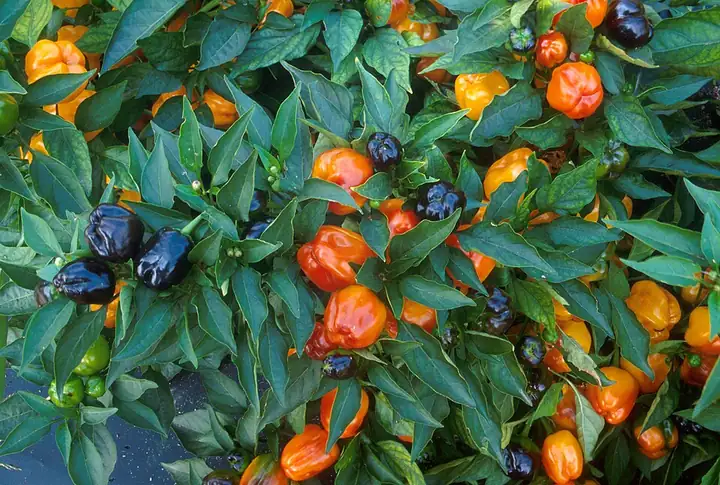
Pepper (sweet and chili)
Capsicum annuum (most sweet and chili types); habanero and Scotch bonnet are C. chinense, Tabasco is C. frutescens · Nightshade family (Solanaceae)
When to plant: Start seeds indoors 6 to 8 weeks before the last frost and set out plants 2 to 3 weeks after the last frost.
| Hardiness zones | 3 to 11 |
|---|---|
| Sun | full sun |
| Water | moderate |
| Life cycle | tender perennial (grown as an annual) |
| Frost | Tender: killed by frost |
| Soil pH | 6.0–7.0 |
| Spacing | 18 to 24 inches |
| Days to harvest | 70 to 85 days |
| Soil temperature to plant | at least 60°F |
About Pepper (sweet and chili)
Peppers include mild types like bell, banana and pimento and hot types like jalapeno, cayenne and habanero. They are slow, warmth-loving plants that reward a sunny spot with a long run of pods from midsummer to frost. The heat in chilies comes from capsaicin, concentrated in the pale membrane inside the pod.
Grown as a warm-season annual in every zone; it is killed by frost, so plant it out after the danger of frost has passed. Plants sulk and drop blossoms when nights fall below about 60F or days pass 90F.
When to plant
Timing is counted from your average last spring frost (and first fall frost). Sow & Tell works out the actual dates for your ZIP code.
- Start seeds indoors: 6 to 8 weeks before the last frost
- Set out plants: 2 to 3 weeks after the last frost
Days to harvest count from transplanting (about 100 to 120 days from seed). Set plants out once nights stay above 50F; seed comes up slowly in cool soil.
Soil
Well-drained loam or sandy loam; avoid heavy nitrogen, which gives big leafy plants that are slow to set fruit.
Follow a soil test; aim for pH 6.0 to 6.5, work in compost or well-rotted manure, and till any pre-plant fertilizer about 6 inches deep.
Feeding
- 3 to 4 weeks after setting out transplants: nitrogen fertilizer such as calcium nitrate (15.5-0-0). Spread about 1/2 lb per 100 sq ft (about 30 ft of row) 4 to 6 inches from the plants and water it in, rinsing any granules off the leaves.
Look for: nitrogen, in a light feeding. Early on the plant needs leaves to feed its fruit later, but too much nitrogen makes a big leafy plant that is slow to flower. Later, when flowers open and the first small fruits form, switch to a lower-nitrogen fertilizer such as 5-10-15 or 6-12-12. - 3 to 4 weeks after the first feeding: a lower-nitrogen fertilizer such as 5-10-15 or 6-12-12. Use the bag's rate for vegetables, scatter it beside the plants (not against the stems) and water it in.
Look for: lower nitrogen, more phosphorus and potassium, such as 5-10-15 or 6-12-12. Now the plant should put its energy into flowers and fruit. Extra nitrogen at this stage grows leaves instead and can make blossoms drop; phosphorus helps only if your soil is short of it (a soil test tells you).
Too much nitrogen gives bushy, leafy plants that are slow to bear; skip extra phosphorus unless a soil test calls for it.
Harvest
Pick when pods reach full size and the walls feel firm, or leave them on to turn red, yellow or orange. Jalapenos are picked when they turn black-green. Cut the stem instead of pulling so branches do not snap.
Peppers keep flowering and setting new pods as long as you keep harvesting, from about July until frost kills the plant; cut pods off with shears so branches don't snap. They are frost-tender perennials grown as annuals, so before a killing frost pull whole plants and hang them upside down in a garage or other sheltered spot to finish ripening the last pods.
Varieties (82)
| Variety | Type | Season and days | Notes |
|---|---|---|---|
| Mad Hatter | Bishop's crown type (Capsicum baccatum, hybrid) | Mild. It earned the top flavor score (5 out of 5) in a University of Wisconsin trial. Odd, flattened three-cornered 'bishop's crown' shape; fruit were about 1.5 in across in the Wisconsin trial and ripen red. UT Gardens calls the harvest impressive. 2017 All-America Selections winner. AAS judges praised its vigor, earliness and yield, even in cool, damp Northeast summers and humid Mississippi heat. Sources: [12][13][14][15] | |
| Shishito | Frying pepper (Japanese) | Mostly mild, but an occasional pod can be hot (about 50 to 2,500 Scoville units). Small, thin-walled frying pepper, similar to Padrón. Sources: [16] | |
| Padrón | Frying pepper (Spanish) | Mostly mild, but some pods can be very hot (about 50 to 2,500 Scoville units). Elongated, thin-fleshed frying pepper about 2 inches long, from Spain. Sources: [16][17] | |
| Habanada | Heatless habanero (Capsicum chinense) | No heat; habanero aroma that mellows into fruity sweetness. Light green fruit ripen to bright orange. Needs a long, warm season; Cornell suggests a high tunnel in the North. Bred at Cornell University by Michael Mazourek. Oregon State and Maryland Extension list it among heatless habanero types. Sources: [16][18][19] | |
| Roulette | Heatless habanero (Capsicum chinense, hybrid) | Habanero fruitiness with almost no heat. Looks like a red habanero; fruit were about 1.5 in in a Wisconsin trial. UT Gardens calls it very productive. 2018 All-America Selections winner. Tennessee Extension lists it as a habanero that is not as hot. Sources: [13][14][15][20] | |
| Datil | Hot (Capsicum chinense) | Starts bearing 3 to 5 months after planting; in Florida, harvest runs July to November. | About as hot as a habanero (100,000-300,000 Scoville units), with a sweet, fruity tang. Small fruit, 1/2 to 4 in long, that ripen from green to orange. Plants grow 1.5 to 5.5 ft tall. Grown around St. Augustine, Florida, since the 1700s and used in local hot sauces and jellies. UF/IFAS notes it does well with some shade. Sources: [21] |
| Tabasco | Hot (Capsicum frutescens) | Late · 95 days | Very hot; about 30,000 to 50,000 Scoville units. Small, slim pods 1 to 3 inches, yellow ripening to red, held upright on the plant. Named for the hot sauce made from it. Sources: [15][16][22][23] |
| Mexibell | Hot bell (hybrid) | 58 days | Mildly pungent; Oregon State puts hot bells at about 500 to 4,000 Scoville units. Three-lobed bell, green ripening to red, on plants about 26 inches tall. Resistant to TMV. All-America Selections winner. Sources: [16][22][24][25] |
| Charleston Hot | Hot cayenne | Very hot. Open-pollinated, vigorous, high-yielding cayenne on plants about 18 inches tall. Fruit ripens from yellow-green to gold, orange and then deep red. Resistant to southern root-knot nematode. Adapted to the Southeast. Sources: [26][27] | |
| Cherry Bomb | Hot cherry (hybrid) | Early · 65 days | About 20 percent less heat than a jalapeño. Round, hanging fruit about 1.5 inches across, green ripening red, on compact plants; very early and high yielding. Resistant to TMV. Sources: [26][27][28] |
| Hot Sunset | Hot wax / banana (hybrid) | Moderately spicy; AAS lists about 650 Scoville units. It scored 4 out of 5 for flavor in a Wisconsin trial. Long banana-shaped fruit about 7 in long that ripen to orange-red; heavy harvest in the Wisconsin trial. Cornell lists resistance to bacterial leaf spot and tomato spotted wilt virus. 2015 All-America Selections winner. Sources: [13][15][29][30][31] | |
| Lemon Drop | Hot, aji type (Capsicum baccatum) | Hot with a citrus flavor. An aji-type C. baccatum pepper. Popular for seasoning in Peru. Oregon State lists it among C. baccatum peppers for home gardens. Sources: [16][32] | |
| Aji Rico | Hot, aji type (Capsicum baccatum, hybrid) | Citrusy with medium heat. It scored 3.5 out of 5 for flavor in a Wisconsin trial. Narrow, cone-shaped fruit about 3 in long that ripen from green to red; abundant harvest in the Wisconsin trial. 2017 All-America Selections winner. AAS calls it the first hybrid C. baccatum hot pepper bred to ripen early enough for short seasons. Sources: [13][15][16][31][33] | |
| Long Red Cayenne | Hot, cayenne | Midseason · 65 to 75 days | Very hot; about 35,000 Scoville units. Long, slender, wrinkled, thin-walled pods (5 to 6 inches) that ripen from dark green to bright red. Also sold as 'Cayenne Long Slim'. Sources: [26][34][35][36] |
| Fresno | Hot, Fresno chile | Hot. Smooth, cone-shaped light green fruit about 1-2 in long, held pointing up on vigorous plants 2-2.5 ft tall with dense, dark leaves. Resistant to tobacco mosaic virus. Introduced in California in 1952. Mississippi State Extension's Gary Bachman grows it as a culinary pepper. Sources: [15][26][30][37] | |
| Habanero | Hot, habanero (Capsicum chinense) | Late · 90 to 100 days | Extremely hot; about 200,000 to 300,000 Scoville units. Small, wrinkled, lantern-shaped pods, about 2 inches long, green ripening to orange. Sources: [23][26][34][35][38] |
| Scotch Bonnet | Hot, habanero type (Capsicum chinense) | Very hot (Oregon State gives 100,000 to over 1,000,000 Scoville units for this group) with a fruity, tropical aroma. Hanging (pendant) pods. Needs warm conditions; Oregon State says this species is hard to grow outdoors in cool climates without plastic mulch or a greenhouse. Sources: [2][16] | |
| Fish | Hot, heirloom (variegated leaves) | Hot. Leaves are streaked green and white. Hanging fruit about 2.5 in long start cream with green stripes, turn orange with brown stripes, then solid red. Handles heat and drought and grows well in pots. An African-American heirloom documented in Maryland in the 1800s. The pale young pods were used to spice cream sauces for seafood without changing their color. Sources: [26][39] | |
| Jalapeño | Hot, jalapeño | Midseason · 65 to 75 days | Hot; about 2,500 to 8,000 Scoville units. Thick-walled, cylindrical pods about 3 inches long, green ripening to red. Common open-pollinated strains include 'Early Jalapeño' and 'Jalapeño M'. Usually picked green when pods are full size and glossy dark green. Sources: [15][16][26][34][35][36][38] |
| Emerald Fire | Hot, jalapeño (hybrid) | Full jalapeño heat; AAS lists about 2,500 Scoville units fresh. It scored 4 out of 5 for flavor in a Wisconsin trial. Large, bullet-shaped jalapeños, dark green ripening to red; abundant harvest in the Wisconsin trial. 2015 All-America Selections winner. AAS judges saw very little cracking, even after fruit turned red. Sources: [13][15][31][40] | |
| Mucho Nacho | Hot, jalapeño (hybrid) | 72 days | A little hotter than most jalapeños; Iowa State lists 2,500-5,000 Scoville units. Long, thick-walled jalapeños about 4 in long, green ripening to red, on very vigorous, high-yielding plants. Introduced in 1999. One of the top-yielding jalapeños in a 2015 University of Delaware trial. Sources: [22][41][42] |
| Hot Portugal | Hot, long red | 64 to 85 days | Very pungent. Thick-walled, tapered fruit about 6 inches long, shiny dark green ripening to deep crimson, on tall upright plants. NC State lists 64 days; Texas A&M lists 85 days. Sources: [26][34] |
| Cayennetta | Hot, mild cayenne-type chile (hybrid) | 69 days | Mildly spicy. Red, tapered chili about 3-4 in long on upright, compact plants that need no staking. Good for containers and patios. 2012 All-America Selections winner. AAS judges noted good cold tolerance and thick leaves that shade the fruit from sunscald. Sources: [31][43][44] |
| Mariachi | Hot, mild chile (hybrid) | Early | Vigorous plant with large, thick-walled pods about 4 inches long that ripen from yellow to red. 2006 All-America Selections winner. Sources: [22][23][45] |
| TAM Mild Jalapeño | Hot, mild jalapeño | Midseason · 70 to 85 days | About one-third the heat of standard jalapeños. Compact, open-pollinated plant with thick-walled pods; resistant to several viruses and tolerant of Phytophthora root rot. Released by Texas A&M in 1981 (breeder Ben Villalon). Sources: [22][34][36][38][46] |
| Anaheim | Hot, New Mexican / Anaheim (mild) | Midseason · 75 to 80 days | Mild; about 1,000 to 5,000 Scoville units. Long, tapered pods about 7 inches, dark green ripening to red. Sources: [16][23][26][34] |
| NuMex Big Jim | Hot, New Mexican chile | Late · 85 days | Medium heat; about 6,500 Scoville units. Very long, thick, flattened pods (about 7 to 8 inches). Released by New Mexico State University in 1975; once held a record for the largest chile pod. Good for green chile and rellenos. Sources: [34][47] |
| Sandia | Hot, New Mexican chile | Hot for a New Mexican type; about 6,500 Scoville units. Long, medium-wide pods on plants 2 to 2.5 feet tall; earlier than older New Mexico types. Released by New Mexico State University in 1956 and popular with home gardeners. 'NuMex Sandia Select' (2014) is a hotter, thicker-walled update. Sources: [47] | |
| Black Pearl | Hot, ornamental | Spicy and edible. Glossy black leaves and upright clusters of small round fruit (about 0.6 in) that turn from shiny black to red. Plants about 18 in tall and 12 in wide, taller in warm regions; handles heat and humidity. Bred by USDA-ARS and the U.S. National Arboretum; 2006 All-America Selections winner. Needs full sun for the darkest leaves. Sources: [41][48][49][50] | |
| Super Chili | Hot, ornamental chile (hybrid) | Midseason · 75 to 90 days | Pungent. Compact plant with small upright pods (about 2 inches) that turn green, orange, then red. 1988 All-America Selections winner. Sources: [22][23][34][38] |
| Holy Molé | Hot, pasilla (hybrid) | Late · 85 to 105 days | Pasilla-type chile used for mole sauce. 2007 All-America Selections winner. Sources: [15][51] |
| Ancho / Poblano | Hot, poblano (mild) | Midseason to late · 68 to 90 days | Mild; about 1,000 to 2,000 Scoville units. Heart-shaped pods 3 to 4 inches wide and 4 to 7 inches long, very dark green ripening to dark red-brown. Called poblano when fresh and ancho when dried. 'Ancho 101' is a common named strain. Sources: [15][16][26][35] |
| Hidalgo Serrano | Hot, serrano | Late · 85 to 90 days | Serranos run about 7,000 to 25,000 Scoville units; Hidalgo is milder than typical serranos. Compact, open-pollinated plant with blunt-ended pods; resists several viruses and tolerates leafminers and pepper weevil. Released by Texas A&M in 1984. Sources: [34][35][36][46] |
| Carolina Reaper | Hot, superhot (Capsicum chinense) | Extreme heat; averages about 1.64 million Scoville units. Superhot chinense type; Oregon State lists it as a ghost pepper x habanero cross. Bred in Rock Hill, South Carolina; Clemson notes it was ranked the world's hottest pepper as of 2020. Sources: [2][16] | |
| Thai Hot | Hot, Thai | 75 days | Extremely hot. Small pods point upward and turn from green to red. Sources: [22][24] |
| Thai Dragon | Hot, Thai type | 60 to 90 days | Very hot; UC Santa Cruz rates it about five times hotter than a jalapeño. Heavy crop of thin-walled red peppers about 2-3.5 in long that dry quickly, on small, bushy plants. Introduced in 1994. Oklahoma State lists it as a proven variety. Likes hot days and warm nights. Sources: [22][25][52] |
| Hungarian Wax | Hot, wax type | Early to midseason · 58 to 85 days | Medium hot; wax peppers range from about 1,000 to 15,000 Scoville units. Long (about 8 inch) tapered fruit that turns from waxy yellow to crimson. An heirloom. Sweet strains are also sold, so check the label. Sources: [16][26][34][36][38] |
| El Jefe | Jalapeño (hybrid) | 67 days | Jalapeño ripening green to red. Maryland lists resistance to bacterial leaf spot (races 0 to 3, 7, 8) and PVY, and tolerance to cucumber mosaic virus. Sources: [23][53][54] |
| Señorita | Mild jalapeño | 80 to 90 days | Very mild. NC State's cultivar list puts it under 600 Scoville heat units in most conditions. Blunt jalapeño-type pods about 3 in by 1 in, dark green ripening to red. Resistant to tobacco mosaic, tobacco etch and pepper mottle viruses. Released in 1995. Texas A&M lists it at 80 days; UC Santa Cruz lists 85-90 days to green fruit. Use fresh, pickled or smoked as chipotles. Sources: [22][34][52] |
| Española Improved | New Mexican chile | Early | About 2,500 Scoville units. Open-pollinated New Mexican type with pods about 6 inches long; matures early. Released by New Mexico State University in 1984 for northern New Mexico. Sources: [26][47] |
| NuMex Joe E. Parker | New Mexican chile (mild) | Mild, about 900 Scoville units. Open-pollinated, high-yielding New Mexican type, more uniform than New Mexico 6-4; green pods ripen red. Resistant to TMV. Released by New Mexico State University in 1990; yields well for red chile and is high in vitamin C. Sources: [22][47][54] | |
| Tiburon | Poblano / ancho | 85 days | Mild, about 1,000 to 2,000 Scoville units for poblanos. Heart-shaped poblano pods about 3 to 4 inches wide and 4 to 7 inches long. Sources: [16][27][53][55] |
| Ghost Pepper (Bhut Jolokia) | Superhot (Capsicum chinense) | Extremely hot. Superhot chile grouped with habanero types; Oregon State notes Capsicum frutescens in its background. Like other C. chinense peppers, it needs warm conditions. Georgia lists it among specialty hot peppers. Sources: [2][16][17] | |
| Sweet Sunset | Sweet banana (hybrid) | Sweet; it won the taste test at one AAS trial site. Banana-type fruit that ripen from light yellow to orange-red on a compact plant. 2015 All-America Selections winner. Sources: [15][31][56] | |
| California Wonder | Sweet bell | 68 to 89 days | Large, blocky, thick-walled bell that ripens from glossy deep green to red. An old standard that Oregon State calls a dependable producer. Sources: [16][26][36] |
| Jupiter | Sweet bell | 70 to 75 days | Large, blocky, mostly four-lobed fruit, medium green turning red. Resistant to tobacco mosaic virus. Recommended in Mississippi, Texas, Kansas, Oklahoma and South Carolina. Sources: [2][23][25][34][38][57] |
| Keystone Resistant Giant | Sweet bell | Midseason · 75 to 78 days | Large green-to-red bell. Recommended on extension lists from Mississippi, Texas, Kansas and Oregon. Sources: [16][23][34][36][38] |
| Yolo Wonder | Sweet bell | Midseason · 75 days | Blocky green bell that ripens red. Oregon State lists it as a dependable producer. Sources: [16][34][36] |
| Purple Beauty | Sweet bell (colored) | Compact plants with medium, thick-walled bells that turn dark purple, then red. Sources: [15][22] | |
| Ace | Sweet bell (hybrid) | 50 to 70 days | Small to medium bell with 3-4 lobes, green ripening to red. Sets fruit well in cool weather and yields heavily. The earliest variety in both years of Colorado State's northern Colorado trial. UC Santa Cruz lists about 50 days to green and 70 to red. Sources: [26][52][58] |
| Aristotle | Sweet bell (hybrid) | 70 days | Large to extra-large blocky bell with thick walls, green ripening red. Resistant to bacterial leaf spot (races 1 to 3), PVY and tobamoviruses. Adapted to the eastern U.S. Sources: [17][23][26][53][54] |
| Bell Boy | Sweet bell (hybrid) | Early | Early, large, mostly four-lobed bell with thick walls, green ripening red. Resistant to TMV. 1967 All-America Selections bronze medal winner. Sources: [16][23][26][55] |
| Big Bertha | Sweet bell (hybrid) | Midseason · 70 days | Very large, four-lobed, thick-walled bell, deep green ripening to red, with good leaf cover. Sources: [15][23][26][34] |
| Camelot | Sweet bell (hybrid) | 74 to 75 days | Large, square, four-lobed fruit about 5 by 4 inches, thick-walled, dark glossy green ripening red, on upright plants. Resistant to TMV; Mississippi also lists bacterial leaf spot. Mississippi calls it a good choice for home and market gardens. Sources: [23][26][38] |
| King Arthur | Sweet bell (hybrid) | Late · 79 days | Green-to-red bell. Sources: [15][23][38] |
| North Star | Sweet bell (hybrid) | 50 to 70 days | Medium to large, blocky bell with 3-4 lobes that ripens red. Very productive; resistant to tobacco mosaic virus. Released in 1989 and recommended for short-season areas. Sources: [22][31][52] |
| Red Knight | Sweet bell (hybrid) | Early · 77 days | Large, blocky green-to-red bell. Resistant to bacterial leaf spot races 1-3 and potato virus Y. Sources: [15][22][38][54] |
| Chocolate Beauty | Sweet bell, brown | Large, smooth bell that turns from medium-dark green to chocolate brown at full ripeness. Resistant to TMV. Sources: [26][27] | |
| Gourmet | Sweet bell, orange | 85 days | Sweet. Blocky, thick-walled four-lobed bell that ripens from green to orange, on plants about 17 in tall. Open-pollinated. Recommended by Oregon State Extension and tested in Colorado State's northern Colorado trial. Sources: [16][26][58] |
| Orange Blaze | Sweet bell, orange (hybrid) | AAS describes it as very sweet once fully orange. Dark green fruit that ripen to orange. Cornell lists resistance to bacterial leaf spot and tobamovirus. 2011 All-America Selections winner, picked for early ripening, sweet flavor and disease resistance. Sources: [15][30][41][59] | |
| Islander | Sweet bell, purple | 56 to 81 days | Purple bell pepper. Resistant to tobacco mosaic virus. Sources: [27][53] |
| Early Sunsation | Sweet bell, yellow (hybrid) | 70 days | Bell that ripens from green to yellow. Resistant to bacterial leaf spot (races 1 to 3). Sources: [53][54][55] |
| Biscayne | Sweet Cubanelle (hybrid) | 63 days | Prolific, smooth, large light green fruit up to about 6 by 2.4 inches, on plants about 26 inches tall with good leaf cover. Sources: [2][23][26][27][54] |
| Corno di Toro | Sweet Italian | 70 to 75 days | Italian-type sweet frying pepper; Kentucky groups it with Italian and Cubanelle types. Wisconsin lists a yellow form. Sources: [27][53][60] |
| Giant Marconi | Sweet Italian (hybrid) | 72 days | Kentucky notes it is good for roasting. Long, tapered red Marconi-type fruit on vigorous plants; stores well. Resistant to TMV and PVY. Sources: [23][26][27][28][53][55] |
| Cornito Giallo | Sweet Italian bull's horn, yellow (hybrid) | Sweet and fruity. It scored 3 out of 5 for flavor in a Wisconsin trial. Bright yellow, horn-shaped fruit about 6 in long; abundant harvest in the Wisconsin trial. 2016 All-America Selections winner. AAS notes it blooms early and keeps producing into fall. Sources: [13][15][61] | |
| Escamillo | Sweet Italian bull's horn, yellow (hybrid) | Sweet. It scored 4 out of 5 for flavor in a Wisconsin trial; a Maryland Extension grower found it meaty and good fried, roasted or raw. Golden yellow, horn-shaped fruit about 5-6 in or longer, with thick walls. Gave an abundant harvest in the Wisconsin trial. 2016 All-America Selections winner. AAS judges noted the fruit hang up off the soil, which cuts down on rot. Recommended by Kansas State. Sources: [13][15][23][62][63] | |
| Jimmy Nardello | Sweet Italian frying pepper (heirloom) | 65 to 85 days | Sweet with a smoky note. Long, thin, wrinkled fruit 8-10 in long that ripen to a dull red. Tall, bushy plant can carry 30-40 fruit. Good fried fresh or dried. UC Master Gardeners in Santa Clara County call it a very popular Italian sweet frying pepper. Cornell's 'Hendrix' was bred from it. Sources: [18][52][64] |
| Pepperoncini | Sweet Italian, pepperoncini (wax type) | Mild, with no heat in NC State's listing. Bushy plants with thin-walled yellow-green fruit about 2-4 in long that ripen to red. Italian heirloom type. NC State also lists a strain from Milan sold as 'Peperoncino'. Oregon State notes wax-type peppers vary a lot in heat. Sources: [16][22][26] | |
| Mama Mia Giallo | Sweet Italian, yellow (hybrid) | Sweet. Long, tapered yellow Italian-type fruit on a compact plant. It was the highest-yielding Italian type in a 2015 University of Delaware trial. 2014 All-America Selections winner. AAS judges noted it ripens very early and suits containers. Sources: [15][42][65] | |
| Fooled You | Sweet jalapeño (no heat) | Tastes like a jalapeño without the heat. Tapered, medium to dark green jalapeño-shaped fruit about 3 in long. Resistant to potato virus Y. Introduced around 1999 for home gardens. Maryland Extension lists it with other heatless jalapeños such as 'Felicity'. Sources: [19][26][66] | |
| Pretty N Sweet | Sweet mini, edible ornamental (hybrid) | Sweet. It scored 4 out of 5 for flavor in a University of Wisconsin trial. Compact plant with small cone-shaped fruit, about 1.5 in long in the Wisconsin trial, where it gave an abundant harvest. 2015 All-America Selections winner. AAS judges found it earlier, more productive and sweeter than similar ornamental peppers, and a good fit for containers. UT Gardens calls it a high-quality miniature sweet pepper. Sources: [13][14][15][67] | |
| Sweet Banana | Sweet non-bell, banana/wax | Midseason · 68 to 72 days | Mild and sweet. Thick-walled, bright yellow fruit that ripens toward red; good for pickling. 1941 All-America Selections winner. Sources: [2][22][23][34][38][68] |
| Cubanelle | Sweet non-bell, frying | Early-midseason · 65 days | Mild, about 1,000 Scoville heat units. Slightly tapered frying pepper with rounded ends, up to about 2 by 6 inches. Sources: [2][15][16][26] |
| Carmen | Sweet non-bell, Italian bull's horn (hybrid) | Midseason · 75 days | Sweet flesh (no heat). Long, tapered fruit 6 to 10 inches, green ripening to red, with fairly thin skin. 2006 All-America Selections winner; good for roasting. Sources: [15][16][23][26][38][69] |
| Lipstick | Sweet non-bell, pimiento type | 53 to 73 days | Sweet. Small, tapered red fruit 3-5 in long on narrow plants 15-18 in tall that can be set 9-10 in apart. UC Santa Cruz says it is sometimes the earliest sweet pepper to ripen. Recommended by Kansas State. Sources: [15][23][52] |
| Gypsy | Sweet non-bell, wedge-shaped (hybrid) | Early · 60 to 65 days | Compact, early plant with elongated, thick-fleshed fruit that goes from pale yellow-green to red. Resistant to tobacco mosaic virus. 1981 All-America Selections winner. Sources: [16][26][34][38][70] |
| Pimiento L | Sweet pimiento | 78 days | Sweet, with no heat. Conical, thick-walled fruit about 2 to 3 by 3 to 4 inches, red when ripe. Sources: [16][60] |
| Just Sweet | Sweet snack / mini bell (hybrid) | Sweet. It had the best flavor score (4.3 out of 5) among sweet peppers in Colorado State's northern Colorado trials. Small four-lobed fruit about 1 oz each; yielded well for its size in the Colorado trials. 2019 All-America Selections winner. AAS says it won taste tests easily and is sized for lunchboxes. Sources: [58][71] | |
| Lunchbox | Sweet snack pepper (hybrid) | 60 to 70 days | Sweet and fruity, with no heat. Mini fruit 1-2 in wide and 1-3 in long in red, yellow or orange, on compact plants 24-36 in tall. Very productive. Kansas State recommends it as a snack-size sweet pepper. Good in containers. Sources: [23][72] |
| Sweet Chocolate | Sweet, brown | Sweet. Early, thick-fleshed fruit that ripen from green to chocolate brown. Released in 1965 by the New Hampshire Agricultural Experiment Station for the northern U.S. and Canada. Good in salads or frozen whole. Sources: [22][41] | |
| Tangerine Dream | Sweet, edible ornamental | 70 days | Sweet, with no heat. Low, spreading plant about 1 ft tall and a little over 2 ft across, with dark green leaves. Upright cone-shaped fruit about 3 in long come in clusters of three or four and ripen from green to orange-red. Released by USDA's Agricultural Research Service for both flower beds and the kitchen; USDA says the fruit turn orange-red in about 70 days. Bred from a cross of 'Cadice' and 'Tennessee Cheese'. Sources: [73][74][75] |
Good neighbors
Extension sources pair peppers with basil and early greens mainly to use space well, not because of proven pest control.
Pests to watch for
Aphids, Thrips, Corn earworm (tomato fruitworm), Cutworms, Tomato hornworm, Cabbage looper, Flea beetles, Colorado potato beetle, Leafminers, Slugs, Stink bugs, Root-knot nematodes, Eriophyid mites (rust, bud, blister and gall mites), Mole crickets, Potato psyllid (tomato psyllid), Broad mite, Rose chafer, Beet armyworm, European corn borer, Pepper weevil, Pepper maggot, Leaffooted bugs, Fungus gnats
Diseases and problems
Bacterial leaf spot, Tomato spotted wilt virus, Cucumber mosaic virus, Fusarium wilt, Cercospora leaf spot, Anthracnose fruit rot, Southern blight, Blossom end rot, Heat stress (blossom drop), Transplant shock, Too little light (leggy plants), Leaf sunburn, Magnesium deficiency, Black walnut toxicity, Ozone injury, Sunscald, Nutrient deficiency, Herbicide injury, Frost and freeze injury, Tomato yellow leaf curl, Bacterial canker of tomato, Early blight, Verticillium wilt, Powdery mildew, Bacterial wilt, Damping-off, White mold, Root and crown rot, Sooty mold, Tomato brown rugose fruit virus, Tobacco mosaic and tomato mosaic, Impatiens necrotic spot, Pepper mild mottle, Curly top, Potato virus Y, Alfalfa mosaic, Mosaic viruses
In the kitchen
Sweet peppers are eaten raw, roasted or stuffed; chilies add heat to salsas, sauces and stews and can be dried or pickled.
Keeping it: Keep unwashed peppers in the fridge crisper or a cool spot around 45-55F and use them within 1 to 2 weeks; weeks of colder storage can pit the skins.
Safety: Hot pepper juice burns skin and eyes, so wear gloves when cutting chilies. Cayenne or capsaicin supplements can upset the stomach and can interact with several medicines, including blood-pressure and anti-platelet drugs; MSKCC advises avoiding cayenne supplements while pregnant or breastfeeding.
Pets: Not listed as toxic by the ASPCA (its 'ornamental pepper' entry is Jerusalem cherry, a different, toxic plant).
Sources
- extension.umn.edu
- hgic.clemson.edu
- extension.illinois.edu
- extension.unh.edu
- extension.colostate.edu
- extension.umn.edu
- extension.umd.edu
- mskcc.org
- mskcc.org
- aspca.org
- extension.oregonstate.edu
- all-americaselections.org
- westmadison.ars.wisc.edu
- utgardens.tennessee.edu
- uthort.tennessee.edu
- extension.oregonstate.edu
- fieldreport.caes.uga.edu
- ctl.cornell.edu
- marylandgrows.umd.edu
- all-americaselections.org
- gardeningsolutions.ifas.ufl.edu
- cucurbitbreeding.wordpress.ncsu.edu
- bookstore.ksre.ksu.edu
- extension.usu.edu
- extension.okstate.edu
- cucurbitbreeding.wordpress.ncsu.edu
- florence.extension.wisc.edu
- ask.ifas.ufl.edu
- all-americaselections.org
- vegetables.cornell.edu
- publications.mgcafe.uky.edu
- uog.edu
- all-americaselections.org
- agrilifeextension.tamu.edu
- aggie-horticulture.tamu.edu
- aggie-horticulture.tamu.edu
- extension.msstate.edu
- extension.msstate.edu
- americanhistory.si.edu
- all-americaselections.org
- yardandgarden.extension.iastate.edu
- sites.udel.edu
- all-americaselections.org
- purdue.edu
- all-americaselections.org
- texaslocalproduce.tamu.edu
- pubs.nmsu.edu
- ars.usda.gov
- usna.usda.gov
- ars.usda.gov
- all-americaselections.org
- ucanr.edu
- publications.mgcafe.uky.edu
- extension.umd.edu
- ndsu.edu
- all-americaselections.org
- agrilife.org
- engagement.source.colostate.edu
- all-americaselections.org
- agrilifeextension.tamu.edu
- all-americaselections.org
- all-americaselections.org
- marylandgrows.umd.edu
- ucanr.edu
- all-americaselections.org
- purdue.edu
- all-americaselections.org
- all-americaselections.org
- all-americaselections.org
- all-americaselections.org
- all-americaselections.org
- extension.wvu.edu
- ars.usda.gov
- ars.usda.gov
- hort.extension.wisc.edu
Photo: Photo: John Stommel, USDA ARS, Public domain (USDA ARS), via Wikimedia Commons. Photo resized for the web.

Planting dates and advice are general guidance; check with your local Cooperative Extension office for your area.