
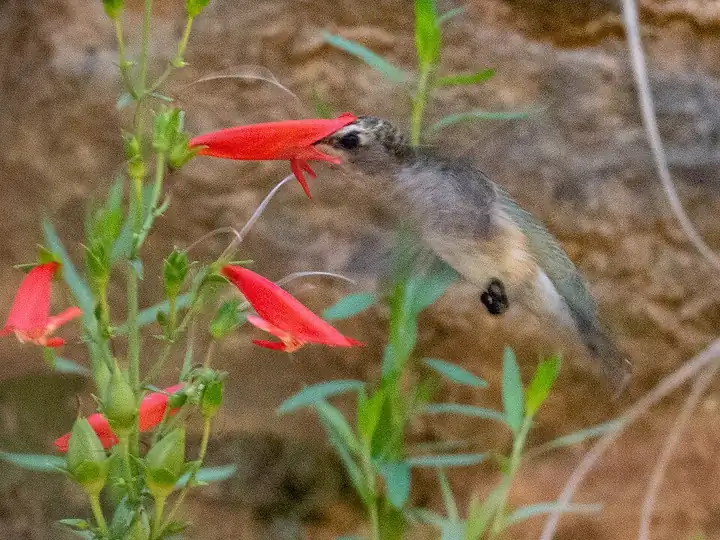
Penstemon (beardtongue)
Penstemon spp. (e.g. P. barbatus, P. eatonii, P. digitalis, P. strictus and garden hybrids) · Plantain family (Plantaginaceae)
When to plant: Sow seed in late summer, take cuttings in summer, or divide clumps (NC State).
| Hardiness zones | 3 to 8 |
|---|---|
| Sun | full sun |
| Water | low |
| Life cycle | perennial |
| Frost | Hardy: takes frost |
About Penstemon (beardtongue)
Penstemons are North American wildflowers with spikes of tubular, two-lipped flowers; there are about 280 species, from tiny alpine mats to plants several feet tall (Colorado State). Red, tubular kinds such as firecracker penstemon (P. eatonii) and beardlip penstemon (P. barbatus) are classic hummingbird flowers: Utah State calls firecracker penstemon a favorite hummingbird nectar source, and the U.S. Forest Service lists beardlip penstemon for hummingbird gardens and uses penstemon as its example of the long tubes hummers favor. Penstemons are also especially attractive to native solitary bees (Colorado State). Most western species want sun, sharp drainage and little water; eastern foxglove beardtongue (P. digitalis) takes ordinary garden soil.
Varies by species: foxglove beardtongue is hardy in zones 3-8 and firecracker penstemon in 3-7 (NC State; Utah State), while many garden hybrids are only half-hardy and are grown in containers (Colorado State).
When to plant
Sow seed in late summer, take cuttings in summer, or divide clumps (NC State).
Seed of western species such as firecracker penstemon needs a long cold, moist stratification (up to about 16 weeks) if you start it indoors (Utah State). Don't overwater after flowering, which causes crown rot (Colorado State).
Soil
Loose, well-drained soil is a must; penstemons rot in wet or compacted ground and many western kinds live longer in lean, low-fertility soil (Colorado State; Utah State).
No fertilizer is needed in most garden soils; focus on drainage and loosen compacted soil, since penstemons rot in wet, airless ground (Colorado State). Many western kinds live longer in lean soil (Utah State).
Feeding
- container or cut-flower penstemons, during the growing season: light application of a balanced fertilizer. Colorado State suggests only light feedings for penstemons in containers or grown for cut flowers; garden plants usually need none.
Look for: a balanced or all-purpose fertilizer at the label rate. Skip high-phosphorus "bloom boosters" unless a soil test shows low phosphorus: most garden soils already have enough, and the extra can wash into streams.
Rich soil, fertilizer and overwatering after bloom shorten penstemon life and cause crown rot (Colorado State; Utah State).
Harvest
Flowers open from the bottom of the spike up in late spring and summer. Cut spent flower stalks before seed forms to tidy the plant and help it live longer, or leave a few if you want it to self-sow (Colorado State); firecracker penstemon may rebloom if you remove spent flowers (Utah State).
Varieties (18)
| Variety | Type | Zones | Notes |
|---|---|---|---|
| Coral Gem | Beardlip penstemon (P. barbatus) | 3–8typical for penstemon | Listed by Utah State as a beardlip penstemon cultivar; flower color not given on the page we opened. Sources: [3] |
| Jingle Bells | Beardlip penstemon (P. barbatus) | 3–8typical for penstemon | Listed by Utah State as a beardlip penstemon cultivar. Sources: [3] |
| Pristine Princess Pink | Beardlip penstemon (P. barbatus) | 3–8typical for penstemon | Pink flowers; a border plant. Colorado State trial winner in 2024. Sources: [1] |
| Schooley's Yellow | Beardlip penstemon (P. barbatus) | 3–8typical for penstemon | Yellow-flowered selection of a species that is usually red. Beardlip penstemon blooms late June into September (Utah State). Sources: [3] |
| Richfield Selection | Firecracker penstemon (P. eatonii) | 3–7 | Bright scarlet tubular flowers on 10-40 in stems. Firecracker penstemon is a favorite hummingbird nectar source; blooms May to mid-July (Utah State). Sources: [2] |
| Husker Red | Foxglove beardtongue (P. digitalis) | 3–8 | Maroon-red leaves and stems with white to light pink flowers. Sources: [4][5] |
| Delfts Blue Riding Hood | Half-hardy hybrid | 3–8typical for penstemon | Half-hardy; best in containers. Sources: [1] |
| Prairie Twilight | Half-hardy hybrid | 3–8typical for penstemon | Half-hardy; best in containers. Sources: [1] |
| Red Riding Hood | Half-hardy hybrid | 3–8typical for penstemon | Half-hardy; best in containers. Sources: [1] |
| Twizzle series | Half-hardy hybrid | 3–8typical for penstemon | Half-hardy penstemons suited to containers. Sources: [1] |
| Coral Baby | Hybrid penstemon | 3–8typical for penstemon | Coral-pink flowers; drought-tolerant. Suits dry, water-wise gardens (Colorado State). Sources: [1] |
| Dark Towers | Hybrid penstemon | 3–8typical for penstemon | Listed by NC State as a garden cultivar; we found no trait details from a sourced page. Sources: [4] |
| Mountain Treats series | Hybrid penstemon | 3–8typical for penstemon | Listed by NC State; no trait details on the page we opened. Sources: [4] |
| Prairie Jewel (P. grandiflorus 'P010S') | Large beardtongue (P. grandiflorus) | 3–8typical for penstemon | Pink and white flowers. A Plant Select choice for borders (Colorado State). Sources: [1] |
| Red Rocks (P. x mexicali 'P008S') | Mexicali hybrid | 3–8typical for penstemon | Pink to red flowers. Mexicali hybrids suit borders and containers (Colorado State). Sources: [1][4] |
| Bridges' penstemon (P. rostriflorus) | Western native species | 3–8typical for penstemon | Red tubular flowers; water-wise. Sources: [1] |
| Pineleaf penstemon (P. pinifolius) | Western native species | 3–8typical for penstemon | Red, orange or yellow flowers over needle-like leaves; a border plant. Sources: [1] |
| Rocky Mountain penstemon (P. strictus) | Western native species | 3–8typical for penstemon | Blue flowers; water-wise but needs good spring moisture. Sources: [1] |
Pests to watch for
Diseases and problems
In the kitchen
Safety: NC State notes that foxglove beardtongue is not related to true foxglove (Digitalis) and lacks its toxicity. The other sources we checked list no toxic parts.
Pets: Not listed as toxic by the ASPCA (penstemon has no ASPCA entry).
Sources
- extension.colostate.edu
- extension.usu.edu
- cwelwnp.usu.edu
- plants.ces.ncsu.edu
- plants.ces.ncsu.edu
- fs.usda.gov
- fs.usda.gov
- pollinators.psu.edu
- aspca.org
- aspca.org
Photo: Photo: Bettina Arrigoni, CC BY 2.0, via Wikimedia Commons (CC BY 2.0). Photo resized for the web.

Planting dates and advice are general guidance; check with your local Cooperative Extension office for your area.