
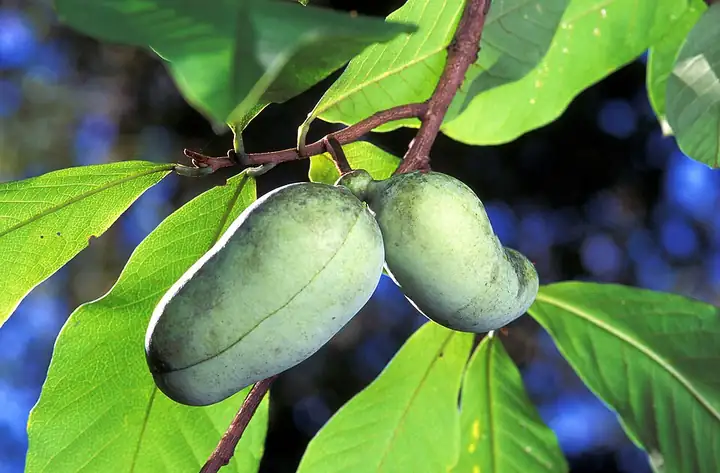
Pawpaw
Asimina triloba · Custard apple family (Annonaceae)
When to plant: Pawpaws have brittle roots and are hard to transplant: plant in spring as new growth starts, and shade young trees the first year or two (Kentucky State University).
| Hardiness zones | 5 to 9 |
|---|---|
| Sun | full sun to part shade |
| Water | moderate |
| Life cycle | perennial |
| Frost | Hardy: takes frost |
| Soil pH | 5.5–7.0 |
| Spacing | 96 to 120 inches |
About Pawpaw
Pawpaw is a native understory tree with the largest edible fruit native to the US, with soft, custard-like flesh. It has few pest problems but needs two genetically different trees for fruit.
Grows in zones 5-8 (Kentucky State University) and NC State lists 5-9. It needs about 400-1,000 chill hours, with northern selections needing more (Kentucky State University), so it may not suit some coastal areas (NC State).
When to plant
Pawpaws have brittle roots and are hard to transplant: plant in spring as new growth starts, and shade young trees the first year or two (Kentucky State University).
Grafted trees can begin flowering 2-3 years after planting, while seedlings usually start flowering and fruiting in 4-8 years (Kentucky State University).
Soil
Deep, fertile, well-drained, slightly acid soil with plenty of moisture; drainage is essential, and it struggles in heavy or waterlogged soil.
Plant in deep, fertile, well-drained soil that is slightly acid (pH 5.5-7); pawpaws do not do well in heavy or waterlogged soil.
Feeding
- Young trees: every few weeks during the first half of the growing season: balanced fertilizer such as 20-20-20. Apply lightly around the young tree and keep the soil moist, especially in the first two years.
Look for: mostly nitrogen, in spring as growth starts. Spring feeding grows the new shoots and leaves that carry flowers and fruit; feeding after midsummer pushes soft growth that may not harden before winter.
Don't expect fruit fast: grafted trees can bear in about 3 years, but seedling trees usually take 5-8 years, often once they are about 6 feet tall.
Harvest
A ripe pawpaw gives when gently squeezed, like a ripe peach, picks easily and smells strongly fruity; skin color is not a reliable sign (Kentucky State University).
Pawpaw gives one crop a year, ripening from August to October. Pick when fruit gives to a gentle squeeze, comes off with a light tug and smells strongly fruity; skin color is not a reliable sign.
Varieties (14)
NC State lists 13 named pawpaw cultivars with short descriptions; zones are its range for the species. Kentucky State University, home of the USDA pawpaw repository, has released three cultivars, but only KSU-Chappell could be confirmed in a source that could be opened. No chill-hour data was found.
| Variety | Type | Season and days | Zones | Notes |
|---|---|---|---|---|
| KSU-Chappell | Kentucky State University release | 5–8typical for pawpaw | The third pawpaw cultivar released by Kentucky State University's pawpaw program. Needs a genetically different pawpaw (another cultivar or seedling) nearby for fruit. Sources: [1][7] | |
| Allegheny | Named cultivar | Midseason | 5–9 | Large, greenish-yellow fruit. Highly productive. Needs a genetically different pawpaw (another cultivar or seedling) nearby for fruit. Sources: [3] |
| Davis | Named cultivar | Midseason | 5–9 | Mottled green skin and yellow flesh. Keeps well in cold storage. Needs a genetically different pawpaw (another cultivar or seedling) nearby for fruit. Sources: [3] |
| Mango | Named cultivar | Midseason | 5–9 | Round fruit that looks like a mango. Vigorous; selected in Georgia. Needs a genetically different pawpaw (another cultivar or seedling) nearby for fruit. Sources: [3] |
| NC-1 | Named cultivar | Early | 5–9 | Medium fruit. Early ripening. Needs a genetically different pawpaw (another cultivar or seedling) nearby for fruit. Sources: [3] |
| Overleese | Named cultivar | Midseason | 5–9 | Large yellow-orange fruit with dark yellow flesh and few seeds. Needs a genetically different pawpaw (another cultivar or seedling) nearby for fruit. Sources: [3] |
| Potomac | Named cultivar | Late | 5–9 | Very large fruit, among the biggest. Needs a genetically different pawpaw (another cultivar or seedling) nearby for fruit. Sources: [3] |
| Shenandoah | Named cultivar | Late | 5–9 | Large fruit, among the biggest. Needs a genetically different pawpaw (another cultivar or seedling) nearby for fruit. Sources: [3] |
| Sunflower | Named cultivar | Very late | 5–9 | Medium fruit. The latest-ripening cultivar NC State lists. Needs a genetically different pawpaw (another cultivar or seedling) nearby for fruit. Sources: [3] |
| Susquehanna | Named cultivar | Late | 5–9 | Large fruit. Needs a genetically different pawpaw (another cultivar or seedling) nearby for fruit. Sources: [3] |
| Taylor | Named cultivar | Late | 5–9 | Large fruit. Needs a genetically different pawpaw (another cultivar or seedling) nearby for fruit. Sources: [3] |
| Wabash | Named cultivar | Midseason | 5–9 | Large fruit. Productive. Needs a genetically different pawpaw (another cultivar or seedling) nearby for fruit. Sources: [3] |
| Wells | Named cultivar | Midseason | 5–9 | Green skin, orange flesh and a banana-like flavor. Needs a genetically different pawpaw (another cultivar or seedling) nearby for fruit. Sources: [3] |
| Wilson | Named cultivar | Midseason | 5–9 | Large fruit with custard-like flesh. Pyramid-shaped tree. Needs a genetically different pawpaw (another cultivar or seedling) nearby for fruit. Sources: [3] |
Pests to watch for
In the kitchen
Eaten fresh; the flesh is soft and custard-like.
Keeping it: Fully ripe pawpaws last only a few days at room temperature or about a week in the fridge. Firm-ripe fruit can be refrigerated up to 3 weeks, then ripened on the counter.
Safety: Eating the skin or seeds can cause stomach and intestinal pain, and handling the fruit can irritate skin (NC State).
Pets: Not listed as toxic by the ASPCA
Sources
Photo: Photo: Scott Bauer, USDA ARS, Public domain (USDA ARS), via Wikimedia Commons. Photo resized for the web.

Planting dates and advice are general guidance; check with your local Cooperative Extension office for your area.