
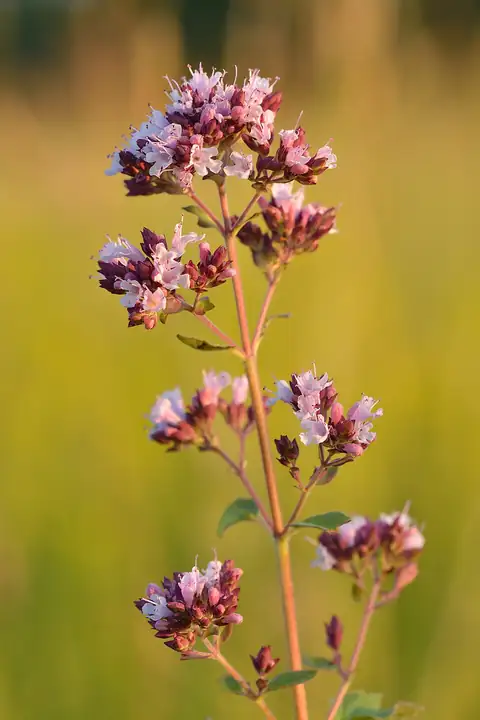
Oregano
Origanum vulgare · Mint family (Lamiaceae)
| Hardiness zones | 4 to 8 |
|---|---|
| Sun | full sun to part shade |
| Water | low |
| Life cycle | perennial |
| Frost | Hardy: takes frost |
| Soil pH | 6.0–7.5 |
| Spacing | 10 to 12 inches |
| Soil temperature to plant | at least 60°F |
About Oregano
Oregano is a spreading, hardy perennial whose leaves are a staple of Mediterranean and Mexican cooking. Flavor varies a lot between plants, so many cooks grow it from cuttings of a plant they like.
NC State lists oregano as hardy in zones 4-8.
Planting
It grows from seed, division or cuttings; cuttings keep the flavor of a favorite plant. University of Minnesota Extension groups oregano with warm-season herbs that prefer soil near 60 F.
Soil
Clay, loam or sandy soil with good drainage; it tolerates occasional dry spells.
Plant in full sun in well-drained, average soil with a pH of about 6.0 to 8.0; oregano grows well in poor soil. Follow a soil test before adding fertilizer.
Feeding
- once a year: balanced fertilizer such as 10-10-10. Apply lightly, following your soil test and the label rate, and water it in.
Look for: a light, all-purpose or nitrogen fertilizer. Herbs are grown for fresh leaves to pick, so a little nitrogen keeps new growth coming; most need only light feeding.
Rich soil or heavy feeding gives fast, lush growth with less essential oil, so leaves have weaker flavor and scent.
Harvest
Clip leaves as needed; flavor is best just before the plant flowers. Leaves dry well for year-round use.
Clip leaves as needed; shear plants back regularly before they flower to push out new leaves (flavor is best just before bloom). Cut back in late fall.
Varieties (13)
Extension sources document about 12 oreganos (species, subspecies and cultivars) plus Mexican oregano, which is a different plant. Common names like Greek and Italian oregano are used inconsistently.
| Variety | Type | Zones | Notes |
|---|---|---|---|
| Mexican oregano | Different plant (Lippia graveolens, verbena family) | 9–11 | Sharper and more pungent than European oregano; used for chili and Mexican dishes. Not winter hardy (Illinois Extension). Not a true oregano: it belongs to the verbena family, not the mint family, but is used the same way in the kitchen. Sources: [11][12][13] |
| Italian oregano | Hybrid oregano (Origanum x majoricum) | 4–8typical for oregano | Culinary perennial with white flowers. Names are used loosely: NC State lists Italian oregano as the hybrid O. x majoricum, while UF/IFAS groups it with Greek oregano. Sources: [9][14] |
| Hopley's Purple | Oregano | 5–9typical for Ornamental oregano (Origanum laevigatum) | Mild. Compact plant with purple-green leaves; not winter hardy in Illinois. The source lists this cultivar under Origanum laevigatum. Sources: [12][15] |
| Profusion | Oregano | 4–8typical for oregano | Intense flavor. Very hardy. Sources: [12] |
| Variegated oregano | Oregano (O. vulgare 'Variegata') | 5–9 | Green and white variegated leaves. Sources: [9] |
| Golden oregano (Aureum) | Oregano (O. vulgare) | 4–8typical for Oregano (Origanum vulgare) | Golden-yellow leaves on a compact mound 8-10 inches tall. Give it some afternoon shade to prevent leaf scorch. Sources: [1][13] |
| Hot & Spicy | Oregano (O. vulgare) | 5–9 | Fiery, hot-pepper kick; suits Tex-Mex and Cajun dishes. Sources: [9] |
| Turkestan oregano | Oregano (Origanum tyttanthum) | 4–8typical for oregano | Strong flavor. Robust plant that does well indoors; not winter hardy. Sources: [12] |
| Greek oregano | Oregano (Origanum vulgare subsp. hirtum) | 5–9 | Sharp, biting oregano flavor; NC State calls it the standard culinary oregano. Six inches to 2 feet tall with gray-green leaves and small purple or white flowers; hardy. UF/IFAS lists it as heat tolerant for Central Florida. Sources: [1][9][10][12] |
| Common oregano | Oregano (Origanum vulgare) | 4–8 | Coarser and stronger than sweet marjoram; used on pizza, in tomato sauces and with meats. Sprawling perennial 1-2 feet tall with small pink, white or purplish flowers in summer. Flavor varies from plant to plant, so many gardeners start new plants from cuttings of one they like. Plants get woody after 3-4 years. Sources: [1][7][8][10] |
| Rosenkuppel | Ornamental oregano (O. vulgare) | 4–8typical for Oregano (Origanum vulgare) | Long-lasting violet-red flowers. Sources: [1][14] |
| Cleopatra | Syrian oregano (Origanum syriacum) | 4–8typical for oregano | 2015 All-America Selections winner. Sources: [16][17] |
| Syrian oregano (za'atar) | Syrian oregano (Origanum syriacum) | 4–8typical for oregano | Strong, spicy flavor. Less winter hardy than common oregano; may need to come indoors for winter. Also called Syrian marjoram or za'atar. Sources: [11][12] |
Pests to watch for
In the kitchen
Leaves flavor tomato dishes, meats and sauces, and leaves and flowers can be used in tea.
Keeping it: Keep fresh sprigs wrapped in the fridge and use within a few days. Dried oregano keeps its punch for about a year in a sealed jar.
Pets: Toxic to dogs, cats and horses (ASPCA, 'Oregano', Origanum vulgare hirtum): can cause mild vomiting and diarrhea
Sources
- plants.ces.ncsu.edu
- extension.umn.edu
- aspca.org
- aspca.org
- aspca.org
- aggie-hort.tamu.edu
- extension.psu.edu
- extension.umd.edu
- blogs.ifas.ufl.edu
- hgic.clemson.edu
- hort.purdue.edu
- extension.illinois.edu
- blogs.ifas.ufl.edu
- plants.ces.ncsu.edu
- plants.ces.ncsu.edu
- all-americaselections.org
- all-americaselections.org
Photo: Photo: Ivar Leidus, CC BY-SA 3.0, via Wikimedia Commons (CC BY-SA 3.0). Photo resized for the web.

Planting dates and advice are general guidance; check with your local Cooperative Extension office for your area.