
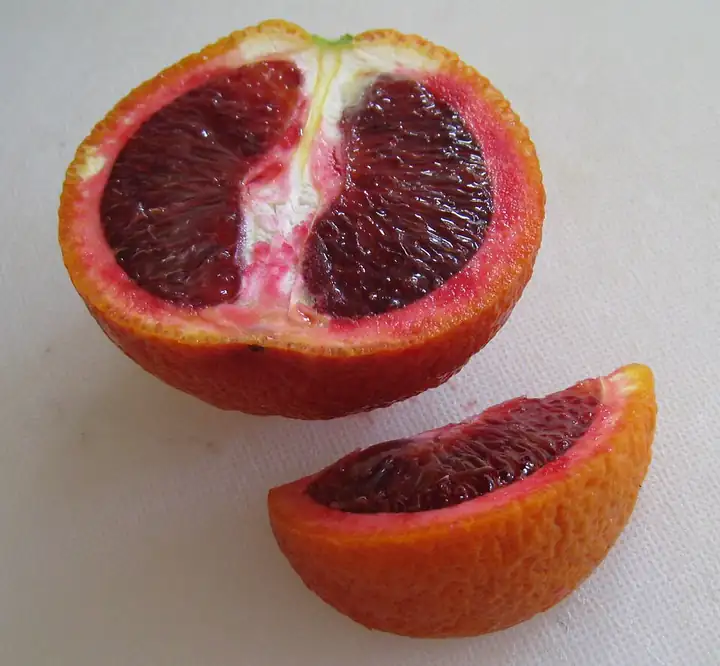
Orange and blood orange
Citrus x sinensis · Citrus family (Rutaceae)
When to plant: Set out plants up to 2 weeks after the last frost.
| Hardiness zones | 9 to 11 |
|---|---|
| Sun | full sun |
| Water | moderate |
| Life cycle | perennial |
| Frost | Tender: killed by frost |
| Soil pH | 5.5–6.5 |
| Spacing | 144 to 288 inches |
About Orange and blood orange
Sweet oranges are evergreen trees with fragrant white spring flowers and juicy fruit; home types include navels, juice oranges like Valencia and Hamlin, and blood oranges such as Moro, Tarocco and Sanguinelli. Blood oranges get their red flesh from anthocyanin, the pigment in purple grapes, and it colors best where winter nights turn chilly. A smaller tree on a dwarfing rootstock makes a good porch tree in colder areas.
NC State lists sweet orange for zones 9a-11b; trees are badly damaged in the low to mid 20s F, so north of zone 9 grow them in pots and bring them in (UGA; Mississippi State).
When to plant
Timing is counted from your average last spring frost (and first fall frost). Sow & Tell works out the actual dates for your ZIP code.
- Set out plants: up to 2 weeks after the last frost
A potted tree goes outside after the last spring frost and is eased into full sun over about two weeks (Maryland Extension; Wisconsin says wait until temperatures stay above 50 F). In the ground (zones 9-11), UGA advises planting in early spring after freezes are past. Budded trees may bear a few fruit in the second year but usually start in the third (Texas A&M).
Soil
Well-drained soil; UF recommends a pH of about 5.5-6.5 for home citrus, and in pots a fast-draining bark-based mix (UF/IFAS; Mississippi State).
Pot it in a fast-draining, slightly acid potting mix (bark-based, or palm-and-cactus mix) in a container with drainage holes, never garden soil; in the ground, test the soil and keep the pH around 6.0-7.0 (Mississippi State; UC Master Gardeners; UGA).
Feeding
- First feeding after planting, once new growth starts (about 4 to 6 weeks): citrus fertilizer with micronutrients (about a 2-1-1 or 3-1-1 N-P-K ratio with iron, manganese and zinc, or a slow-release 12-6-6 or 12-4-6). Follow the label for a pot; in the ground, UGA starts a young tree with about 1/3 lb of 8-8-8 with micronutrients spread in a 30-inch circle and watered in.
Look for: mostly nitrogen, in spring as growth starts. Spring feeding grows the new shoots and leaves that carry flowers and fruit; feeding after midsummer pushes soft growth that may not harden before winter. - Early spring each year, as new growth begins: citrus fertilizer with micronutrients (N-P-K about 2-1-1 or 3-1-1). Slow-release granules need 2 to 3 feedings a season; a water-soluble citrus food can instead go on about once a month from late winter to fall (Clemson; Maryland; UC Master Gardeners; Texas A&M).
Look for: mostly nitrogen, in spring as growth starts. Spring feeding grows the new shoots and leaves that carry flowers and fruit; feeding after midsummer pushes soft growth that may not harden before winter. - Early summer: citrus fertilizer with micronutrients. Repeat the spring feeding at the label rate and water it in (Maryland Extension).
Look for: mostly nitrogen, in spring as growth starts. Spring feeding grows the new shoots and leaves that carry flowers and fruit; feeding after midsummer pushes soft growth that may not harden before winter. - Late summer (the last feeding of the year): citrus fertilizer with micronutrients. Give the final feeding, then stop by early fall so new growth can harden before winter; in the ground, UGA says no fertilizer from August 1 to February 15.
Look for: mostly nitrogen, in spring as growth starts. Spring feeding grows the new shoots and leaves that carry flowers and fruit; feeding after midsummer pushes soft growth that may not harden before winter. - Any time young leaves turn yellow with green veins: chelated iron fertilizer or a sulfur soil acidifier. Apply as the label directs; this pattern usually means iron is short or the mix is not acid enough (Maryland Extension).
Look for: mostly nitrogen, in spring as growth starts. Spring feeding grows the new shoots and leaves that carry flowers and fruit; feeding after midsummer pushes soft growth that may not harden before winter.
Don't feed through the winter indoors (Wisconsin and Minnesota feed only about April to September), and don't overwater or let the root ball dry out: too much water drops leaves and too little drops flowers (Maryland; Mississippi State).
Harvest
Pick by taste, not color: sweetness does not go up after picking, and ripe Valencias can turn greenish again on the tree (UC IPM). At Riverside, navels ripen about November to January, blood oranges December to February, and Valencias in spring and summer, and the fruit keeps best left on the tree (UC Riverside; UC IPM).
Oranges give one crop a year whose timing depends on type: navels may not be ready until late winter and Valencias ripen in summer. Ripe fruit keeps best on the tree, so pick as you need it; picked fruit keeps 4-6 weeks in the refrigerator.
Varieties (15)
| Variety | Type | Season and days | Zones | Notes |
|---|---|---|---|---|
| Moro | Blood orange | Very early for a blood orange; December to February at Riverside (often ready in January) | 9–11typical for orange and blood orange | Pleasant, with a distinctive aroma; flavor fades if the fruit is stored too long. The darkest blood orange: flesh deep violet-red, rind orange with a light red blush. Medium to medium-large fruit, few or no seeds. Medium-size, spreading, very productive tree. From Sicily. Colors best in warm inland valleys; on the cool coast the rind stays orange, but it still colors inside more than any other blood orange. Sources: [10][11] |
| Ruby | Blood orange | December to February at Riverside | 9–11typical for orange and blood orange | Rich. Medium fruit with relatively few seeds; orange flesh streaked with red in good years, but coloring is unreliable. Compact, moderately vigorous, productive tree. Brought to Florida from the Mediterranean around 1880 and to California soon after; red color develops only in hot interior areas. Sources: [10][26] |
| Sanguinelli | Blood orange | Late midseason; December to February at Riverside | 9–11typical for orange and blood orange | Can still be tart early in the season. Striking deep red rind color and red flesh. Fruit can run small when the crop is heavy. Small to medium, thornless, very productive tree. A Spanish sport of 'Doblefina' found around 1950; holds on the tree longer than its parent. Sources: [10][13] |
| Tarocco | Blood orange | December to February at Riverside, about the same as Moro | 9–11typical for orange and blood orange | Very good; UC Riverside calls it one of the most delicious blood oranges in its collection. Medium-large to large fruit with few or no seeds; red flesh but little or no red on the rind. Vigorous tree with moderate yields. Needs a chilly winter to develop its red color. Described here from UC Riverside's 'Tarocco #7' selection. Sources: [10][12] |
| Hamlin | Early juice orange | Early; October to January in Florida, mid-November to early December in south Georgia | 9–11typical for orange and blood orange | Sweet and low in acid. Medium-small, smooth-skinned fruit with six or fewer seeds. Productive tree, more cold tolerant than most sweet oranges. A Florida seedling found near Glenwood around 1879; the world's main very early juice orange. Sources: [2][3][27][28] |
| Valencia | Juice orange | Late; March to June in Florida, March to July at Riverside | 9–11typical for orange and blood orange | Smooth, thin-skinned fruit; seed count varies. Ripe fruit can turn greenish again on the tree without losing quality. The main late juice orange. UC Riverside's widely planted 'Olinda' selection was found in 1939 in Olinda, California. Clemson calls Valencia more patio-friendly than navels. Sources: [2][5][9][29] |
| Pineapple | Midseason juice orange | Midseason; December to February in Florida | 9–11typical for orange and blood orange | Rich and sweet with a delicate fragrance. Medium, moderately seedy fruit. Thornless, very productive tree, but more easily hurt by frost than most oranges. Grown from seed near Citra, Florida, around 1860 and named for its fragrance; it doesn't hold on the tree as well as some types. Sources: [2][30] |
| Fukumoto | Navel orange | Early; mid-October to late December, 3 to 4 weeks before Washington navel | 9–11typical for orange and blood orange | Deep reddish-orange rind; medium to large, mostly seedless fruit. Tree tends to be smaller than other navels. From Wakayama, Japan, introduced to California in 1983. It has declined on some citrange rootstocks. Sources: [10][31] |
| Lane Late | Navel orange | Late; February to June at Riverside | 9–11typical for orange and blood orange | Sweet, getting better balanced later in the season. Similar to Washington navel in size, with a smoother peel and a smaller navel; usually seedless. Found in Australia in 1950. Fruit can hang on the tree for months after ripening without losing quality. Sources: [10][32] |
| Robertson | Navel orange | December to January at Riverside, 10 to 14 days before Washington navel | 9–11typical for orange and blood orange | Slightly lower quality than Washington navel. Medium-large seedless fruit that often grows in tight clusters. Small, less vigorous but very productive tree. Found near Redlands, California, in 1925. Its small size and early, heavy bearing made it popular as a container patio tree. Sources: [15] |
| Washington navel | Navel orange | November to January at Riverside; October to January in Florida | 9–11typical for orange and blood orange | Rich, with firm, deep-colored flesh. Large, seedless, easy-peeling fruit with a slightly pebbled rind. Tree is not very vigorous, with a rounded, somewhat drooping canopy. Came from Bahia, Brazil, and was made famous by Eliza Tibbets of Riverside in the 1870s. Heat and dry air at bloom time can cut the crop. Sources: [2][3][14] |
| Cara Cara | Navel orange (pink-fleshed) | November to January at Riverside; November to December in south Georgia | 9–11typical for orange and blood orange | Pink flesh colored by lycopene; small navel and a plain orange rind. Tree much like Washington navel. A 1976 mutation of Washington navel found at Hacienda Cara Cara in Venezuela. Branches now and then produce variegated twigs. Sources: [3][10][33] |
| Shamouti (Jaffa) | Sweet orange | Midseason | 9–11typical for orange and blood orange | Pleasantly sweet. Medium-large, oval, nearly seedless fruit with a thick, tough peel that comes off easily. Upright, thornless tree. Found before 1844 near Jaffa; heat and dry air during bloom can reduce the crop. Sources: [34] |
| Trovita | Sweet orange | December to February at Riverside | 9–11typical for orange and blood orange | Mild, pleasant and juicy. Medium-small, few-seeded fruit without a navel. Vigorous, upright tree that may bear heavily every other year. Found as a seedling at UC Riverside in 1916 and released in 1935; it does better than navels in hot, dry desert areas. Sources: [35] |
| Midknight | Valencia-type juice orange | March to July at Riverside | 9–11typical for orange and blood orange | High juice and sugar content. Large, nearly seedless fruit with a smooth rind. Tree grows more slowly than standard Valencia and has large leaves. From South Africa in the 1930s. It shows bud-union trouble on rough lemon rootstock. Sources: [10][36] |
Pests to watch for
Asian citrus psyllid, Citrus leafminer, Scale insects, Mealybugs, Aphids, Whiteflies, Twospotted spider mite, Thrips, Brown garden snail, Katydids, Ground squirrels, Roof rats and Norway rats
Diseases and problems
Citrus greening (HLB), Citrus canker, Phytophthora root rot, Foot rot (gummosis), Greasy spot, Citrus scab, Sooty mold
In the kitchen
Eaten fresh or juiced: navels are seedless and peel easily, Valencia is the classic late juice orange, and blood oranges give deep red flesh and juice (UC Riverside; UF/IFAS).
Keeping it: Refrigerate oranges in a plastic bag for a few weeks; on the counter they keep only days. Squeezed juice is best within a day.
Safety: The fruit is a common food. FDA warns that sour (Seville) oranges and tangelos may interfere with some medicines the way grapefruit does, and that the allergy drug fexofenadine may work less well with orange juice. NC State notes the plant's oils can cause contact dermatitis.
Pets: Toxic to dogs, cats and horses (ASPCA): the fruit is edible, but peel, leaves and stems contain essential oils and psoralens that can cause vomiting, diarrhea, depression and skin irritation.
Sources
- plants.ces.ncsu.edu
- ask.ifas.ufl.edu
- fieldreport.caes.uga.edu
- extension.msstate.edu
- hgic.clemson.edu
- hgic.clemson.edu
- aggie-horticulture.tamu.edu
- ipm.ucanr.edu
- ipm.ucanr.edu
- extension.arizona.edu
- citrusvariety.ucr.edu
- citrusvariety.ucr.edu
- citrusvariety.ucr.edu
- citrusvariety.ucr.edu
- citrusvariety.ucr.edu
- hort.extension.wisc.edu
- extension.umd.edu
- ucanr.edu
- fda.gov
- aspca.org
- aphis.usda.gov
- usda.gov
- sandiegocounty.gov
- agrilifetoday.tamu.edu
- extension.umn.edu
- citrusvariety.ucr.edu
- citrusvariety.ucr.edu
- ufdcimages.uflib.ufl.edu
- citrusvariety.ucr.edu
- citrusvariety.ucr.edu
- citrusvariety.ucr.edu
- citrusvariety.ucr.edu
- citrusvariety.ucr.edu
- citrusvariety.ucr.edu
- citrusvariety.ucr.edu
- citrusvariety.ucr.edu
Photo: Photo: Dvortygirl, CC BY-SA 4.0, via Wikimedia Commons (CC BY-SA 4.0). Photo resized for the web.

Planting dates and advice are general guidance; check with your local Cooperative Extension office for your area.