
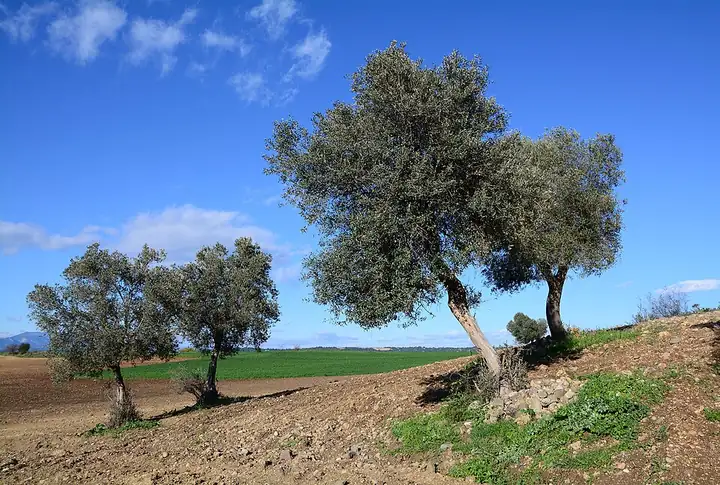
Olive
Olea europaea · Olive family (Oleaceae)
When to plant: In the ground, plant in spring after frost or in fall, 20-25 ft apart, with the root crown slightly high (UC Marin Master Gardeners).
| Hardiness zones | 8 to 10 |
|---|---|
| Sun | full sun |
| Water | low |
| Life cycle | perennial |
| Frost | Half-hardy: takes a light frost |
| Spacing | 240 to 300 inches |
About Olive
The olive is a slow, long-lived evergreen tree with silvery leaves that handles heat, drought and poor soil. Most varieties crop better with a second variety nearby, and the fruit is too bitter to eat until it is cured. In a pot it makes a handsome porch tree that fruits best after hot summers. Heads-up: the California Invasive Plant Council rates olive as a 'Limited' invasive because birds spread seedlings into wild areas there.
NC State lists zones 8-10 (some cultivars 7); UF/IFAS says olives grow where winters stay above about 12 F. Cal-IPC rates olive 'Limited' (escaping in southern California and the Central Valley) and suggests fruitless types near open space; USDA PLANTS lists no noxious status.
When to plant
In the ground, plant in spring after frost or in fall, 20-25 ft apart, with the root crown slightly high (UC Marin Master Gardeners).
Potted trees go back outside once frost danger has passed (no source gives a set number of weeks, so the window is left blank). Grafted or cutting-grown trees start bearing in about four years (UF/IFAS).
Soil
Any well-drained soil, including poor soil, up to about pH 8.5; sandy soils are best because olives get root rot in wet ground (UF/IFAS; UC Marin Master Gardeners).
No rich soil needed: olives grow in almost any well-drained soil up to about pH 8.5 and bear poorly on very fertile ground (UF/IFAS).
Feeding
- Young in-ground trees, monthly in the growing season: nitrogen fertilizer such as urea or blood meal. UC Marin Master Gardeners use about 1 oz under each drip emitter each month; mature in-ground trees usually need no fertilizer.
Look for: mostly nitrogen, in spring as growth starts. Spring feeding grows the new shoots and leaves that carry flowers and fruit; feeding after midsummer pushes soft growth that may not harden before winter. - Potted trees, monthly during spring and summer growth: balanced liquid fertilizer. Feed once a month to support a crop (RHS); stop over winter.
Look for: mostly nitrogen, in spring as growth starts. Spring feeding grows the new shoots and leaves that carry flowers and fruit; feeding after midsummer pushes soft growth that may not harden before winter.
Too much nitrogen gives lots of leafy shoots but fewer olives and poorer oil (UF/IFAS). Overwatering invites root rot.
Harvest
Fruit ripens in late fall, turning from green to black-purple (some stay green or turn copper-brown), and olives often bear heavily only every other year (UF/IFAS; UC Marin). Raw olives are bitter and must be cured before eating.
Olives ripen once a year in late fall, turning from green to black, and trees tend to crop heavily only in alternate years. The fruit must be cured before eating.
Varieties (18)
| Variety | Type | Zones | Notes |
|---|---|---|---|
| Little Ollie | Compact ornamental | 8–10typical for olive | Compact, rounded shrub form (NC State). Sources: [3] |
| Swan Hill | Fruitless ornamental | 8–10typical for olive | Sterile: makes no pollen and no fruit (UF/IFAS; NC State). A good choice for people with olive pollen allergy or where fruiting olives are banned or could spread. Sources: [1][3] |
| Wilsoni | Fruitless ornamental | 8–10typical for olive | Sterile: no pollen and no fruit (UF/IFAS; NC State). Sources: [1][3] |
| Arbequina | Oil | 8–10typical for olive | From Spain. Small fruit. Cold hardiness: hardy (UF/IFAS). Oil content about 22-27%, low in polyphenols (UC ANR); resistant to verticillium wilt (UC Marin). Sources disagree on pollination: UF/IFAS lists it as needing a partner (Arbosana, Koroneiki or Picual), while UC ANR and UC Marin call it self-fruitful. Sources: [1][2][4] |
| Carolea | Oil | 8–10typical for olive | From Italy. Large fruit. Cold hardiness: hardy (UF/IFAS). Needs a partner: Ascolano, Maurino or Picholine (UF/IFAS). Sources: [1] |
| Frantoio | Oil | 8–10typical for olive | From Italy. Medium fruit. Cold hardiness: cold-sensitive (UF/IFAS). Oil content about 23-26%, medium-high polyphenols (UC ANR). Self-fertile (UF/IFAS); pairs with Kalamata, Leccino, Mission, Moraiolo or Pendolino. Sources: [1][4] |
| Koroneiki | Oil | 8–10typical for olive | From Greece. Very small fruit. Cold hardiness: cold-sensitive (UF/IFAS). Oil content about 24-28%, very high polyphenols (UC ANR). UF/IFAS lists it as self-fertile. Sources: [1][4] |
| Leccino | Oil | 8–10typical for olive | From Italy. Medium fruit. Cold hardiness: hardy (UF/IFAS). Oil content about 22-27% (UC ANR). Needs a partner: Carolea, Frantoio, Maurino, Pendolino or Picholine (UF/IFAS). Sources: [1][2][4] |
| Maurino | Oil | 8–10typical for olive | From Italy. Medium fruit. Cold hardiness: hardy (UF/IFAS). Pollinated by Grappolo or Lazzero (UF/IFAS). Sources: [1] |
| Moraiolo | Oil | 8–10typical for olive | From Italy. Small fruit. Cold hardiness: cold-sensitive (UF/IFAS). Pollinated by Maurino or Pendolino (UF/IFAS). Sources: [1] |
| Picual | Oil | 8–10typical for olive | From Spain. Medium fruit. Cold hardiness: hardy (UF/IFAS). Very high in polyphenols (UC ANR). UF/IFAS pairs it with Hojiblanca or Manzanillo; UC ANR calls it self-compatible. Sources: [1][4] |
| Pendolino | Oil (often a pollinizer) | 8–10typical for olive | From Italy. Medium fruit. Cold hardiness: hardy (UF/IFAS). Pollinizes Frantoio, Leccino, Moraiolo and Maurino (UF/IFAS). Sources: [1][4] |
| Kalamata | Table | 8–10typical for olive | From Greece. Large fruit. Cold hardiness: medium (UF/IFAS). Needs a partner such as Barnea, Frantoio or Koroneiki; UF/IFAS says it won't pollinate with Arbequina, Pendolino or Picual. Sources: [1] |
| Sevillano | Table | 8–10typical for olive | From Spain. Very large fruit. Cold hardiness: hardy (UF/IFAS). Oil content only about 12-17% (UC ANR). Self-fertile (UF/IFAS). Sources: [1][4] |
| Manzanillo | Table (and oil) | 8–10typical for olive | From Spain. Large fruit. Cold hardiness: cold-sensitive (UF/IFAS). High in polyphenols (UC ANR). Needs a partner such as Ascolano or Sevillano; does not pollinate with Mission (UF/IFAS). Sources: [1][2][4] |
| Ascolano | Table and oil | 8–10typical for olive | From Italy. Large fruit. Cold hardiness: hardy (UF/IFAS). Oil content about 15-22% (UC ANR). UF/IFAS lists it as self-fertile; UC ANR pairs it with 'Manzanillo' or 'Mission'. Good partners: Carolea, Manzanillo, Mission, Picholine. Sources: [1][4] |
| Mission | Table and oil | 8–10typical for olive | From the United States (California). Medium fruit. Cold hardiness: hardy (UF/IFAS). High oil content (UC Marin), about 19-24% (UC ANR). Self-fertile (UF/IFAS; UC Marin); doesn't pollinate Manzanillo. Sources: [1][2][4] |
| Picholine | Table and oil | 8–10typical for olive | From France. Medium fruit. Cold hardiness: medium (UF/IFAS). Pollinated by Ascolano, Carolea, Leccino or Manzanillo (UF/IFAS). Sources: [1] |
Pests to watch for
Diseases and problems
Olive knot, Verticillium wilt, Peacock spot, Root rot, Anthracnose
In the kitchen
Cured olives for the table and pressed olive oil (UF/IFAS; UC Marin).
Keeping it: Fresh olives are too bitter to eat and must be cured first; start curing soon after picking. How long cured olives keep, and whether they need the fridge, depends on the curing method.
Safety: Olive pollen is a common allergen; UF/IFAS notes some cities ban fruiting olives for that reason and sell pollen-free types like 'Swan Hill'. MSKCC says olive leaf extract may add to the effect of blood pressure and diabetes medicines.
Pets: Not listed as toxic by the ASPCA
Sources
- ask.ifas.ufl.edu
- ucanr.edu
- plants.ces.ncsu.edu
- ucanr.edu
- rhs.org.uk
- cal-ipc.org
- calinvasives.ucdavis.edu
- plantsservices.sc.egov.usda.gov
- mskcc.org
- yardandgarden.extension.iastate.edu
- aspca.org
- aspca.org
- aspca.org
- codelibrary.amlegal.com
- clarkcountynv.gov
Photo: Photo: Zeynel Cebeci, CC BY-SA 4.0, via Wikimedia Commons (CC BY-SA 4.0). Photo resized for the web.

Planting dates and advice are general guidance; check with your local Cooperative Extension office for your area.