
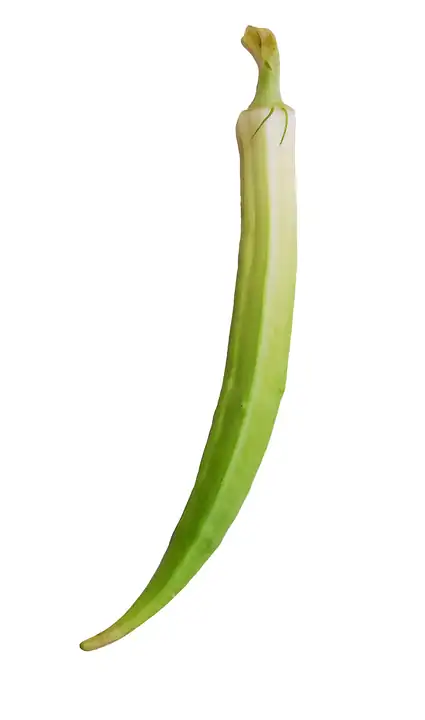
Okra
Abelmoschus esculentus · Mallow family (Malvaceae)
When to plant: Sow seeds outdoors 1 to 3 weeks after the last frost.
| Hardiness zones | 3 to 11 |
|---|---|
| Sun | full sun |
| Water | moderate |
| Life cycle | annual |
| Frost | Tender: killed by frost |
| Soil pH | 5.8–6.5 |
| Spacing | 12 to 24 inches |
| Days to harvest | 50 to 70 days |
| Soil temperature to plant | at least 65°F |
About Okra
Okra is a tall, hibiscus-like plant grown for tender green or red pods and a Southern kitchen staple. It thrives in heat and keeps producing all summer if picked often.
Grown as a summer annual, but it needs a long, hot season: it grows best at 75 to 90F and can take about 90 days in cool-summer areas, so it is most productive in the South and challenging in short northern summers.
When to plant
Timing is counted from your average last spring frost (and first fall frost). Sow & Tell works out the actual dates for your ZIP code.
- Sow seeds outdoors: 1 to 3 weeks after the last frost
Days count from seeding. Sow 1 inch deep once the soil is warm; in short seasons, seed can be started indoors 4 to 5 weeks before transplanting. Frost blackens and kills the plants.
Soil
Well-drained sandy loam; okra does not tolerate wet soil.
Follow a soil test and keep pH 5.8 to 6.5; without a test, work in about 2 lb of balanced fertilizer such as 10-10-10 per 100 sq ft, or 1/2 to 1 inch of compost, 3 to 6 inches deep.
Feeding
- 3 to 4 weeks after planting, when plants are about 6 to 8 inches tall: nitrogen fertilizer such as calcium nitrate (15.5-0-0), or balanced 10-10-10. Use 1 to 2 lb of calcium nitrate per 100 ft of row (or about 3 oz of 10-10-10 per 100 ft of row) beside the plants and water it in.
Look for: nitrogen, in a light feeding. Early on the plant needs leaves to feed its fruit later, but too much nitrogen makes a big leafy plant that is slow to flower. Later, when flowers open and the first small fruits form, switch to a lower-nitrogen fertilizer such as 5-10-15 or 6-12-12. - 6 to 8 weeks after planting, while pods are forming: a lower-nitrogen fertilizer such as 5-10-15 or 6-12-12. Use the bag's rate for vegetables, scatter it beside the plants (not against the stems) and water it in.
Look for: lower nitrogen, more phosphorus and potassium, such as 5-10-15 or 6-12-12. Now the plant should put its energy into flowers and fruit. Extra nitrogen at this stage grows leaves instead and can make blossoms drop; phosphorus helps only if your soil is short of it (a soil test tells you).
Too much nitrogen, especially early, gives leafy plants with few pods; pick pods every few days so plants keep producing.
Harvest
Pick pods at 2 to 3 inches long while tender, at least every other day; a pod whose stem is hard to cut is too old.
Pick pods at least every other day; pods left to mature on the plant slow new pod production, and well-picked, watered and fed plants bear for up to 12 weeks. For a fall crop, cut plants back to 6 to 12 inches between mid-July and mid-August; new pods follow in 4 to 6 weeks and continue until frost.
Varieties (27)
| Variety | Type | Season and days | Notes |
|---|---|---|---|
| Blondy | Compact | Compact plant. Sources: [9][10][11] | |
| Gold Coast | Dwarf | Dwarf plant with straight, dark green pods. Bears over a long season and is good for freezing. Released by the Louisiana Agricultural Experiment Station in 1959. Sources: [12] | |
| Louisiana Green Velvet | Green | 55 days | Recommended for Texas gardens. Sources: [13][14] |
| Annie Oakley II | Green, compact hybrid | 48 days | Early, compact, spineless plant about 4.5 feet tall with angular, dark green pods that stay tender to about 4.5 inches. Sources: [1][12][15][16][17][18] |
| Dwarf Green Long Pod | Green, dwarf | 60 days | Recommended for Northeast and East Texas. Sources: [13] |
| Jambalaya | Green, dwarf hybrid | 50 days | Very early, dwarf plant that yields well. A good okra for containers. Sources: [15][19] |
| Cajun Delight | Green, hybrid | 49 to 55 days | Vigorous, spineless plant about 4 feet tall with smooth, five-sided, dark green pods. Starts earlier than Clemson types and keeps bearing a long time. An All-America Selections winner. Sources: [1][12][13][15][16][20] |
| Cow Horn (Cow's Horn) | Green, long-pod (heirloom) | 55 days | Tall plants up to about 8 feet with pods that can reach 14 inches. An heirloom dating to the 1800s. Pick pods young for tenderness. Sources: [15] |
| Emerald | Green, round-pod (open-pollinated) | 55 to 58 days | Deep green, round, slender, spineless pods that stay tender even when larger; semi-dwarf plant with large leaves. Bred by Campbell Soup Company around 1950. Sources: [12][13][15][19][21] |
| Jade | Green, semi-dwarf | 56 days | Semi-dwarf plant with few branches and straight, ribbed, dark green pods; about 10 days earlier than Clemson Spineless. Released by the University of Arkansas (1990) for home gardens and market. Sources: [12][15] |
| Clemson Spineless | Green, spineless (open-pollinated) | 55 to 65 days | Straight, tapered, ridged green pods without spines on 4- to 5-foot plants; high yielding. Selected from 'Perkins' at the South Carolina station; a 1939 All-America Selections winner and the leading home-garden okra. Sources: [12][13][15][16][17][20][21] |
| Clemson Spineless 80 | Green, spineless (open-pollinated) | Dark green pods without spines. Sources: [1][10] | |
| Perkins Spineless | Green, spineless (open-pollinated) | Semi-dwarf, early plant with spineless, deep green pods and deeply cut leaves. From a cross of Campbell's Long Green and Clemson Spineless (1945); part of the Perkins family of okras. Sources: [12][20] | |
| Lee | Green, spineless, semi-dwarf | 50 to 58 days | Semi-dwarf plant with few side branches and straight, bright green, spineless pods. Developed by the Arkansas Agricultural Experiment Station (1978). Sources: [1][12][13][15][21] |
| Stewart's Zeebest | Heirloom | A Texas heirloom recommended by Texas A&M AgriLife. Sources: [9] | |
| North and South | Hybrid | Early-bearing hybrid that tolerates cool temperatures. Dark green pods with little fiber. Introduced by Burpee in 1995. UF/IFAS recommends it for Florida. Sources: [12][22] | |
| Prelude | Open-pollinated | 48 days | Fluted, medium dark green pods about 3.5 inches long. Introduced in 1984. Sources: [12] |
| Alabama Red | Red, ornamental | Grown partly as an ornamental for its bold red foliage and showy flowers. Sources: [22] | |
| Burgundy | Red-podded (open-pollinated) | 55 to 60 days | Plants about 4 to 5 feet tall with red coloring in the stems and leaves and burgundy-red pods about 6 to 8 inches long. Ornamental in the garden. Also sold as 'Red Burgundy'. A 1988 All-America Selections winner. Pods turn green when cooked. Sources: [1][13][15][16][20][21] |
| Little Lucy | Red-podded dwarf hybrid | Dwarf, very attractive red okra plant. A 1998 All-America Selections winner; fits small gardens and containers. Sources: [12] | |
| Evergreen | Spineless | Tall plant with long, slender, spineless, medium green pods. Introduced in 1945. Sources: [12] | |
| White Lightning | White-podded | Long, slender, tender white pods. Introduced by H.G. Hastings Co. of Atlanta in 1939. Sources: [12] | |
| Baby Bubba | Oklahoma State lists it for home gardens. Sources: [10] | ||
| Choppee | On Texas A&M's suggested okra list. Sources: [14] | ||
| Hill Country Red | 65 days | Recommended for Central Texas gardens. Sources: [21] | |
| Jefferson | Tall plants with few side branches and early, dark green pods with few spines. Released by the University of Arkansas in 1981. Sources: [12] | ||
| Silver Queen | Recommended for Texas gardens. Sources: [14] |
Good neighbors
UMD Extension shows okra with a sweet potato ground cover in an intensive garden; this is a space-saving idea rather than proven pest control.
Pests to watch for
Aphids, Corn earworm (tomato fruitworm), Stink bugs, Root-knot nematodes, Whiteflies, Harlequin bug, Red imported fire ant, Leaffooted bugs
Diseases and problems
Fusarium wilt, Verticillium wilt, Root rot, Pod rot, Damping off, Sooty mold
In the kitchen
Used in gumbo, stews and curries, fried, roasted or pickled; the pods thicken soups.
Keeping it: Keep dry, unwashed pods in a plastic bag in the fridge and use them within a few days to a week; okra doesn't like being too cold for long.
Safety: The pods have fine hairs that can irritate skin; wear gloves when harvesting (the hairs wash off).
Pets: Not listed as toxic by the ASPCA
Sources
- hgic.clemson.edu
- extension.usu.edu
- extension.illinois.edu
- plants.ces.ncsu.edu
- yardandgarden.extension.iastate.edu
- extension.umd.edu
- fieldreport.caes.uga.edu
- ucanr.edu
- aggie-horticulture.tamu.edu
- extension.okstate.edu
- agrilife.org
- cucurbitbreeding.wordpress.ncsu.edu
- agrilifeextension.tamu.edu
- aggie-horticulture.tamu.edu
- uaex.uada.edu
- yardandgarden.extension.iastate.edu
- site.extension.uga.edu
- secure.caes.uga.edu
- fieldreport.caes.uga.edu
- extension.msstate.edu
- agrilifeextension.tamu.edu
- gardeningsolutions.ifas.ufl.edu
Photo: Photo: Wilfredor, CC0, via Wikimedia Commons (CC0). Photo resized for the web.

Planting dates and advice are general guidance; check with your local Cooperative Extension office for your area.