
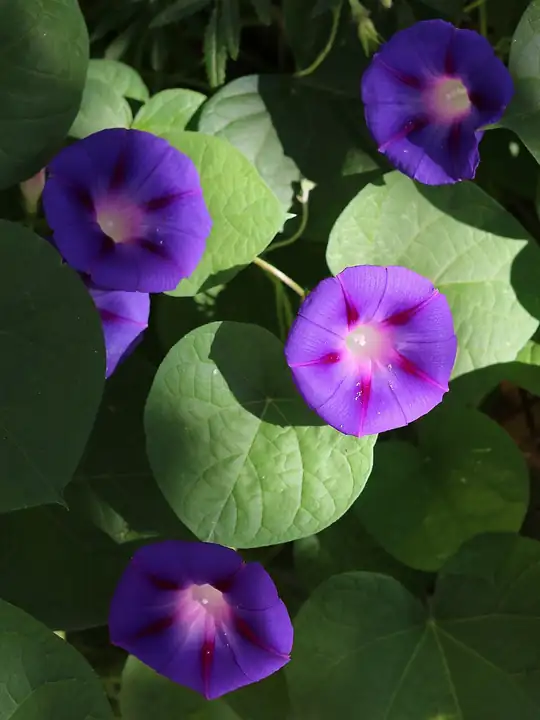
Morning glory
Ipomoea purpurea (common morning glory) and Ipomoea tricolor (Heavenly Blue types) · Morning glory family (Convolvulaceae)
When to plant: Start seeds indoors 4 to 6 weeks before the last frost, set out plants up to 2 weeks after the last frost and sow seeds outdoors up to 2 weeks after the last frost.
| Hardiness zones | 2 to 12 |
|---|---|
| Sun | full sun |
| Water | moderate |
| Life cycle | annual |
| Frost | Tender: killed by frost |
About Morning glory
Morning glories are fast annual vines from Mexico and Central America with heart-shaped leaves and trumpet flowers that open in the morning and fade by afternoon. One plant can cover a fence or trellis in a single summer, and hummingbirds and butterflies visit the flowers (NC State, Iowa State). They drop lots of long-lived seed, and common morning glory is also a farm weed (the app's tall morning glory weed page); Arizona lists both species as prohibited noxious weed seeds, and the seeds are poisonous.
Grown as a summer annual in every zone (NC State); Arizona's seed rules prohibit selling seed of common morning glory and I. tricolor, and some other states limit morning glory seed in farm seed.
When to plant
Timing is counted from your average last spring frost (and first fall frost). Sow & Tell works out the actual dates for your ZIP code.
- Start seeds indoors: 4 to 6 weeks before the last frost
- Set out plants: up to 2 weeks after the last frost
- Sow seeds outdoors: up to 2 weeks after the last frost
Nick the hard seed coat with a file or soak seeds overnight in warm water, then sow outdoors after frost danger has passed or start indoors 4-6 weeks before setting out (Iowa State, NC State, Illinois). There is no sourced count from sowing to bloom; Cornell weed scientists note common morning glory flowers about 6-8 weeks after the seedlings come up. Give vines a trellis, fence or strings to twine on.
Soil
Average, well-drained soil; it blooms well in poor soil with little or no fertilizer and doesn't like standing water (NC State, Illinois).
No compost or fertilizer needed; average or even poor, well-drained soil suits it (NC State, Illinois).
Feeding
Look for: a balanced or all-purpose fertilizer at the label rate. Skip high-phosphorus "bloom boosters" unless a soil test shows low phosphorus: most garden soils already have enough, and the extra can wash into streams.
Skip rich soil and extra fertilizer: Illinois Extension says morning glories prefer low fertility, and NC State notes they bloom well with little or no fertilizer.
Harvest
Blooms from early or midsummer until frost; each flower lasts only a morning, staying open longer on cloudy days (NC State, Iowa State). There's no need to deadhead for more flowers, but pulling off seed pods before they dry and split cuts down on next year's volunteers.
Varieties (12)
Extension sources document 12 named morning glories, several with no traits listed. NC State's species assignments are followed as given.
| Variety | Type | Season and days | Notes |
|---|---|---|---|
| Alba | Ipomoea purpurea | White flowers. Sources: [1] | |
| Darling | Ipomoea purpurea | Wine-red to deep rose flowers with a white throat. Sources: [1] | |
| Milky Way | Ipomoea purpurea | Smaller white flowers with purple centers. Sources: [1] | |
| Tie Dye | Ipomoea purpurea | Sky-blue flowers swirled and striped with navy. Introduced by Park Seed (Iowa State). Sources: [4] | |
| Violacea | Ipomoea purpurea | Rich, deep violet flowers. Sources: [1] | |
| Blue Star | Ipomoea tricolor | Listed by NC State without traits. Sources: [2] | |
| Flying Saucers | Ipomoea tricolor | Named by NC State as a common name for I. tricolor; no traits given. Sources: [2] | |
| Heavenly Blue | Ipomoea tricolor | Midsummer to fall | Large sky-blue trumpets with a white and yellow throat; the most common morning glory. Sources: [2][3][5] |
| Heavenly Blue Improved | Ipomoea tricolor | An improved selection of 'Heavenly Blue'; NC State lists no further traits. Sources: [2] | |
| Pearly Gates | Ipomoea tricolor | Pearl-white flowers with a faint pink tint. NC State lists it among common morning glory cultivars and also as a name for I. tricolor. Sources: [1][2] | |
| Crimson Rambler | Ipomoea tricolor (as listed by NC State) | Listed by NC State without traits. Sources: [2] | |
| Scarlett O'Hara | Morning glory (listed under I. purpurea by NC State) | Bright red flowers. Sources: [1] |
Pests to watch for
Diseases and problems
Powdery mildew, Root rot
In the kitchen
Safety: The seeds are poisonous: eating them can cause nausea, vomiting, diarrhea, dilated pupils and, in larger amounts, hallucinations (NC State: low severity). Leaves and stems may cause vomiting. Keep seeds away from children and wear gloves when handling plants.
Pets: Toxic to dogs, cats and horses (ASPCA, Ipomoea spp.): indole alkaloids related to lysergic acid cause vomiting, and eating large amounts of seeds may cause hallucinations.
Sources
- plants.ces.ncsu.edu
- plants.ces.ncsu.edu
- extension.illinois.edu
- yardandgarden.extension.iastate.edu
- homegarden-cahnr.media.uconn.edu
- cals.cornell.edu
- aspca.org
- ams.usda.gov
- law.cornell.edu
- law.cornell.edu
Photo: Photo: George Chernilevsky / Wikimedia Commons, Public domain. Photo resized for the web.

Planting dates and advice are general guidance; check with your local Cooperative Extension office for your area.