
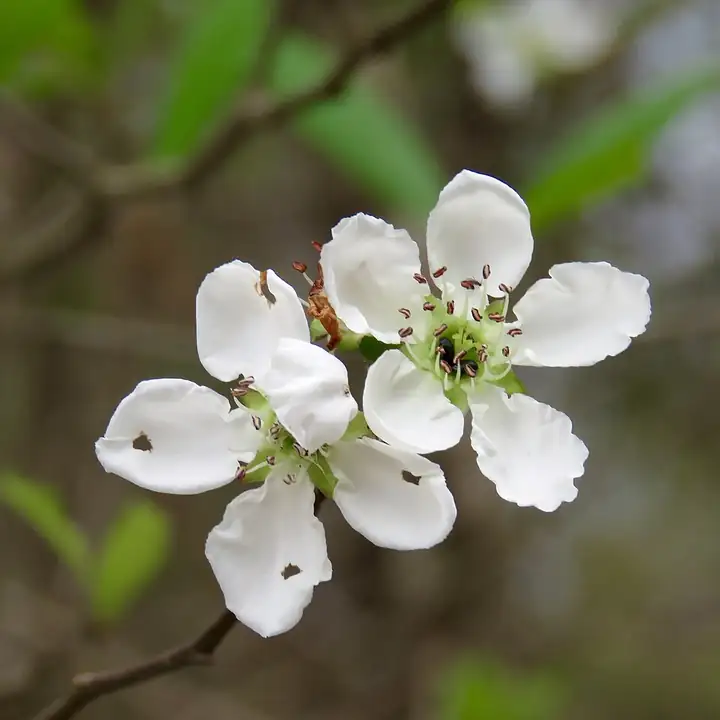
Mayhaw
Crataegus aestivalis (eastern mayhaw), C. opaca (western mayhaw) and C. rufula · Rose family (Rosaceae)
When to plant: Fall is a good planting time in the Deep South (LSU AgCenter).
| Hardiness zones | 6 to 11 |
|---|---|
| Sun | full sun |
| Water | moderate |
| Life cycle | perennial |
| Frost | Hardy: takes frost |
| Soil pH | 6.0–6.5 |
| Spacing | 180 to 240 inches |
About Mayhaw
Mayhaws are native Southern hawthorns: small, thorny trees that bloom white in late winter and ripen tart red fruit around May. The fruit makes a prized jelly. They thrive in low, wet spots where many fruit trees fail, and also grow on upland sites.
NC State lists eastern mayhaw for zones 6-11. It grows wild from North Carolina to Florida and west to Texas (UGA), needs far fewer winter chill hours than peaches, and has fruited in zone 10b in Florida (UF/IFAS).
When to plant
Fall is a good planting time in the Deep South (LSU AgCenter).
Plant grafted or own-root nursery trees on mayhaw rootstock; Washington hawthorn rootstock does poorly (UGA). In UGA trials, 6-year-old trees gave 10-20 pounds of fruit each and 9-year-old trees 25-40 pounds.
Soil
Moist, well-drained, fairly acid soil is best for fruit, but mayhaws also handle low, wet ground and seasonal standing water (NRCS; UGA).
Test the soil and adjust the pH to 6.0-6.5 before planting (UGA).
Feeding
- Young trees: early spring: balanced fertilizer such as 10-10-10. Use 1/2 to 1 pound per inch of trunk diameter, spread under the branches (UGA).
Look for: mostly nitrogen, in spring as growth starts. Spring feeding grows the new shoots and leaves that carry flowers and fruit; feeding after midsummer pushes soft growth that may not harden before winter. - Young trees: summer: balanced fertilizer such as 10-10-10. Repeat the spring rate of 1/2 to 1 pound per inch of trunk diameter (UGA).
Look for: mostly nitrogen, in spring as growth starts. Spring feeding grows the new shoots and leaves that carry flowers and fruit; feeding after midsummer pushes soft growth that may not harden before winter. - Older, bearing trees: early spring and again in summer: balanced fertilizer such as 10-10-10. Feed twice a year, following a soil test (UGA).
Look for: mostly nitrogen, in spring as growth starts. Spring feeding grows the new shoots and leaves that carry flowers and fruit; feeding after midsummer pushes soft growth that may not harden before winter.
Don't skip annual sucker removal: mayhaws send up root sprouts that crowd the tree (UGA).
Harvest
Fruit ripens from mid-April into May in the Deep South (NRCS; UGA). It ripens over several weeks, so plan more than one picking: shake limbs over a tarp, hand-pick, or gather fallen fruit (UGA).
Mayhaw gives one crop a year, ripening from late April to mid-May in Georgia depending on cultivar. Fruit ripens over a week or more, so plan several pickings: gather fallen fruit, pick low limbs, or shake limbs over a tarp.
Varieties (17)
| Variety | Type | Season and days | Zones | Notes |
|---|---|---|---|---|
| Turnage 57 | Georgia selection | Blooms early to mid-March; ripens early to mid-May | 6–11typical for mayhaw | Medium fruit with light red skin and yellow flesh; soft. Bears young and heavily; kept about 80 percent crops after spring freezes. Its flowers seem to make no pollen. Sources: [1] |
| Turnage 88 | Georgia selection | Blooms early to mid-March; ripens mid-May | 6–11typical for mayhaw | Medium fruit with light red skin and yellow flesh; soft. Slow to start bearing heavily, then an outstanding cropper; the top yielder in one Georgia freeze year, about 41 lb per tree. Sources: [1] |
| Big Red | Grafted fruiting cultivar | Blooms early March; ripens late April to early May | 6–11typical for mayhaw | Large fruit with red skin and pink flesh; good firmness. Bore only a light crop after a hard spring freeze in Georgia. Texas A&M lists it among later-blooming types for northeast Texas. Sources: [1][13] |
| Big V | Grafted fruiting cultivar | Blooms early to mid-March; ripens late April to early May | 6–11typical for mayhaw | Large fruit with light red skin and pinkish flesh; soft and drops fairly easily. Kept 40-50 percent crops after spring freezes in Georgia trials. Sources: [1] |
| Crimson | Grafted fruiting cultivar | Blooms mid-March; ripens late April to early May | 6–11typical for mayhaw | Large fruit with mostly red skin and light pink flesh; only fair firmness. Late bloom helped it carry 30-80 percent crops after spring freezes in Georgia. Mississippi State rates its fire blight resistance moderate (based on limited data). Sources: [1][2] |
| Double G | Grafted fruiting cultivar | 6–11typical for mayhaw | LSU AgCenter lists it for fruit production. Mississippi State rates its fire blight resistance fair (based on limited data). Sources: [2][4] | |
| Elite | Grafted fruiting cultivar | 6–11typical for mayhaw | Mississippi State rates its fire blight resistance high (based on limited data). Sources: [2] | |
| Mason's Superberry | Grafted fruiting cultivar | Blooms mid- to late February; ripens late April | 6–11typical for mayhaw | Large, very dark red fruit with pink flesh; very firm, but can cling to the tree too tightly. Its very early bloom led to light crops in freeze years in Georgia. Also called Texas Superberry or Mason. Mississippi State rates its fire blight resistance fair (based on limited data). Sources: [1][2] |
| Maxine | Grafted fruiting cultivar | 6–11typical for mayhaw | LSU AgCenter lists it for fruit production. Mississippi State rates its fire blight resistance high (based on limited data). Sources: [2][4] | |
| Red Champ | Grafted fruiting cultivar | 6–11typical for mayhaw | LSU AgCenter lists it for fruit production. Mississippi State rates its fire blight resistance moderate (based on limited data). Sources: [2][4] | |
| Royal Star | Grafted fruiting cultivar | Ripens late April to early May | 6–11typical for mayhaw | Very large, soft fruit with red skin. Reported to do well in Louisiana and Texas. From southeast Texas; also known as G-5. Mississippi State rates its fire blight resistance poor (based on limited data). Sources: [1][2] |
| Saline | Grafted fruiting cultivar | Blooms early to mid-March; ripens late April to early May | 6–11typical for mayhaw | Large fruit with mostly red skin and light pink-orange flesh; firm and holds well on the tree. Still bore about 60 percent of a crop after a hard spring freeze in Georgia trials. Mississippi State rates its fire blight resistance fair (based on limited data). Sources: [1][2] |
| Spectacular | Grafted fruiting cultivar | 6–11typical for mayhaw | Mississippi State rates its fire blight resistance high (based on limited data). Sources: [2] | |
| Super Spur | Grafted fruiting cultivar | Blooms late February to early March; ripens late April to early May (south Georgia) | 6–11typical for mayhaw | Large fruit with light red-yellow skin and yellow flesh; soft and drops easily. Very productive when no late freeze hits the early bloom. Texas A&M ranks it among the best for yield and tree shape. Texas A&M suggests it for central and southeast Texas, but it may not get enough winter chill near Beaumont. Mississippi State rates its fire blight resistance moderate (based on limited data). Also written Superspur. Sources: [1][2][13] |
| Surprise | Grafted fruiting cultivar | 6–11typical for mayhaw | LSU AgCenter lists it for fruit production. Sources: [4] | |
| T.O. Superberry | Grafted fruiting cultivar | Blooms mid- to late February; ripens late April | 6–11typical for mayhaw | Large, dark red fruit with pink flesh; very firm and holds well on the tree. Very early bloom meant light crops in several freeze years in Georgia. Sources: [1] |
| Texas Star | Grafted fruiting cultivar | Blooms mid-March; ripens early to mid-May | 6–11typical for mayhaw | Large, sometimes very large fruit with red-orange skin and yellow flesh; fairly firm and tends to hang on the tree. Its later bloom helps it crop after spring freezes in Texas and Louisiana. Mississippi State rates its fire blight resistance poor (based on limited data). Sources: [1][2] |
Pests to watch for
Plum curculio, Apple maggot, Scale insects, Aphids, Whiteflies, Deer, Rabbits, Birds
Diseases and problems
Cedar-apple rust, Quince rust, Fire blight, Brown rot, Hawthorn leaf blight
In the kitchen
Cooked into jelly, syrup, sauces, juice and wine (UGA; NRCS); the fruit looks like a cranberry and tastes like a crabapple (UF/IFAS).
Keeping it: Mayhaws don't keep long: freeze them or make them into juice or jelly within a few days of picking.
Safety: The branches have sharp thorns. Hawthorn supplements (made from other hawthorn species) can cause dizziness and stomach upset and may interact with heart medicines, and little is known about their safety in pregnancy (NCCIH).
Pets: Listed as non-toxic to dogs, cats and horses by the ASPCA (hawthorn, Crataegus species)
Sources
- secure.caes.uga.edu
- extension.msstate.edu
- plants.ces.ncsu.edu
- lsuagcenter.com
- plants.sc.egov.usda.gov
- nrcs.usda.gov
- gardeningsolutions.ifas.ufl.edu
- blogs.ifas.ufl.edu
- nccih.nih.gov
- plantsservices.sc.egov.usda.gov
- plantsservices.sc.egov.usda.gov
- aspca.org
- aggie-horticulture.tamu.edu
Photo: Photo: Laura Clark / Wikimedia Commons, CC BY 4.0 (CC BY 4.0). Photo resized for the web.

Planting dates and advice are general guidance; check with your local Cooperative Extension office for your area.