
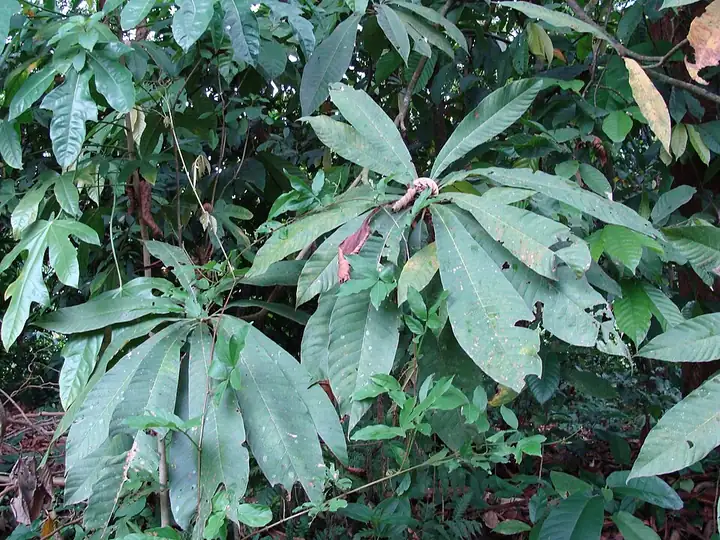
Mamey sapote
Pouteria sapota · Sapodilla family (Sapotaceae)
When to plant: Plant a grafted tree at the start of the rainy season (or any time you can water reliably) in full sun, 20-30 ft or more from other trees, buildings and power lines; plant on a 2-3 ft mound where the water table is high (UF/IFAS).
| Hardiness zones | 10 to 11 |
|---|---|
| Sun | full sun |
| Water | moderate |
| Life cycle | perennial |
| Frost | Tender: killed by frost |
| Spacing | 240 to 360 inches |
About Mamey sapote
Mamey sapote is a large tropical tree from Mexico and Central America with football-shaped fruit that has rough brown skin and sweet, creamy salmon-to-red flesh tasting a bit like pumpkin and almond. In the U.S. it is grown mostly in Miami-Dade County, Florida, where Cuban and Central American families made it popular. Grafted trees start bearing in 3-5 years, and by planting a few varieties you can pick fruit almost all year.
UF/IFAS says it is not frost tolerant: young trees are hurt below 32 F, mature trees take a few hours at 28 F with slight damage, and long spells below 22 F kill them; UF limits home planting to the warmest parts of south Florida. The zone range is our estimate from those temperatures. The Hawaii-Pacific Weed Risk Assessment rates it low risk, and we found no U.S. invasive or noxious listing.
When to plant
Plant a grafted tree at the start of the rainy season (or any time you can water reliably) in full sun, 20-30 ft or more from other trees, buildings and power lines; plant on a 2-3 ft mound where the water table is high (UF/IFAS).
Seedlings take 7 or more years to bear and vary in quality, so UF/IFAS does not recommend them for home growers.
Soil
Grows in many well-drained soils, from clay to sand and Florida limestone, but not in soil that stays wet or floods, which kills roots and invites root rot (UF/IFAS).
Don't put fertilizer, topsoil or compost in the hole; mix any amendment no more than half and half with native soil, and plant on a 2-3 ft high mound where the water table is high (UF/IFAS).
Feeding
- First 3 years: when new growth appears and through the growing season, mid-March to October: Granular fruit tree fertilizer with magnesium, such as 6-6-6-2 or 8-3-8-3. About 1/4-1/2 lb per tree per feeding in year one and 1/2-3/4 lb in year two, about four times a year, increasing a little each year after that (UF/IFAS).
Look for: mostly nitrogen, in spring as growth starts. Spring feeding grows the new shoots and leaves that carry flowers and fruit; feeding after midsummer pushes soft growth that may not harden before winter. - March through October, each year: Leaf spray with magnesium, manganese, zinc, molybdenum and boron. Three or four sprays a season, especially on limestone soils; follow the label to avoid leaf burn (UF/IFAS).
Look for: mostly nitrogen, in spring as growth starts. Spring feeding grows the new shoots and leaves that carry flowers and fruit; feeding after midsummer pushes soft growth that may not harden before winter. - April through early fall, when leaves yellow between green veins: Chelated iron soil drench (Fe-EDDHA on alkaline soil, Fe-DTPA on acid soil). Drench moist soil around the tree one or more times a year; iron leaf sprays don't work well (UF/IFAS).
Look for: mostly nitrogen, in spring as growth starts. Spring feeding grows the new shoots and leaves that carry flowers and fruit; feeding after midsummer pushes soft growth that may not harden before winter.
Cut back or skip nitrogen from November to February so the tree doesn't push tender growth before cold weather, and don't overwater, which brings root rot (UF/IFAS).
Harvest
Fruit takes 13-24 months from flower to maturity. Scratch a tiny spot of skin: if the layer underneath has turned from green to pinkish-brown, orange or red, it's mature. Twist or clip it off and let it soften for a few days to a week; immature fruit never softens (UF/IFAS).
Each tree ripens its fruit at one time of year, but fruit takes 13-24 months to mature, so a tree often carries flowers, young fruit and ripe fruit at once. Planting 3-4 varieties with different seasons (such as 'Tazumal', 'Pace', 'Magana' and 'Pantin') can give fruit nearly all year.
Varieties (18)
| Variety | Type | Season and days | Zones | Notes |
|---|---|---|---|---|
| Abuelo | Florida cultivar | Ripens Oct-Nov in Florida | 10–11typical for mamey sapote | Excellent flavor. Very large fruit, about 26-85 oz, on a spreading tree. Not on UF/IFAS's home-garden list. Sources: [1] |
| Akil Especial | Florida cultivar | Ripens Apr-Jun in Florida | 10–11typical for mamey sapote | Good flavor. Fruit about 13 oz. UF/IFAS hasn't rated it for home gardens yet. Sources: [1] |
| AREC No. 33 | Florida cultivar | Ripens Jul-Sep in Florida | 10–11typical for mamey sapote | Poor to good flavor. Fruit about 14-26 oz on a medium tree. Not on UF/IFAS's home-garden list. Sources: [1] |
| Cepeda Especial | Florida cultivar | Ripens Apr-Jun in Florida | 10–11typical for mamey sapote | Good flavor. Fruit about 13.5 oz. UF/IFAS hasn't rated it for home gardens yet. Sources: [1] |
| Chenox | Florida cultivar | Ripens May-Jun in Florida | 10–11typical for mamey sapote | Good flavor. Fruit about 14-30 oz on a medium tree. Not on UF/IFAS's home-garden list. Sources: [1] |
| Copan | Florida cultivar | Ripens Jul-Aug in Florida | 10–11typical for mamey sapote | Excellent flavor. Fruit about 15-32 oz on a medium, spreading tree; listed as cold tolerant. Not on UF/IFAS's home-garden list. Sources: [1] |
| Flores | Florida cultivar | Ripens Nov-Dec in Florida | 10–11typical for mamey sapote | Excellent flavor. Very large fruit, about 26-85 oz, on an upright tree. Not on UF/IFAS's home-garden list. Sources: [1] |
| Florida | Florida cultivar | Ripens Mar-Apr in Florida | 10–11typical for mamey sapote | Good flavor. Fruit about 14-40 oz on a tall tree; not cold tolerant. Not on UF/IFAS's home-garden list. Sources: [1] |
| Francisco Fernandez | Florida cultivar | Ripens Aug-Sep in Florida | 10–11typical for mamey sapote | Excellent flavor. Fruit about 20-25 oz on an upright tree; not cold tolerant. Not on UF/IFAS's home-garden list. Sources: [1] |
| Lara | Florida cultivar | Ripens Aug-Sep in Florida | 10–11typical for mamey sapote | Excellent flavor. Fruit about 14-40 oz; listed as cold tolerant. Recommended for home gardens by UF/IFAS. Sources: [1] |
| Lorito | Florida cultivar | Ripens Jul-Aug in Florida | 10–11typical for mamey sapote | Excellent flavor. Fruit about 14 oz. UF/IFAS hasn't rated it for home gardens yet. Sources: [1] |
| Magana | Florida cultivar | Ripens Apr-May in Florida | 10–11typical for mamey sapote | Good flavor. Very large fruit, about 26-85 oz, on a small, slow-growing tree that bears young; not cold tolerant, and fruit can ripen unevenly. Recommended for home gardens by UF/IFAS; the second most planted mamey in Florida. Sources: [1] |
| Mayapan | Florida cultivar | Ripens Jul-Aug in Florida | 10–11typical for mamey sapote | Good flavor. Fruit about 18-40 oz on a tall, upright tree; listed as cold tolerant. Recommended for home gardens by UF/IFAS. Sources: [1] |
| Pace | Florida cultivar | Ripens Mar-Apr in Florida | 10–11typical for mamey sapote | Excellent flavor. Fruit about 15-32 oz on a tall tree that bears young; listed as cold tolerant. Recommended for home gardens by UF/IFAS. Sources: [1] |
| Pantin | Florida cultivar | Ripens Jul-Aug in Florida | 10–11typical for mamey sapote | Excellent flavor. Fruit about 14-40 oz on a tall tree; listed as cold tolerant. Also called 'Key West'. Recommended for home gardens by UF/IFAS; the most planted mamey in Florida. Sources: [1] |
| Piloto | Florida cultivar | Ripens Aug-Sep in Florida | 10–11typical for mamey sapote | Excellent flavor. Fruit about 14-26 oz on a medium tree; not cold tolerant. Not on UF/IFAS's home-garden list. Sources: [1] |
| Tazumal | Florida cultivar | Ripens Jan-Feb in Florida | 10–11typical for mamey sapote | Good flavor. Fruit about 14-30 oz on a medium tree that bears young. Not on UF/IFAS's home-garden list; a winter crop that helps stretch the season. Sources: [1] |
| Viejo | Florida cultivar | Ripens Dec in Florida | 10–11typical for mamey sapote | Excellent flavor. Fruit about 16-20 oz on a spreading tree. Not on UF/IFAS's home-garden list. Sources: [1] |
Pests to watch for
Diseases and problems
Anthracnose, Algal leaf spot (red alga), Root rot
In the kitchen
Eaten fresh with a spoon after removing the big seed, and made into milkshakes, ice cream, jellies and fruit pastes, often from frozen pulp (UF/IFAS).
Keeping it: Let mature fruit soften at room temperature for a few days to a week, then keep ripe fruit chilled (about 50-55 F is ideal) and use it soon.
Safety: The fruit is eaten as a food. The sources we checked list no toxic parts, and we found no research-based guidance on pregnancy, drug interactions or allergies for mamey sapote.
Pets: Not listed by the ASPCA
Sources
Photo: Photo: Alexis López Hernández, CC BY 4.0, via Wikimedia Commons (CC BY 4.0). Photo resized for the web.

Planting dates and advice are general guidance; check with your local Cooperative Extension office for your area.