
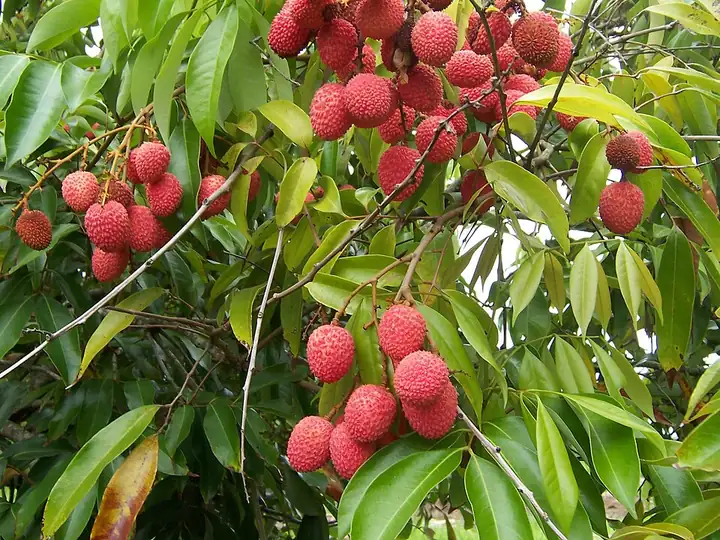
Lychee
Litchi chinensis · Soapberry family (Sapindaceae)
| Hardiness zones | 10 to 11 |
|---|---|
| Sun | full sun |
| Water | moderate |
| Life cycle | perennial |
| Frost | Tender: killed by frost |
| Soil pH | 5.0–5.5 |
| Spacing | 216 to 360 inches |
About Lychee
Lychee is a dense, rounded evergreen tree from southern China that bears clusters of bumpy pink-to-red fruit with sweet, juicy, translucent white flesh around one shiny seed. In the U.S. it fruits mainly in south Florida's coastal areas and in Hawaii, where it needs a cool, dry winter to bloom well. Crops are often uneven from year to year.
UF/IFAS lists zones 10A-11 and limits Florida plantings to southern coastal areas; young trees are damaged at 28-32 F and big trees can be badly hurt at 24-25 F (UF/IFAS). In Hawaii it grows from sea level to about 2,000 ft and needs a dry winter with temperatures below 59 F to flower well (University of Hawaii), which rates lychee low-risk as a weed; we found no U.S. invasive or noxious listing in the sources we checked.
Planting
No source ties planting to a frost date. Plant air-layered or grafted trees (seedlings don't come true and can take 10 or more years to bear); they start bearing in 3-5 years (UF/IFAS). Space trees 25-30 ft from buildings and other trees in Florida; Hawaii guidance ranges from 18 ft for upright types to 24-36 ft for vigorous ones (UF/IFAS; University of Hawaii).
Soil
Well-drained, acidic sandy soil with some organic matter; muck soils give lots of leaves but little fruit, and rocky limestone soils need extra micronutrients (UF/IFAS).
Choose well-drained, acidic sandy soil; don't add fertilizer to the hole, mix any compost no more than 1:1 with native soil, and plant on a mound in flood-prone spots (UF/IFAS).
Feeding
- Young trees (under 4 years), every 8 weeks: complete fertilizer with 6-8% nitrogen, 2-4% phosphate, 6-8% potash and 3-4% magnesium, such as 6-6-6-2 or 8-3-8-3, with 20-50% of the nitrogen in organic form. 1/4-1/2 lb per tree each time in year one (about 6 times a year), then 1/2-1 lb 4-5 times a year in years two and three (UF/IFAS).
Look for: mostly nitrogen, in spring as growth starts. Spring feeding grows the new shoots and leaves that carry flowers and fruit; feeding after midsummer pushes soft growth that may not harden before winter. - Bearing trees, late February or early March through August only: the same fertilizer. 2-3 feedings a year; skip nitrogen from August until late winter so the tree doesn't push new leaves instead of flowers (UF/IFAS). Hawaii growers feed only after flower clusters have fully formed (University of Hawaii).
Look for: mostly nitrogen, in spring as growth starts. Spring feeding grows the new shoots and leaves that carry flowers and fruit; feeding after midsummer pushes soft growth that may not harden before winter. - March through October, 2-4 times: micronutrient sprays with magnesium, manganese, zinc, molybdenum and boron. On limestone soils, drench chelated iron (EDDHA) into the soil 2-4 times from April through September; iron sprays on leaves don't work well (UF/IFAS).
Look for: mostly nitrogen, in spring as growth starts. Spring feeding grows the new shoots and leaves that carry flowers and fruit; feeding after midsummer pushes soft growth that may not harden before winter.
Late-season nitrogen, fall tip pruning, or watering from September until bloom can trade next spring's flowers for leafy growth (UF/IFAS; University of Hawaii).
Harvest
Let fruit ripen fully on the tree, since lychees picked early are not sweet; ripe fruit is plump with the full color and size of its variety (UF/IFAS). Cut the whole cluster with several inches of stem. Florida harvest runs mid-May to early July, peaking in June.
Lychee gives one crop a year, ripening mid-May to early July in Florida, but bearing is often uneven: a mature 'Brewster' may give a big crop only about one year in three or four, while well-tended 'Mauritius' bears more steadily. A dry, cool winter and no late-season nitrogen help it bloom.
Varieties (12)
From the UF/IFAS variety table (vigor, habit, fruit size, color, flavor, bearing and anthracnose ratings) and University of Hawaii trials; sources document 12 lychees.
| Variety | Season and days | Zones | Notes |
|---|---|---|---|
| Bosworth 3 | Late season in Hawaii | 10–11typical for lychee | Flavor rated fair to excellent (UF/IFAS). Low- to moderate-vigor, upright tree; small pink fruit; bears regularly. Anthracnose: susceptible. Late in Hawaii; heart-shaped bright red fruit, and an upright tree that can be spaced closer (about 18 ft). Sources: [1][3] |
| Brewster | Midseason in Hawaii | 10–11typical for lychee | Excellent flavor (UF/IFAS rating). Vigorous, upright to spreading tree; medium pink to red fruit; irregular to very irregular bearing. Anthracnose: resistant. Florida's second commercial lychee; prone to bearing heavily only every few years. In Hawaii fruit is nearly round and bright red, about 19 g. Sources: [1][2][3] |
| Emperor | 10–11typical for lychee | Good flavor (UF/IFAS rating). Low-vigor, spreading tree; medium to large red fruit; bears irregularly. Sources: [1][2] | |
| Groff | Late season (July-August in Hawaii) | 10–11typical for lychee | Selected in Hawaii from Hak Ip seedlings; small, about 11 g, dark maroon fruit. Performs well in Hawaii (University of Hawaii). Sources: [3] |
| Hak Ip | Midseason in Hawaii | 10–11typical for lychee | Good to excellent flavor (UF/IFAS rating). Vigorous, upright to spreading tree; medium purplish red fruit; fairly regular bearing. Anthracnose: resistant. In Hawaii fruit is egg-round with dull red, smooth skin, about 17 g, with a large seed. Sources: [1][2][3] |
| Hanging Green | 10–11typical for lychee | Excellent flavor (UF/IFAS rating). Low- to moderate-vigor, spreading tree; medium green to pink fruit; very irregular bearing. Anthracnose: resistant. UF/IFAS does not recommend it for home or commercial planting because it bears very irregularly. Sources: [1] | |
| Kaimana | Early to mid season (May-June in Hawaii) | 10–11typical for lychee | Good flavor (UF/IFAS rating). Moderate- to high-vigor, spreading tree; medium to large red fruit; very irregular bearing. Anthracnose: resistant. Selected in Hawaii from Hak Ip seedlings; ripens early to mid season (May-June) there and needs less winter chill than traditional Chinese types. UF/IFAS rates it very irregular in Florida. Sources: [1][3] |
| Kwai May Pink | 10–11typical for lychee | Named by UF/IFAS among recommended lychees for Florida; no other details given. Sources: [2] | |
| Mauritius | 10–11typical for lychee | Good flavor (UF/IFAS rating). Vigorous, spreading tree; medium to large pink to red fruit; bears regularly. Anthracnose: susceptible. The main commercial lychee in Florida and the most popular; tends to bear more regularly than others. Sources: [1][2] | |
| Souey Tung | Midseason in Hawaii | 10–11typical for lychee | Heart-shaped, dull red, thin-skinned fruit of about 22 g. Sources: [3] |
| Sweet Cliff | 10–11typical for lychee | Fair to good flavor (UF/IFAS rating). Moderately vigorous, upright tree; small pink fruit; bears irregularly. Sources: [1][2] | |
| Tai So | Early to mid season in Hawaii | 10–11typical for lychee | Vigorous tree; fruit about 24 g. Hawaii's first lychee tree, planted in 1873, was this variety. Needs wide spacing, about 24 by 36 ft (University of Hawaii). Sources: [3] |
Pests to watch for
Eriophyid mites (rust, bud, blister and gall mites), Scale insects, Mealybugs
Diseases and problems
Anthracnose, Mushroom root rot, Parasitic lichen, Algal leaf spot (red algae)
In the kitchen
Best eaten fresh, soon after picking; the fruit can also be frozen whole in the peel, canned without the peel, or dried in the peel (UF/IFAS).
Keeping it: Lychees taste best soon after picking; keep them in a plastic bag in the refrigerator for 5-10 days (UF/IFAS).
Safety: The sources we checked list no toxic parts, and we found no research-based guidance on pregnancy, drug interactions or allergies for lychee.
Pets: Not listed by the ASPCA
Sources
- ask.ifas.ufl.edu
- gardeningsolutions.ifas.ufl.edu
- www3.ctahr.hawaii.edu
- www3.ctahr.hawaii.edu
- www3.ctahr.hawaii.edu
- aspca.org
- aspca.org
Photo: Photo: B. Navez / Wikimedia Commons, CC BY-SA 3.0 (CC BY-SA 3.0). Photo resized for the web.

Planting dates and advice are general guidance; check with your local Cooperative Extension office for your area.