
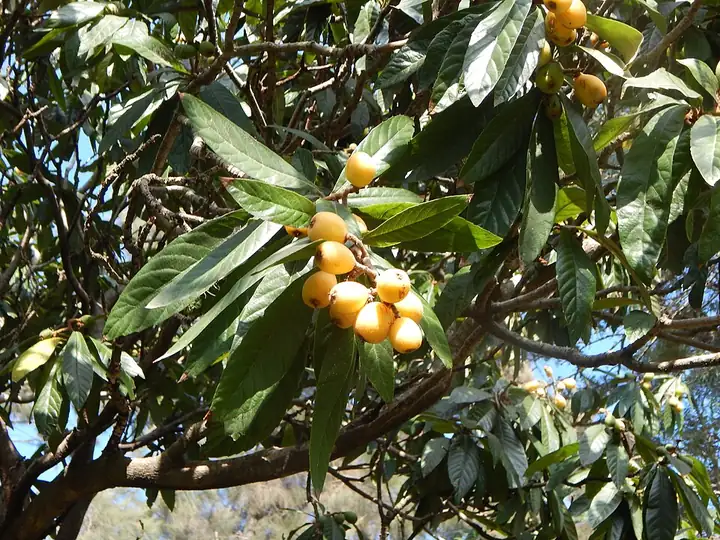
Loquat
Eriobotrya japonica · Rose family (Rosaceae)
When to plant: Potted trees go back outside once frost danger has passed.
| Hardiness zones | 8 to 11 |
|---|---|
| Sun | full sun to part shade |
| Water | moderate |
| Life cycle | perennial |
| Frost | Half-hardy: takes a light frost |
| Soil pH | 5.5–6.5 |
| Spacing | 300 to 360 inches |
About Loquat
Loquat is an evergreen tree with big, crinkled leaves and fragrant fall flowers that turn into clusters of sweet-tart yellow to orange fruit in late winter and spring. The tree itself is fairly cold hardy, but frost kills the flowers and young fruit. Heads-up: the South Carolina Invasive Pest Council lists loquat as invasive, and UF/IFAS says to manage it so it doesn't escape in central and south Florida.
NC State and UF/IFAS list zones 8-11 (Clemson 8b-10); trees take about 8-12 F, but flowers and fruit die below about 27 F (UF/IFAS; Texas A&M). It is on the South Carolina Invasive Pest Council list, and UF/IFAS rates it 'caution' in central and south Florida; USDA PLANTS lists no noxious status.
When to plant
Potted trees go back outside once frost danger has passed.
In the ground, give an unpruned tree 25-30 ft from buildings and other trees, and in cold areas plant on the south or southeast side (UF/IFAS; Texas A&M). Grafted trees bear 1-2 years after planting; seedlings take 6-8 years (UF/IFAS).
Soil
Almost any well-drained soil, acid or alkaline; it will not stand flooded or salty ground (UF/IFAS; Texas A&M).
Fertilize based on a soil test (Clemson); loquats grow in acid or alkaline soil as long as it drains (Texas A&M). Compost or topsoil can be mixed in up to half and half (UF/IFAS).
Feeding
- First-year in-ground trees, 2-3 times a year once new growth starts: balanced fertilizer such as 6-6-6 or 8-3-9. UF/IFAS uses 1/4 to 1/2 lb per feeding in year one, rising each year to about 3-3.5 lb per feeding by year seven; spread it under the canopy and water in.
Look for: mostly nitrogen, in spring as growth starts. Spring feeding grows the new shoots and leaves that carry flowers and fruit; feeding after midsummer pushes soft growth that may not harden before winter. - Bearing trees: just before or at bloom in late fall, again in March, and once in summer: balanced fertilizer such as 6-6-6 or 8-3-9. Follow the UF/IFAS table for tree age; Texas A&M gives mature trees about 1 lb of 21-0-0 per inch of trunk width per year, split into 2-3 feedings.
Look for: mostly nitrogen, in spring as growth starts. Spring feeding grows the new shoots and leaves that carry flowers and fruit; feeding after midsummer pushes soft growth that may not harden before winter. - Potted trees, from the start of new growth in spring through summer: complete liquid fertilizer with micronutrients, or a timed-release fertilizer. Feed liquid fertilizer at least monthly, or timed-release about every 12 weeks, because nutrients wash out of pots quickly (UF/IFAS St. Lucie County; NC State). Stop in winter and start again when new growth appears (Maryland Extension).
Look for: mostly nitrogen, in spring as growth starts. Spring feeding grows the new shoots and leaves that carry flowers and fruit; feeding after midsummer pushes soft growth that may not harden before winter.
Heavy nitrogen makes loquats more prone to fire blight (UF/IFAS; Clemson).
Harvest
Fruit ripens February to May, depending on variety; color deepens and fruit softens over the last 4-5 weeks, and it does not ripen after picking, so taste a few first (UF/IFAS; Clemson). Clip whole clusters, then snip off single fruit.
Loquat blooms in fall and early winter and gives one crop, ripening in late winter and spring (February-May in Florida). Pick at nearly full to full color by cutting whole clusters and then clipping off single fruits.
Varieties (15)
| Variety | Type | Season and days | Zones | Notes |
|---|---|---|---|---|
| Premier | Dwarf | 8–11typical for loquat | Dwarf tree about 6 ft tall with yellow-orange fruit; suits containers. Sources: [4] | |
| Advance | Named cultivar | March to April | 8–11typical for loquat | Sweet-tart; white flesh under thin yellow skin. Medium-large, pear-shaped fruit with 1-2 seeds. An 1897 heirloom; partly self-infertile but a good pollinizer for other varieties (Clemson). Recommended by UF/IFAS. Sources: [1][4][7] |
| Champagne | Named cultivar | March to May | 8–11typical for loquat | Sweet and a little spicy; white to light yellow flesh. Medium-large, pear-shaped fruit with thin, pale yellow-orange skin. Dates to about 1908; self-infertile but a good pollinizer (Clemson). Recommended by UF/IFAS. Sources: [1][4][7] |
| Emanuel | Named cultivar | March to April | 8–11typical for loquat | Mildly sweet; orange flesh. Medium-large, pear-shaped fruit with dark yellow-orange skin. From Israel (Clemson). Recommended by UF/IFAS. Sources: [1][4] |
| Gold Nugget | Named cultivar | March to May | 8–11typical for loquat | Mildly sweet (UF/IFAS rates it fair); orange flesh. NC State calls it sweet. Round orange fruit with thick skin and 3-6 seeds. Sold as 'Golden Nugget' too; not on UF/IFAS's recommended list. Sources: [1][5] |
| Golitch | Named cultivar | March to April | 8–11typical for loquat | Mildly sweet; orange flesh. Round, medium-large orange fruit with thick skin. Recommended by UF/IFAS. Sources: [1] |
| Juda | Named cultivar | March to May | 8–11typical for loquat | Sweet and mildly tart. Medium-large, pear-shaped pale orange fruit with thin skin. Recommended by UF/IFAS. Sources: [1] |
| Judith | Named cultivar | March to April | 8–11typical for loquat | Mild and sweet; dark yellow-orange flesh. Small to medium pear-shaped fruit with thick skin. Recommended by UF/IFAS. Sources: [1] |
| Macbeth | Named cultivar | 8–11typical for loquat | Large yellow fruit (NC State). Sources: [5] | |
| Oliver | Named cultivar | March to May | 8–11typical for loquat | Very sweet; pale orange flesh. Medium-large fruit with thick, leathery orange skin and 1-2 seeds. A Florida hybrid from 1908, introduced in 1947 (Clemson). Recommended by UF/IFAS. Sources: [1][4] |
| Sherry | Named cultivar | March to May | 8–11typical for loquat | Mildly sweet; white to pale yellow flesh. The largest fruit in UF/IFAS trials, with thick yellow skin. Selected in 1950 (Clemson). Sources: [1][4] |
| Thales | Named cultivar | February to May | 8–11typical for loquat | Sweet; yellow-orange flesh. Small to medium pear-shaped fruit with thin skin. Recommended by UF/IFAS. Sources: [1][7] |
| Thursby | Named cultivar | March to May | 8–11typical for loquat | Mildly sweet-tart; dark yellow flesh. Small to medium fruit with thick, dark yellow-orange skin. Selected in 1949 (Clemson). Recommended by UF/IFAS. Sources: [1][4] |
| Wolfe | Named cultivar | March to May | 8–11typical for loquat | Sweet-tart and spicy; white to pale orange flesh. Large, pear-shaped fruit with thin yellow skin and 1-2 seeds. Released in 1996 (Clemson). Recommended by UF/IFAS. Sources: [1][4][7] |
| Variegata | Ornamental | 8–11typical for loquat | Leaves are variegated white and light green; grown mainly for looks. UF/IFAS rates it for zones 8A-11. Sources: [2][4][5] |
Pests to watch for
Diseases and problems
Fire blight, Crown rot, Canker, Scab, Anthracnose
In the kitchen
Eaten fresh or used in fruit salads, pies, sauces, jams, jellies and syrup; it also cans, dries and freezes (UF/IFAS).
Keeping it: Ripe loquats bruise easily: handle them gently, refrigerate them in a plastic bag, and use them soon.
Safety: The seeds (and young leaves) are mildly poisonous; eating large amounts of cracked seeds can cause vomiting, weakness, breathing trouble and seizures (NC State; Missouri Botanical Garden). We found no research-based guidance on pregnancy or drug interactions.
Pets: Not listed as toxic by the ASPCA
Sources
- ask.ifas.ufl.edu
- ask.ifas.ufl.edu
- aggie-hort.tamu.edu
- hgic.clemson.edu
- plants.ces.ncsu.edu
- missouribotanicalgarden.org
- fieldreport.caes.uga.edu
- invasiveplantatlas.org
- invasiveplantatlas.org
- plantsservices.sc.egov.usda.gov
- yardandgarden.extension.iastate.edu
- aspca.org
- aspca.org
- aspca.org
- blogs.ifas.ufl.edu
- content.ces.ncsu.edu
- extension.umd.edu
- assessment.ifas.ufl.edu
- law.cornell.edu
Photo: Photo: Adriel anv00, CC BY-SA 4.0, via Wikimedia Commons (CC BY-SA 4.0). Photo resized for the web.

Planting dates and advice are general guidance; check with your local Cooperative Extension office for your area.