
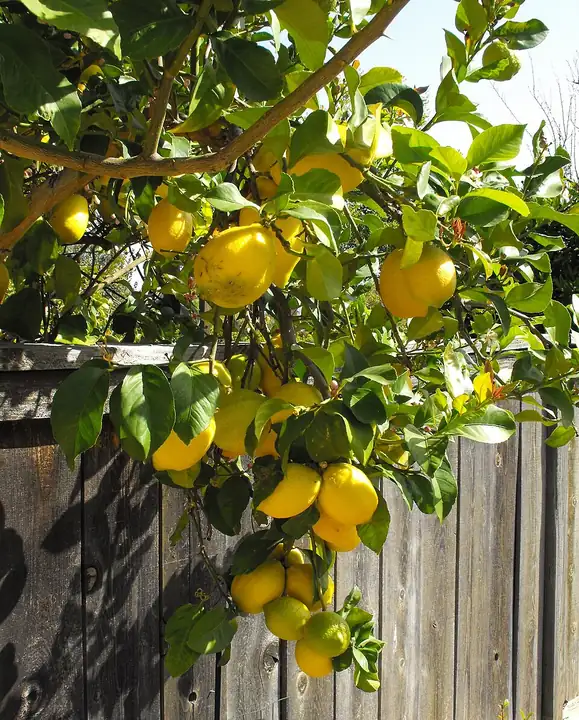
Lemon
Citrus limon · Citrus family (Rutaceae)
When to plant: Move potted trees outdoors in spring once the danger of frost has passed (UMD).
| Hardiness zones | 9 to 11 |
|---|---|
| Sun | full sun |
| Water | moderate |
| Life cycle | perennial |
| Frost | Tender: killed by frost |
| Soil pH | 5.5–6.5 |
| Spacing | 180 to 300 inches |
About Lemon
The true lemon is thought to have started in the foothills of the Himalayas as a cross of citron and sour orange, and Spanish explorers carried it to the Americas in 1493 (UF/IFAS). 'Eureka' and 'Lisbon' are the classic sour, juicy lemons, and the trees bear several crops a year. Lemons are less cold-hardy than Meyer lemons and grow into bigger trees, so potted lemons do best on a dwarfing rootstock.
NC State lists zones 9-11. UF/IFAS says flowers and young fruit die at about 29 F, leaves drop at 22-24 F and wood is badly hurt at 20 F, so frost-prone areas should grow lemons in pots.
When to plant
Move potted trees outdoors in spring once the danger of frost has passed (UMD).
In zones 9-11, plant container trees in the ground any time of year, 15 to 25 feet from buildings and other trees (UF/IFAS). Grafted trees usually start bearing in their third year (UF/IFAS).
Soil
Any well-drained soil; lemons will not stand flooding, and wetting the leaves and trunk invites disease (UF/IFAS). In pots use a light, well-drained mix (UMD).
Pot in a light, well-drained mix with perlite, vermiculite, coir or peat (LSU AgCenter) in a pot with drainage holes. In the ground, choose well-drained soil with a pH of 5.5-6.5 (UF/IFAS).
Feeding
- Potted trees: early spring, as new growth starts: citrus fertilizer with micronutrients, with an N-P-K ratio near 2-1-1 or 3-1-1. Feed only while the tree is actively growing (UMD). Either mix slow-release fertilizer into the pot, or use a liquid citrus fertilizer once or twice a month (UC Master Gardeners); follow the label, since trees in pots need less than trees in the ground (UC IPM).
Look for: mostly nitrogen, in spring as growth starts. Spring feeding grows the new shoots and leaves that carry flowers and fruit; feeding after midsummer pushes soft growth that may not harden before winter. - Potted trees: early summer: citrus fertilizer with micronutrients. Give the second of at least three growing-season feedings (UMD), or keep up the liquid feeding. Potted citrus outdoors may need watering daily in summer (UMD), so check the pot often.
Look for: mostly nitrogen, in spring as growth starts. Spring feeding grows the new shoots and leaves that carry flowers and fruit; feeding after midsummer pushes soft growth that may not harden before winter. - Potted trees: late summer (last feeding of the year): citrus fertilizer with micronutrients. Give the last feeding in late summer and stop by early fall; don't feed through winter (UMD).
Look for: mostly nitrogen, in spring as growth starts. Spring feeding grows the new shoots and leaves that carry flowers and fruit; feeding after midsummer pushes soft growth that may not harden before winter. - Any time new leaves come out yellow with green veins (zinc, iron or manganese shortage): chelated micronutrient spray (zinc, iron, manganese). Spray the new spring growth with a chelated micronutrient product, or add zinc or iron sulfate to the soil (UC IPM); follow the label.
Look for: mostly nitrogen, in spring as growth starts. Spring feeding grows the new shoots and leaves that carry flowers and fruit; feeding after midsummer pushes soft growth that may not harden before winter. - In-ground trees (zones 9-11), first year, spread through the growing season: citrus fertilizer such as 6-6-6-2 with minor elements. UF/IFAS gives young lemon trees about 1/4 to 1/2 pound of 6-6-6-2 per feeding, 3 to 4 times the first year, rising each year; it also suggests 2 to 4 foliar sprays of magnesium, manganese, zinc and other minor elements from April to September. Follow a soil test.
Look for: mostly nitrogen, in spring as growth starts. Spring feeding grows the new shoots and leaves that carry flowers and fruit; feeding after midsummer pushes soft growth that may not harden before winter.
Don't feed in fall or winter (UMD; UC IPM). Over-fertilizing gives lush leaves at the expense of fruit (UF/IFAS). Never apply sulfur and oil sprays within three weeks of each other (UF/IFAS).
Harvest
Lemons can be picked once they reach about 1.5 to 2 inches across, even while the peel is still light green; they turn yellow and get juicier at room temperature (UF/IFAS). Fruit takes 4 to 12 months from bloom; 'Eureka' bears all year, mainly late winter to early summer, and 'Lisbon' mainly in winter and early spring (UC Riverside).
After the main winter-spring bloom, lemon trees can bloom again in June and November, so fruit may be ready at almost any time of year; each crop takes 4 to 12 months from flower. Pick once fruit is about 1.5-2 inches across with a light green peel and let it turn yellow at room temperature.
Varieties (12)
Sources we could open document 12 lemons, mostly from the UC Riverside Citrus Variety Collection. UF/IFAS also names 'Avon' and 'Harvey' for Florida but gives almost no detail. Meyer lemon is a separate plant in this app. Hardiness zones are for the species, not rated by variety.
| Variety | Type | Season and days | Zones | Notes |
|---|---|---|---|---|
| Eureka | Eureka-type lemon | All year, mainly late winter, spring and early summer | 9–11typical for lemon | Very sour, juicy and nearly seedless: the classic store lemon. Medium-sized, open, spreading tree that is nearly thornless and bears young, often with fruit at the branch tips. Less vigorous and less cold-hardy than Lisbon. Grown from seed of Italian fruit in Los Angeles around 1858 and sold as 'Garey's Eureka' around 1877. Shorter-lived and more easily hurt by pests and neglect than Lisbon; UC Master Gardeners call it frost-tender. Sources: [1][2][7][17] |
| Genoa | Eureka-type lemon | 9–11typical for lemon | Fruit is hard to tell from Eureka; the tree is a bit more vigorous and densely leafy, and it proved fairly cold-hardy in Chile. Brought to California from Genoa, Italy, around 1875. Mostly grown commercially in Argentina and Chile. Sources: [18] | |
| Villafranca | Eureka-type lemon | Mainly winter | 9–11typical for lemon | Fruit looks just like Eureka, but the tree grows more like Lisbon: more open, less upright, less thorny and less densely leafy. Came to Florida around 1875 and later to California. UF/IFAS calls it a high-quality lemon; UC Riverside notes some trees sold as 'Galligan Lisbon' may really be Villafranca. Sources: [1][19] |
| Winters Seedless Eureka | Eureka-type lemon | October to January in Riverside | 9–11typical for lemon | Sold as a seedless Eureka, but UC Riverside has received reports that the fruit is actually quite seedy; its young trees there had not yet been fully evaluated as of 2023. Sources: [20] |
| Variegated Pink Eureka | Eureka-type lemon (variegated sport) | All year, mainly late winter, spring and early summer | 9–11typical for lemon | Very sour juice from light pink flesh with few seeds. Green-and-white leaves and green-and-cream striped young fruit; the stripes fade as the fruit turns yellow. Grows a little less vigorously than a regular Eureka. Found as a sport of Eureka in a Burbank, California, home garden and selected in 1931. Also sold as 'Pink Lemonade'. Sources: [7][21] |
| Femminello | Italian lemon | Sets fruit all year | 9–11typical for lemon | Juicy and very sour, with few or no seeds. Vigorous tree with few thorns; medium, oval to oblong fruit with a medium-thick yellow rind. Italy's most important lemon group; in Italy the trees give four separate crops a year. Sources: [22] |
| Bearss (lemon) | Lemon (Florida selection) | 9–11typical for lemon | Very sour, very juicy, with few or no seeds. Vigorous tree with few or no thorns. Oval fruit with a pointed tip and slightly rough yellow peel. Selected in Florida in 1952. Very prone to scab and greasy spot. Not the same as the 'Bearss' lime. Sources: [1] | |
| Interdonato | Lemon-citron hybrid | Fall and early winter | 9–11typical for lemon | Very sour with a slight bitterness; crisp, juicy flesh. Vigorous, usually thornless tree with large citron-like leaves. Large, long fruit with a thin, very smooth, shiny rind and very few seeds. Found in Sicily around 1875; the earliest-ripening Italian lemon. Sources: [23] |
| Ponderosa | Lemon-citron hybrid | Fruit ripens throughout the year | 9–11typical for lemon | Pale green, juicy, sour flesh that can stand in for lemon. Small, round-topped, thorny tree with big citron-like leaves and purple-tinged flowers. Huge, bumpy, thick-skinned fruit; a novelty and patio plant. Raised from seed in Hagerstown, Maryland, around 1887. Sensitive to cold. Sources: [4][24][25] |
| Lisbon | Lisbon-type lemon | Several crops a year, mainly winter and early spring | 9–11typical for lemon | Very sour and juicy, with few to no seeds. Large, vigorous, upright-spreading tree with dense leaves and many thorns. It handles frost, heat, wind and neglect better than other California lemons. 'Frost Lisbon', a UC Riverside seedling selection released around 1950, is a common source of Lisbon trees. Sources: [1][3] |
| Yen Ben | Lisbon-type lemon | Several crops a year, mainly winter and early spring | 9–11typical for lemon | Very sour, with a high share of juice. Thorny, vigorous, upright-spreading tree that bears young and heavily; smooth, thin-skinned fruit with few or no seeds. Heavy crops can mean smaller fruit. A Lisbon sport found in Queensland, Australia, in the 1930s. Sources: [26] |
| Lemonade | Sweet lemon hybrid | January to April in Riverside | 9–11typical for lemon | A sweet lemon hybrid with a very pleasant taste. Small to medium fruit with few seeds that is fairly easy to peel. Semi-dwarf and quite productive on trifoliate rootstock. From New Zealand, where it is a popular home-garden tree. The rind is prone to scab, which is less of a problem in dry climates. Sources: [27] |
Pests to watch for
Asian citrus psyllid, Citrus leafminer, Aphids, Scale insects, Mealybugs, Twospotted spider mite, Whiteflies, Katydids
Diseases and problems
Citrus greening (HLB), Citrus canker, Citrus scab, Greasy spot, Foot rot, Tristeza virus, Sooty mold, Nitrogen deficiency, Potassium deficiency
In the kitchen
Juice and zest flavor drinks, fish, meat, dressings, candies and baked goods, and the peel is candied (UF/IFAS).
Keeping it: Lemons keep about 2 weeks on the counter or about 6 weeks in a plastic bag in the fridge. Use cut lemons promptly.
Safety: The fruit is a common food. Lemon peel and plant sap may cause a skin rash in some people, and heavy use of the juice can wear down tooth enamel (NC State). Juice or peel oil on skin in sunlight can cause a burn-like reaction (RHS). 'Lisbon' trees are thorny, while 'Eureka' is nearly thornless (UF/IFAS).
Pets: Toxic to dogs, cats and horses (ASPCA): the peel and plant contain essential oils and psoralens that can cause vomiting, diarrhea, depression and skin irritation; the fruit flesh itself is edible.
Sources
- ask.ifas.ufl.edu
- citrusvariety.ucr.edu
- citrusvariety.ucr.edu
- plants.ces.ncsu.edu
- extension.umd.edu
- lsuagcenter.com
- ucanr.edu
- hgic.clemson.edu
- extension.oregonstate.edu
- rhs.org.uk
- aggie-hort.tamu.edu
- aphis.usda.gov
- usda.gov
- aspca.org
- ipm.ucanr.edu
- hgic.clemson.edu
- citrusvariety.ucr.edu
- citrusvariety.ucr.edu
- citrusvariety.ucr.edu
- citrusvariety.ucr.edu
- citrusvariety.ucr.edu
- citrusvariety.ucr.edu
- citrusvariety.ucr.edu
- citrusvariety.ucr.edu
- extension.umn.edu
- citrusvariety.ucr.edu
- citrusvariety.ucr.edu
Photo: Photo: Stickpen, Public domain, via Wikimedia Commons. Photo resized for the web.

Planting dates and advice are general guidance; check with your local Cooperative Extension office for your area.